

fungi are able to connect their associated trees in nature (Pérez-Moreno and Read
2004), and influence the functioning of these connected trees through transfer of
carbon, nutrients, water, and allelochemicals affecting therefore plant establishment, survival, and growth, and the community diversity and stability in response
to environmental stress (Simard et al. 2012).
In addition to their ecological importance, the EEMs, or the processed or
preserved products derived from them, have been an important factor of great
social and economic importance, where they are a regular economic income, in
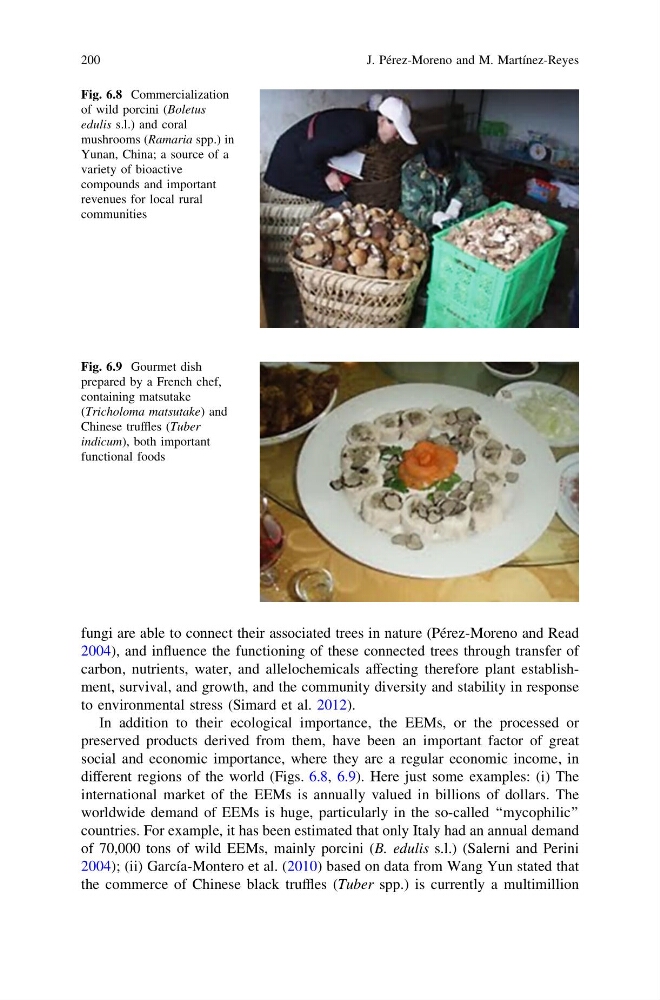
different regions of the world (Figs. 6.8, 6.9). Here just some examples: (i) The
international market of the EEMs is annually valued in billions of dollars. The
worldwide demand of EEMs is huge, particularly in the so-called ‘‘mycophilic’’
countries. For example, it has been estimated that only Italy had an annual demand
of 70,000 tons of wild EEMs, mainly porcini (B. edulis s.l.) (Salerni and Perini
2004); (ii) García-Montero et al. (2010) based on data from Wang Yun stated that
the commerce of Chinese black truffles (Tuber spp.) is currently a multimillion
Fig. 6.8 Commercialization
of wild porcini (Boletus
edulis s.l.) and coral
mushrooms (Ramaria spp.) in
Yunan, China; a source of a
variety of bioactive
compounds and important
revenues for local rural
communities
Fig. 6.9 Gourmet dish
prepared by a French chef,
containing matsutake
(Tricholoma matsutake) and
Chinese truffles (Tuber
indicum), both important
functional foods
200
J. Pérez-Moreno and M. Martínez-Reyes
2004), and influence the functioning of these connected trees through transfer of
carbon, nutrients, water, and allelochemicals affecting therefore plant establishment, survival, and growth, and the community diversity and stability in response
to environmental stress (Simard et al. 2012).
In addition to their ecological importance, the EEMs, or the processed or
preserved products derived from them, have been an important factor of great
social and economic importance, where they are a regular economic income, in
different regions of the world (Figs. 6.8, 6.9). Here just some examples: (i) The
international market of the EEMs is annually valued in billions of dollars. The
worldwide demand of EEMs is huge, particularly in the so-called ‘‘mycophilic’’
countries. For example, it has been estimated that only Italy had an annual demand
of 70,000 tons of wild EEMs, mainly porcini (B. edulis s.l.) (Salerni and Perini
2004); (ii) García-Montero et al. (2010) based on data from Wang Yun stated that
the commerce of Chinese black truffles (Tuber spp.) is currently a multimillion
Fig. 6.8 Commercialization
of wild porcini (Boletus
edulis s.l.) and coral
mushrooms (Ramaria spp.) in
Yunan, China; a source of a
variety of bioactive
compounds and important
revenues for local rural
communities
Fig. 6.9 Gourmet dish
prepared by a French chef,
containing matsutake
(Tricholoma matsutake) and
Chinese truffles (Tuber
indicum), both important
functional foods
200
J. Pérez-Moreno and M. Martínez-Reyes