

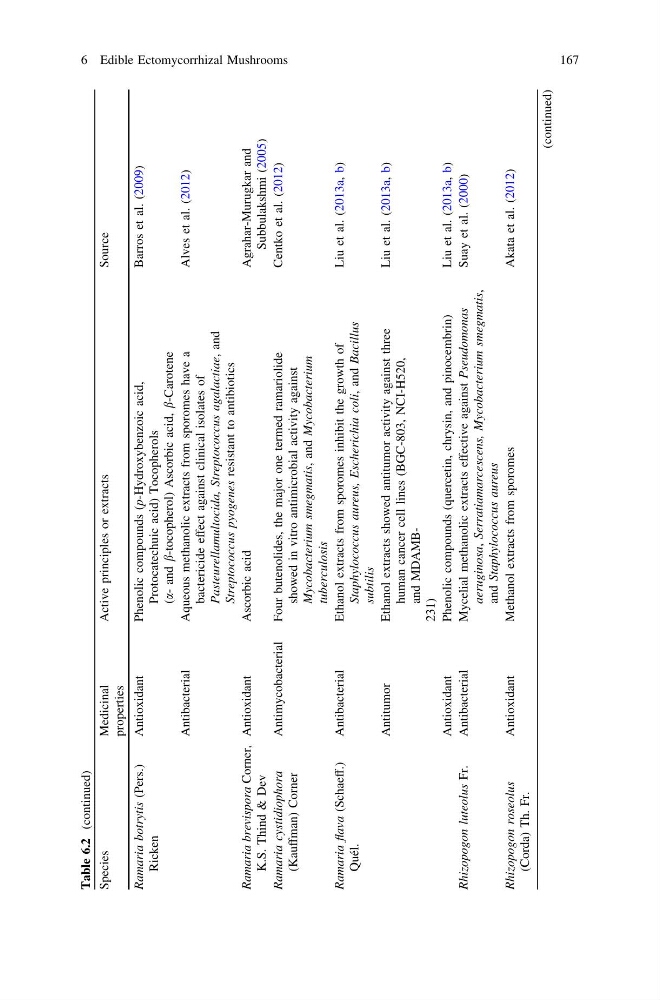
Table 6.2
(continued)
Species
Medicinal
properties
Active principles or extracts
Source
Ramaria botrytis
(Pers.)
Ricken
Antioxidant
Phenolic compounds (p-Hydroxybenzoic acid,
Protocatechuic acid) Tocopherols
(a- and b-tocopherol)
Ascorbic acid, b-Carotene
Barros et al. (2009)
Antibacterial
Aqueous methanolic extracts from sporomes have a
bactericide effect against clinical isolates of
Pasteurellamultocida, Streptococcus agalactiae,
and
Streptococcus pyogenes
resistant to antibiotics
Alves et al. (2012)
Ramaria brevispora
Corner,
K.S. Thind & Dev
Antioxidant
Ascorbic acid
Agrahar-Murugkar and
Subbulakshmi (2005)
Ramaria cystidiophora
(Kauffman) Corner
Antimycobacterial
Four butenolides, the major one termed ramariolide
showed in vitro antimicrobial activity against
Mycobacterium smegmatis,
and Mycobacterium
tuberculosis
Centko et al. (2012)
Ramaria flava
(Schaeff.)
Quél.
Antibacterial
Ethanol extracts from sporomes inhibit the growth of
Staphylococcus aureus, Escherichia coli,
and Bacillus
subtilis
Liu et al. (2013a, b)
Antitumor
Ethanol extracts showed antitumor activity against three
human cancer cell lines (BGC-803, NCI-H520,
and MDAMB231)
Liu et al. (2013a, b)
Antioxidant
Phenolic compounds (quercetin, chrysin, and pinocembrin)
Liu et al. (2013a, b)
Rhizopogon luteolus
Fr.
Antibacterial
Mycelial methanolic extracts effective against Pseudomonas
aeruginosa, Serratiamarcescens, Mycobacterium smegmatis,
and Staphylococcus aureus
Suay et al. (2000)
Rhizopogon roseolus
(Corda) Th. Fr.
Antioxidant
Methanol extracts from sporomes
Akata et al. (2012)
(continued)
6 Edible Ectomycorrhizal Mushrooms
167
(continued)
Species
Medicinal
properties
Active principles or extracts
Source
Ramaria botrytis
(Pers.)
Ricken
Antioxidant
Phenolic compounds (p-Hydroxybenzoic acid,
Protocatechuic acid) Tocopherols
(a- and b-tocopherol)
Ascorbic acid, b-Carotene
Barros et al. (2009)
Antibacterial
Aqueous methanolic extracts from sporomes have a
bactericide effect against clinical isolates of
Pasteurellamultocida, Streptococcus agalactiae,
and
Streptococcus pyogenes
resistant to antibiotics
Alves et al. (2012)
Ramaria brevispora
Corner,
K.S. Thind & Dev
Antioxidant
Ascorbic acid
Agrahar-Murugkar and
Subbulakshmi (2005)
Ramaria cystidiophora
(Kauffman) Corner
Antimycobacterial
Four butenolides, the major one termed ramariolide
showed in vitro antimicrobial activity against
Mycobacterium smegmatis,
and Mycobacterium
tuberculosis
Centko et al. (2012)
Ramaria flava
(Schaeff.)
Quél.
Antibacterial
Ethanol extracts from sporomes inhibit the growth of
Staphylococcus aureus, Escherichia coli,
and Bacillus
subtilis
Liu et al. (2013a, b)
Antitumor
Ethanol extracts showed antitumor activity against three
human cancer cell lines (BGC-803, NCI-H520,
and MDAMB231)
Liu et al. (2013a, b)
Antioxidant
Phenolic compounds (quercetin, chrysin, and pinocembrin)
Liu et al. (2013a, b)
Rhizopogon luteolus
Fr.
Antibacterial
Mycelial methanolic extracts effective against Pseudomonas
aeruginosa, Serratiamarcescens, Mycobacterium smegmatis,
and Staphylococcus aureus
Suay et al. (2000)
Rhizopogon roseolus
(Corda) Th. Fr.
Antioxidant
Methanol extracts from sporomes
Akata et al. (2012)
(continued)
6 Edible Ectomycorrhizal Mushrooms
167