

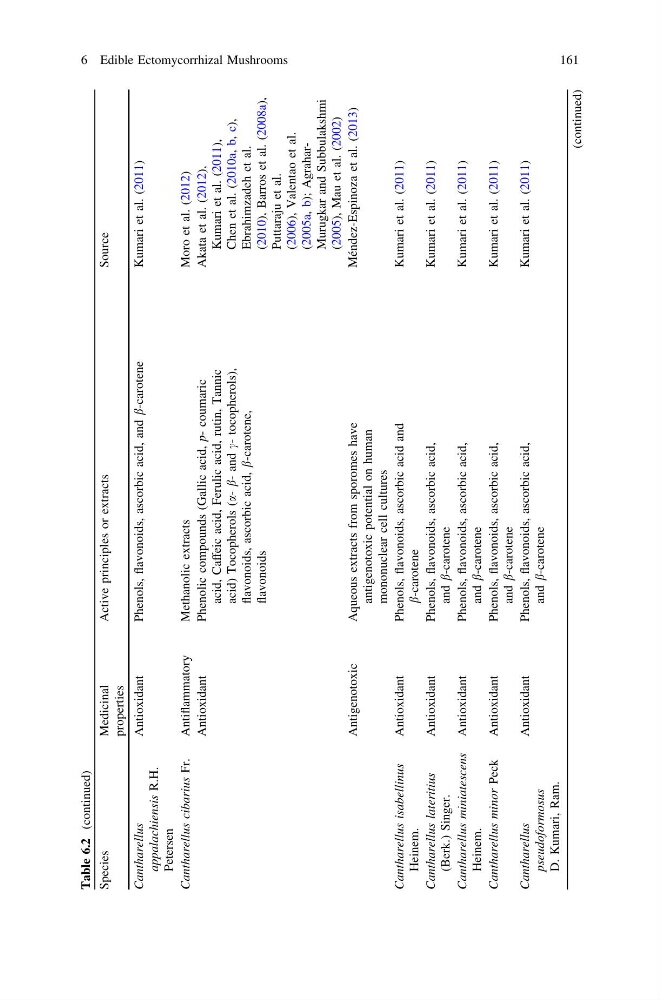
Table 6.2
(continued)
Species
Medicinal
properties
Active principles or extracts
Source
Cantharellus
appalachiensis
R.H.
Petersen
Antioxidant
Phenols, flavonoids, ascorbic acid, and b-carotene
Kumari et al. (2011)
Cantharellus cibarius
Fr.
Antiflammatory
Methanolic extracts
Moro et al. (2012)
Antioxidant
Phenolic compounds (Gallic acid, pcoumaric
acid, Caffeic acid, Ferulic acid, rutin, Tannic
acid) Tocopherols (a- band ctocopherols),
flavonoids, ascorbic acid, b-carotene,
flavonoids
Akata et al. (2012),
Kumari et al. (2011),
Chen et al. (2010a, b, c),
Ebrahimzadeh et al.
(2010), Barros et al. (2008a),
Puttaraju et al.
(2006), Valentao et al.
(2005a, b); AgraharMurugkar and Subbulakshmi
(2005), Mau et al. (2002)
Antigenotoxic
Aqueous extracts from sporomes have
antigenotoxic potential on human
mononuclear cell cultures
Méndez-Espinoza et al. (2013)
Cantharellus isabellinus
Heinem.
Antioxidant
Phenols, flavonoids, ascorbic acid and
b-carotene
Kumari et al. (2011)
Cantharellus lateritius
(Berk.) Singer.
Antioxidant
Phenols, flavonoids, ascorbic acid,
and b-carotene
Kumari et al. (2011)
Cantharellus miniatescens
Heinem.
Antioxidant
Phenols, flavonoids, ascorbic acid,
and b-carotene
Kumari et al. (2011)
Cantharellus minor
Peck
Antioxidant
Phenols, flavonoids, ascorbic acid,
and b-carotene
Kumari et al. (2011)
Cantharellus
pseudoformosus
D. Kumari, Ram.
Antioxidant
Phenols, flavonoids, ascorbic acid,
and b-carotene
Kumari et al. (2011)
(continued)
6 Edible Ectomycorrhizal Mushrooms
161
(continued)
Species
Medicinal
properties
Active principles or extracts
Source
Cantharellus
appalachiensis
R.H.
Petersen
Antioxidant
Phenols, flavonoids, ascorbic acid, and b-carotene
Kumari et al. (2011)
Cantharellus cibarius
Fr.
Antiflammatory
Methanolic extracts
Moro et al. (2012)
Antioxidant
Phenolic compounds (Gallic acid, pcoumaric
acid, Caffeic acid, Ferulic acid, rutin, Tannic
acid) Tocopherols (a- band ctocopherols),
flavonoids, ascorbic acid, b-carotene,
flavonoids
Akata et al. (2012),
Kumari et al. (2011),
Chen et al. (2010a, b, c),
Ebrahimzadeh et al.
(2010), Barros et al. (2008a),
Puttaraju et al.
(2006), Valentao et al.
(2005a, b); AgraharMurugkar and Subbulakshmi
(2005), Mau et al. (2002)
Antigenotoxic
Aqueous extracts from sporomes have
antigenotoxic potential on human
mononuclear cell cultures
Méndez-Espinoza et al. (2013)
Cantharellus isabellinus
Heinem.
Antioxidant
Phenols, flavonoids, ascorbic acid and
b-carotene
Kumari et al. (2011)
Cantharellus lateritius
(Berk.) Singer.
Antioxidant
Phenols, flavonoids, ascorbic acid,
and b-carotene
Kumari et al. (2011)
Cantharellus miniatescens
Heinem.
Antioxidant
Phenols, flavonoids, ascorbic acid,
and b-carotene
Kumari et al. (2011)
Cantharellus minor
Peck
Antioxidant
Phenols, flavonoids, ascorbic acid,
and b-carotene
Kumari et al. (2011)
Cantharellus
pseudoformosus
D. Kumari, Ram.
Antioxidant
Phenols, flavonoids, ascorbic acid,
and b-carotene
Kumari et al. (2011)
(continued)
6 Edible Ectomycorrhizal Mushrooms
161