

packed it behind ingrowing toenails with ‘‘excellent results’’ (Pöder 1993, Hilton
1987). In the case of F. fomentarius, Peintner et al. (1998) based on different
sources pointed out that apart from being a fire starter this mushroom has a range
of medicinal properties including diuretic, laxative, styptic (and therefore called
surgeon’s agaric by surgeons, barbers and dentists) functions, and has been used as
a remedy against dysmehorrhoea, hemorrhoids, and bladder disorders. Additionally,
hemostatic properties were reported for this mushroom by Saar (1991) in Kanthy
people form Western Siberia, and a cytotoxic effect from sterols (fomentarols A–D)
extracted from this mushroom, against some lines of human cancer cells, has been
recently proved by Zhang et al. (2013). Based on these evidences, the association
of sporomes of these two fungi, with the mummy called Ötzi, constitutes the most
ancient conclusive evidence of the use of mushrooms by humans. Meanwhile, the
most ancient record of medicinal properties from edible EEMs is dated at the end of
the ninth century and appears in the Quran, the central religious text of the Muslims.
It is narrated in the hadith (which refers to reports of actions of prophet Mohammad)
named ‘‘Sahih Muslim’’ in Book 23, Chapter 26 entitled ‘‘Excellence of truffles and
their use as a medicine for the eyes,’’ that the prophet Mohammad said ‘‘… Truffles
are part of the ‘manna’ which Allah, sent to the people of Israel through Moses, and
its juice is a medicine for the eyes…’’ (Sahih 2013). The collector of this ancient
report, Ibn al-Hajjaj, lived in Nishapur (currently located in Iran) between 817/818
and 874/875 CE. He widely traveled to gather his collection of reports to regions
which are now in Iraq, the Arabian Peninsula, Syria, and Egypt (Sahih 2009).
Interestingly, in the last decade different authors (Dib-Bellahouel and Fortas 2011;
Mandeel and Al-Laith 2007; Janakat et al. 2004, 2005) have confirmed these
statements by discovering the presence of potent antimicrobial agents in dessert
truffles (in the edible mycorrhizal genera Terfezia and Tirmania) which are effective
against bacteria, such as Staphylococcus aureus, Pseudomonas aeruginosa, or
Chlamydia trachomatis, important agents of human eye infections such as bacterial
conjunctivitis, blepharitis, dacryocystitis, or even trachoma.
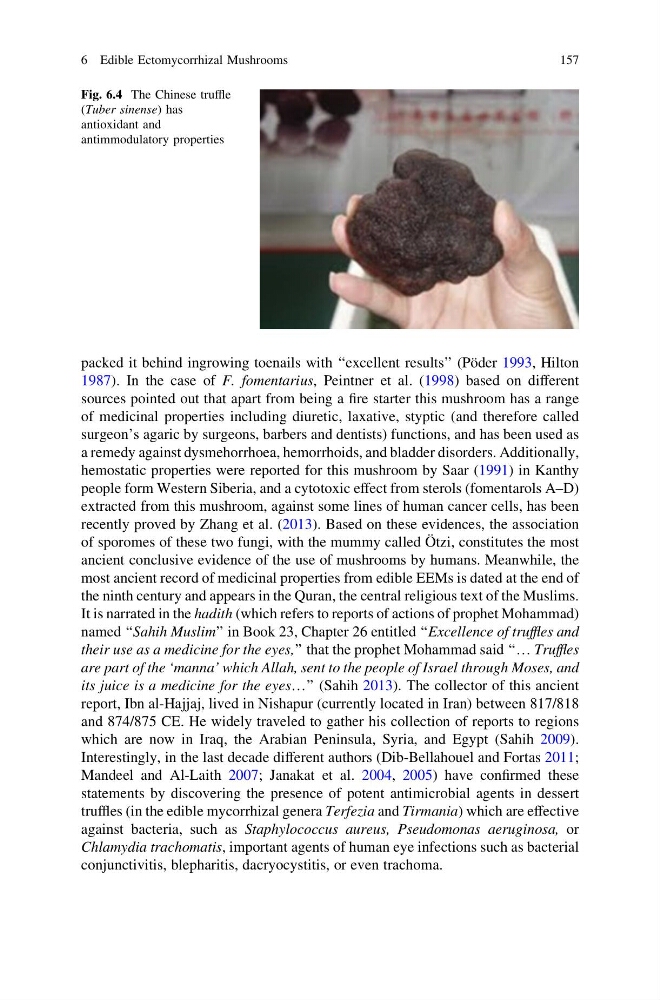
Fig. 6.4 The Chinese truffle
(Tuber sinense) has
antioxidant and
antimmodulatory properties
6 Edible Ectomycorrhizal Mushrooms
157
1987). In the case of F. fomentarius, Peintner et al. (1998) based on different
sources pointed out that apart from being a fire starter this mushroom has a range
of medicinal properties including diuretic, laxative, styptic (and therefore called
surgeon’s agaric by surgeons, barbers and dentists) functions, and has been used as
a remedy against dysmehorrhoea, hemorrhoids, and bladder disorders. Additionally,
hemostatic properties were reported for this mushroom by Saar (1991) in Kanthy
people form Western Siberia, and a cytotoxic effect from sterols (fomentarols A–D)
extracted from this mushroom, against some lines of human cancer cells, has been
recently proved by Zhang et al. (2013). Based on these evidences, the association
of sporomes of these two fungi, with the mummy called Ötzi, constitutes the most
ancient conclusive evidence of the use of mushrooms by humans. Meanwhile, the
most ancient record of medicinal properties from edible EEMs is dated at the end of
the ninth century and appears in the Quran, the central religious text of the Muslims.
It is narrated in the hadith (which refers to reports of actions of prophet Mohammad)
named ‘‘Sahih Muslim’’ in Book 23, Chapter 26 entitled ‘‘Excellence of truffles and
their use as a medicine for the eyes,’’ that the prophet Mohammad said ‘‘… Truffles
are part of the ‘manna’ which Allah, sent to the people of Israel through Moses, and
its juice is a medicine for the eyes…’’ (Sahih 2013). The collector of this ancient
report, Ibn al-Hajjaj, lived in Nishapur (currently located in Iran) between 817/818
and 874/875 CE. He widely traveled to gather his collection of reports to regions
which are now in Iraq, the Arabian Peninsula, Syria, and Egypt (Sahih 2009).
Interestingly, in the last decade different authors (Dib-Bellahouel and Fortas 2011;
Mandeel and Al-Laith 2007; Janakat et al. 2004, 2005) have confirmed these
statements by discovering the presence of potent antimicrobial agents in dessert
truffles (in the edible mycorrhizal genera Terfezia and Tirmania) which are effective
against bacteria, such as Staphylococcus aureus, Pseudomonas aeruginosa, or
Chlamydia trachomatis, important agents of human eye infections such as bacterial
conjunctivitis, blepharitis, dacryocystitis, or even trachoma.
Fig. 6.4 The Chinese truffle
(Tuber sinense) has
antioxidant and
antimmodulatory properties
6 Edible Ectomycorrhizal Mushrooms
157