

5.2 Sugarcane Is More Than Sucrose
According to Hoarau et al. (2007), sugarcane converts the sun’s energy into carbohydrates more efficiently than any other crop plant and has the unusual ability to
store sucrose in stem cell vacuoles. This, along with its high biomass production
and ease of cultivation, makes it one of the most interesting and productive agricultural crops. In fact, Waclawovsky et al. (2010) have established that the current
world yield average for sugarcane is 80 t ha
-1 , but the estimated theoretical yield
potential is over 380 t ha
-1 , while Moore (2009) calculated it over 472 t ha
-1 ,
which supports the hypothesis of yield gains to be expected in the future.
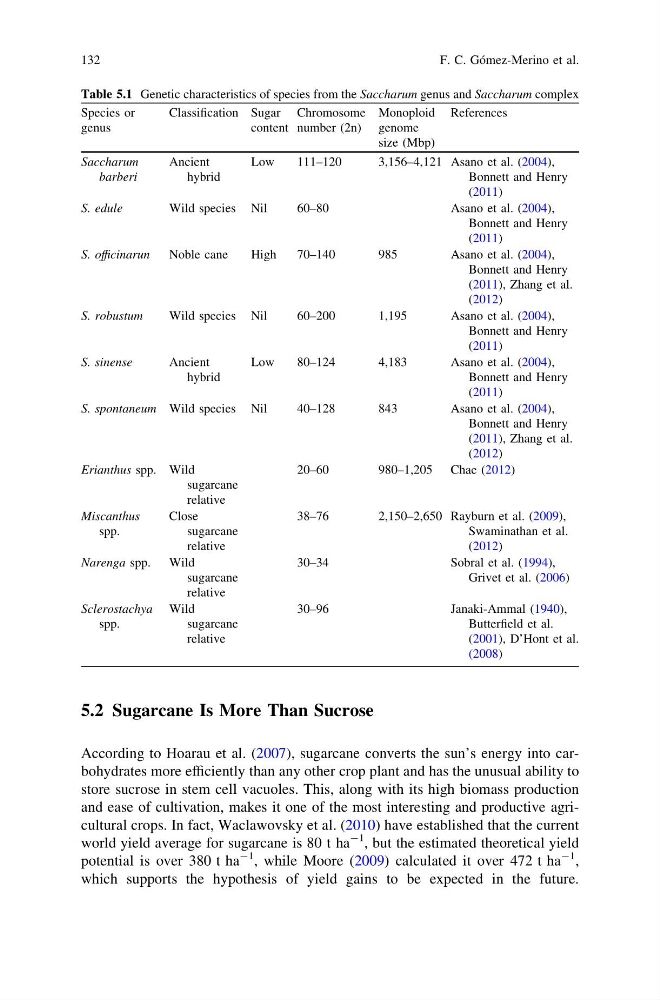
Table 5.1 Genetic characteristics of species from the Saccharum genus and Saccharum complex
Species or
genus
Classification Sugar
content
Chromosome
number (2n)
Monoploid
genome
size (Mbp)
References
Saccharum
barberi
Ancient
hybrid
Low
111–120
3,156–4,121 Asano et al. (2004),
Bonnett and Henry
(2011)
S. edule
Wild species Nil
60–80
Asano et al. (2004),
Bonnett and Henry
(2011)
S. officinarun
Noble cane
High
70–140
985
Asano et al. (2004),
Bonnett and Henry
(2011), Zhang et al.
(2012)
S. robustum
Wild species Nil
60–200
1,195
Asano et al. (2004),
Bonnett and Henry
(2011)
S. sinense
Ancient
hybrid
Low
80–124
4,183
Asano et al. (2004),
Bonnett and Henry
(2011)
S. spontaneum Wild species Nil
40–128
843
Asano et al. (2004),
Bonnett and Henry
(2011), Zhang et al.
(2012)
Erianthus spp. Wild
sugarcane
relative
20–60
980–1,205 Chae (2012)
Miscanthus
spp.
Close
sugarcane
relative
38–76
2,150–2,650 Rayburn et al. (2009),
Swaminathan et al.
(2012)
Narenga spp. Wild
sugarcane
relative
30–34
Sobral et al. (1994),
Grivet et al. (2006)
Sclerostachya
spp.
Wild
sugarcane
relative
30–96
Janaki-Ammal (1940),
Butterfield et al.
(2001), D’Hont et al.
(2008)
132
F. C. Gómez-Merino et al.
According to Hoarau et al. (2007), sugarcane converts the sun’s energy into carbohydrates more efficiently than any other crop plant and has the unusual ability to
store sucrose in stem cell vacuoles. This, along with its high biomass production
and ease of cultivation, makes it one of the most interesting and productive agricultural crops. In fact, Waclawovsky et al. (2010) have established that the current
world yield average for sugarcane is 80 t ha
-1 , but the estimated theoretical yield
potential is over 380 t ha
-1 , while Moore (2009) calculated it over 472 t ha
-1 ,
which supports the hypothesis of yield gains to be expected in the future.
Table 5.1 Genetic characteristics of species from the Saccharum genus and Saccharum complex
Species or
genus
Classification Sugar
content
Chromosome
number (2n)
Monoploid
genome
size (Mbp)
References
Saccharum
barberi
Ancient
hybrid
Low
111–120
3,156–4,121 Asano et al. (2004),
Bonnett and Henry
(2011)
S. edule
Wild species Nil
60–80
Asano et al. (2004),
Bonnett and Henry
(2011)
S. officinarun
Noble cane
High
70–140
985
Asano et al. (2004),
Bonnett and Henry
(2011), Zhang et al.
(2012)
S. robustum
Wild species Nil
60–200
1,195
Asano et al. (2004),
Bonnett and Henry
(2011)
S. sinense
Ancient
hybrid
Low
80–124
4,183
Asano et al. (2004),
Bonnett and Henry
(2011)
S. spontaneum Wild species Nil
40–128
843
Asano et al. (2004),
Bonnett and Henry
(2011), Zhang et al.
(2012)
Erianthus spp. Wild
sugarcane
relative
20–60
980–1,205 Chae (2012)
Miscanthus
spp.
Close
sugarcane
relative
38–76
2,150–2,650 Rayburn et al. (2009),
Swaminathan et al.
(2012)
Narenga spp. Wild
sugarcane
relative
30–34
Sobral et al. (1994),
Grivet et al. (2006)
Sclerostachya
spp.
Wild
sugarcane
relative
30–96
Janaki-Ammal (1940),
Butterfield et al.
(2001), D’Hont et al.
(2008)
132
F. C. Gómez-Merino et al.