

4.2.1 Overview of Biocontrol Programs in the Main Spanish
Protected Vegetables
The fast transition toward a biological control pest management system was
achieved in Almeria not as a merely opportunistic change but after years of
research which began in public and private research centers already in the 1980s
(see analysis of the model below). Several significant changes from previous IPM
models used in the north European countries were developed in order to face the
particular conditions of the area (landscape, climate…), both regarding the selection of new species adapted to the climate conditions and the shipment and release
methods. The techniques and methods used in Almeria, not only the species
released, but the timing, releasing systems and the ratios of introduction, have been
discussed, for instance, by Cabello and Vila (2010), Cabello et al. (2011) and Vila
and Cabello (2012). A short overview of some of the systems used in the main
protected vegetables in Almeria and the most important facing problems is
presented here (Table 4.1), with special attention to those factors interrelated with
the improvements developed and provided by the biomanufacturers.
One of the major problems facing in Almeria is the high pressure of pest in
summer and beginning of autumn, when the season of the main crops begin. This
means that preventive methods and strategies to favor the early establishment of the
natural enemies should primarily be used. A preventive method in biocontrol is the
introduction of the beneficials before than infestation of pests occurs. The feasibility to build up early populations may depend on the dietary habits of the natural
enemy. These can be either polyphagous (e.g., N. pseudoferus; Hem.: Nabidae),
attacking a large number of phytophagous species, pests or not; oliphagous, killing
pest species relatively close (e.g., Aphidius spp.; Hym.: Aphididae); or specialist,
which only prey or parasitize a pest species (e.g., Rodolia cardinalis; Col.: Coccinelidae). Moreover, natural enemies might show more or less omnivorous habits,
being able to feed upon a wide range of organic sources in addition to insects and/or
mites (Lundgren 2009). Some species are omnivorous like the predatory bug
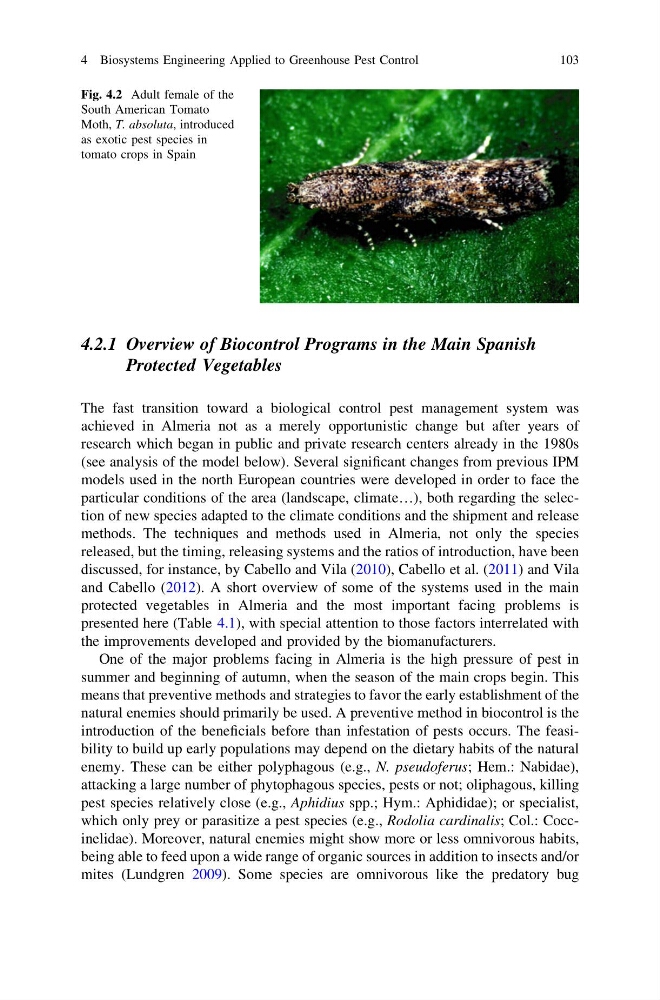
Fig. 4.2 Adult female of the
South American Tomato
Moth, T. absoluta, introduced
as exotic pest species in
tomato crops in Spain
4 Biosystems Engineering Applied to Greenhouse Pest Control
103
Protected Vegetables
The fast transition toward a biological control pest management system was
achieved in Almeria not as a merely opportunistic change but after years of
research which began in public and private research centers already in the 1980s
(see analysis of the model below). Several significant changes from previous IPM
models used in the north European countries were developed in order to face the
particular conditions of the area (landscape, climate…), both regarding the selection of new species adapted to the climate conditions and the shipment and release
methods. The techniques and methods used in Almeria, not only the species
released, but the timing, releasing systems and the ratios of introduction, have been
discussed, for instance, by Cabello and Vila (2010), Cabello et al. (2011) and Vila
and Cabello (2012). A short overview of some of the systems used in the main
protected vegetables in Almeria and the most important facing problems is
presented here (Table 4.1), with special attention to those factors interrelated with
the improvements developed and provided by the biomanufacturers.
One of the major problems facing in Almeria is the high pressure of pest in
summer and beginning of autumn, when the season of the main crops begin. This
means that preventive methods and strategies to favor the early establishment of the
natural enemies should primarily be used. A preventive method in biocontrol is the
introduction of the beneficials before than infestation of pests occurs. The feasibility to build up early populations may depend on the dietary habits of the natural
enemy. These can be either polyphagous (e.g., N. pseudoferus; Hem.: Nabidae),
attacking a large number of phytophagous species, pests or not; oliphagous, killing
pest species relatively close (e.g., Aphidius spp.; Hym.: Aphididae); or specialist,
which only prey or parasitize a pest species (e.g., Rodolia cardinalis; Col.: Coccinelidae). Moreover, natural enemies might show more or less omnivorous habits,
being able to feed upon a wide range of organic sources in addition to insects and/or
mites (Lundgren 2009). Some species are omnivorous like the predatory bug
Fig. 4.2 Adult female of the
South American Tomato
Moth, T. absoluta, introduced
as exotic pest species in
tomato crops in Spain
4 Biosystems Engineering Applied to Greenhouse Pest Control
103