

of the growers, attitude of governmental institutions, the influence of guidelines
and regulations as well as a too stressed auto critical evaluation of the biological
control community (van Lenteren 2012). But little attention has been paid to the
recent developments about biosystems engineering applied to the mass rearing of
beneficial arthropods, as a main factor that has contributed to build up the quality
of the reared natural enemies and the economically affordable quantities to be
released in the crops.
In this chapter, the causes that have contributed to successfully develop biocontrol programs in the Spanish greenhouses are analyzed, as a case study to
discuss the main ingredients that are needed for a transition toward a sustainable
agriculture. This review is then focused on augmentative biocontrol programs.
There has been a change of attitude of farmers that recognize biological control as
the best pest management system after several improvements provided by the
current IPM programs. Although there are other involved factors, the last is the key
driving force, and we explore why the previously pesticide addicted growers of
vegetal and ornamental crops have suffered a drastic change in the mind-set. We
focus special attention in this review in the improvement of mass rearing techniques, selection of species, quality and price of beneficials, and the releasing
strategies developed by the biomanufacturers.
4.2 Chemical Era Decline in the Horticultural
Protected Crops
The world greenhouse area is estimated, excluding China, at approximately
350,000 ha, and the protected area in Spain is around 53,800 ha, 88 % destined to
vegetal production. Most of this area lies within the boundaries of Andalusia,
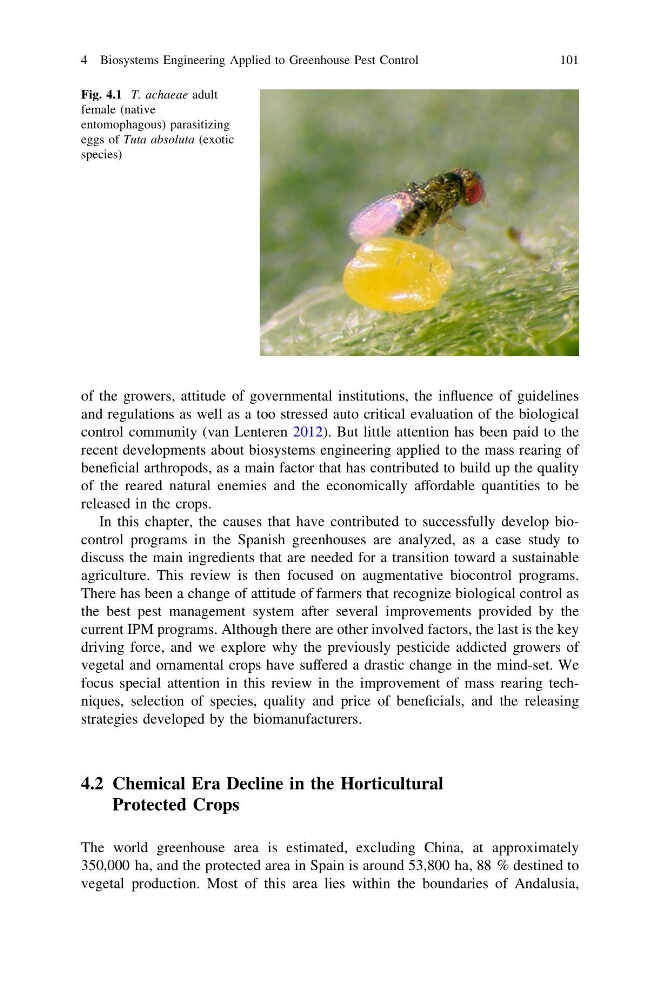
Fig. 4.1 T. achaeae adult
female (native
entomophagous) parasitizing
eggs of Tuta absoluta (exotic
species)
4 Biosystems Engineering Applied to Greenhouse Pest Control
101
and regulations as well as a too stressed auto critical evaluation of the biological
control community (van Lenteren 2012). But little attention has been paid to the
recent developments about biosystems engineering applied to the mass rearing of
beneficial arthropods, as a main factor that has contributed to build up the quality
of the reared natural enemies and the economically affordable quantities to be
released in the crops.
In this chapter, the causes that have contributed to successfully develop biocontrol programs in the Spanish greenhouses are analyzed, as a case study to
discuss the main ingredients that are needed for a transition toward a sustainable
agriculture. This review is then focused on augmentative biocontrol programs.
There has been a change of attitude of farmers that recognize biological control as
the best pest management system after several improvements provided by the
current IPM programs. Although there are other involved factors, the last is the key
driving force, and we explore why the previously pesticide addicted growers of
vegetal and ornamental crops have suffered a drastic change in the mind-set. We
focus special attention in this review in the improvement of mass rearing techniques, selection of species, quality and price of beneficials, and the releasing
strategies developed by the biomanufacturers.
4.2 Chemical Era Decline in the Horticultural
Protected Crops
The world greenhouse area is estimated, excluding China, at approximately
350,000 ha, and the protected area in Spain is around 53,800 ha, 88 % destined to
vegetal production. Most of this area lies within the boundaries of Andalusia,
Fig. 4.1 T. achaeae adult
female (native
entomophagous) parasitizing
eggs of Tuta absoluta (exotic
species)
4 Biosystems Engineering Applied to Greenhouse Pest Control
101