

3 Thermal Infrared Remote Sensing and Sea Surface Temperature . . .
69
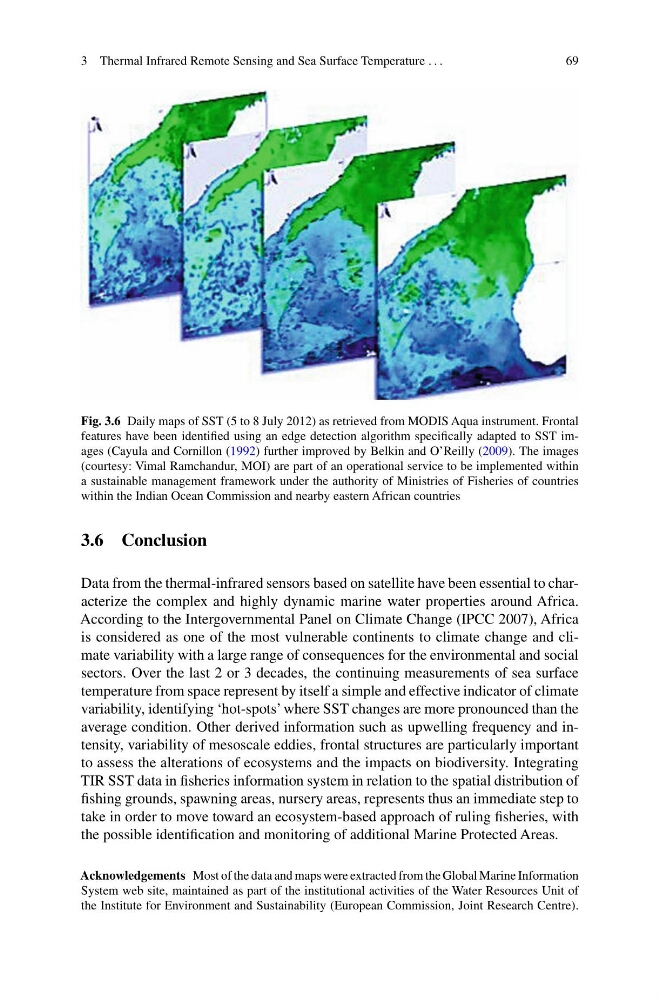
Fig. 3.6 Daily maps of SST (5 to 8 July 2012) as retrieved from MODIS Aqua instrument. Frontal
features have been identified using an edge detection algorithm specifically adapted to SST images (Cayula and Cornillon (1992) further improved by Belkin and O’Reilly (2009). The images
(courtesy: Vimal Ramchandur, MOI) are part of an operational service to be implemented within
a sustainable management framework under the authority of Ministries of Fisheries of countries
within the Indian Ocean Commission and nearby eastern African countries
3.6 Conclusion
Data from the thermal-infrared sensors based on satellite have been essential to characterize the complex and highly dynamic marine water properties around Africa.
According to the Intergovernmental Panel on Climate Change (IPCC 2007), Africa
is considered as one of the most vulnerable continents to climate change and climate variability with a large range of consequences for the environmental and social
sectors. Over the last 2 or 3 decades, the continuing measurements of sea surface
temperature from space represent by itself a simple and effective indicator of climate
variability, identifying ‘hot-spots’ where SST changes are more pronounced than the
average condition. Other derived information such as upwelling frequency and intensity, variability of mesoscale eddies, frontal structures are particularly important
to assess the alterations of ecosystems and the impacts on biodiversity. Integrating
TIR SST data in fisheries information system in relation to the spatial distribution of
fishing grounds, spawning areas, nursery areas, represents thus an immediate step to
take in order to move toward an ecosystem-based approach of ruling fisheries, with
the possible identification and monitoring of additional Marine Protected Areas.
Acknowledgements Most of the data and maps were extracted from the Global Marine Information
System web site, maintained as part of the institutional activities of the Water Resources Unit of
the Institute for Environment and Sustainability (European Commission, Joint Research Centre).
69
Fig. 3.6 Daily maps of SST (5 to 8 July 2012) as retrieved from MODIS Aqua instrument. Frontal
features have been identified using an edge detection algorithm specifically adapted to SST images (Cayula and Cornillon (1992) further improved by Belkin and O’Reilly (2009). The images
(courtesy: Vimal Ramchandur, MOI) are part of an operational service to be implemented within
a sustainable management framework under the authority of Ministries of Fisheries of countries
within the Indian Ocean Commission and nearby eastern African countries
3.6 Conclusion
Data from the thermal-infrared sensors based on satellite have been essential to characterize the complex and highly dynamic marine water properties around Africa.
According to the Intergovernmental Panel on Climate Change (IPCC 2007), Africa
is considered as one of the most vulnerable continents to climate change and climate variability with a large range of consequences for the environmental and social
sectors. Over the last 2 or 3 decades, the continuing measurements of sea surface
temperature from space represent by itself a simple and effective indicator of climate
variability, identifying ‘hot-spots’ where SST changes are more pronounced than the
average condition. Other derived information such as upwelling frequency and intensity, variability of mesoscale eddies, frontal structures are particularly important
to assess the alterations of ecosystems and the impacts on biodiversity. Integrating
TIR SST data in fisheries information system in relation to the spatial distribution of
fishing grounds, spawning areas, nursery areas, represents thus an immediate step to
take in order to move toward an ecosystem-based approach of ruling fisheries, with
the possible identification and monitoring of additional Marine Protected Areas.
Acknowledgements Most of the data and maps were extracted from the Global Marine Information
System web site, maintained as part of the institutional activities of the Water Resources Unit of
the Institute for Environment and Sustainability (European Commission, Joint Research Centre).