

22
V. Barale
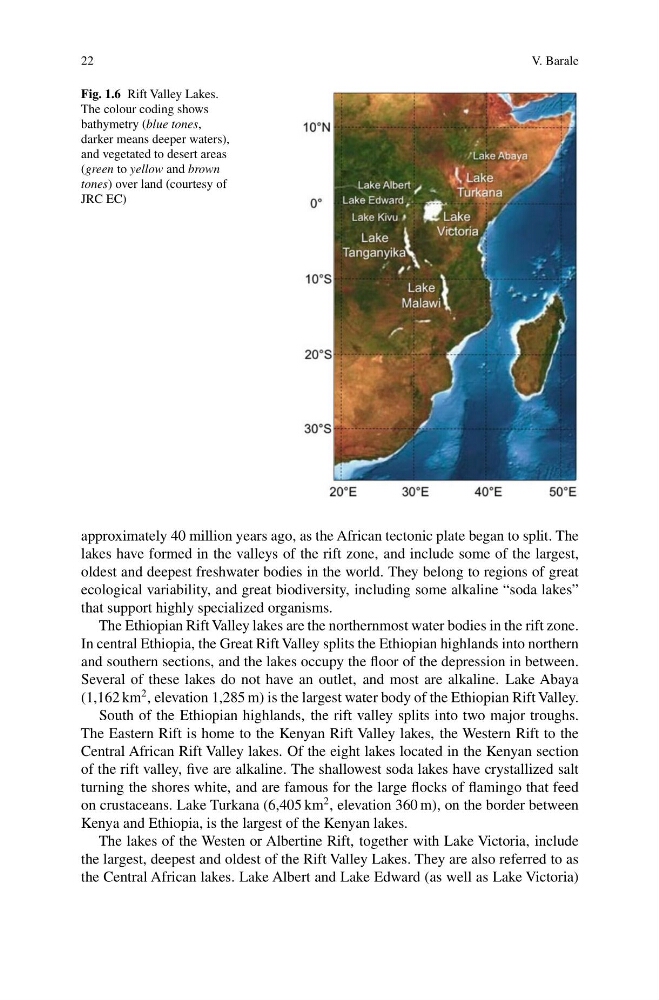
Fig. 1.6 Rift Valley Lakes.
The colour coding shows
bathymetry (blue tones,
darker means deeper waters),
and vegetated to desert areas
(green to yellow and brown
tones) over land (courtesy of
JRC EC)
approximately 40 million years ago, as the African tectonic plate began to split. The
lakes have formed in the valleys of the rift zone, and include some of the largest,
oldest and deepest freshwater bodies in the world. They belong to regions of great
ecological variability, and great biodiversity, including some alkaline “soda lakes”
that support highly specialized organisms.
The Ethiopian Rift Valley lakes are the northernmost water bodies in the rift zone.
In central Ethiopia, the Great Rift Valley splits the Ethiopian highlands into northern
and southern sections, and the lakes occupy the floor of the depression in between.
Several of these lakes do not have an outlet, and most are alkaline. Lake Abaya
(1,162 km
2 , elevation 1,285 m) is the largest water body of the Ethiopian Rift Valley.
South of the Ethiopian highlands, the rift valley splits into two major troughs.
The Eastern Rift is home to the Kenyan Rift Valley lakes, the Western Rift to the
Central African Rift Valley lakes. Of the eight lakes located in the Kenyan section
of the rift valley, five are alkaline. The shallowest soda lakes have crystallized salt
turning the shores white, and are famous for the large flocks of flamingo that feed
on crustaceans. Lake Turkana (6,405 km
2 , elevation 360 m), on the border between
Kenya and Ethiopia, is the largest of the Kenyan lakes.
The lakes of the Westen or Albertine Rift, together with Lake Victoria, include
the largest, deepest and oldest of the Rift Valley Lakes. They are also referred to as
the Central African lakes. Lake Albert and Lake Edward (as well as Lake Victoria)
V. Barale
Fig. 1.6 Rift Valley Lakes.
The colour coding shows
bathymetry (blue tones,
darker means deeper waters),
and vegetated to desert areas
(green to yellow and brown
tones) over land (courtesy of
JRC EC)
approximately 40 million years ago, as the African tectonic plate began to split. The
lakes have formed in the valleys of the rift zone, and include some of the largest,
oldest and deepest freshwater bodies in the world. They belong to regions of great
ecological variability, and great biodiversity, including some alkaline “soda lakes”
that support highly specialized organisms.
The Ethiopian Rift Valley lakes are the northernmost water bodies in the rift zone.
In central Ethiopia, the Great Rift Valley splits the Ethiopian highlands into northern
and southern sections, and the lakes occupy the floor of the depression in between.
Several of these lakes do not have an outlet, and most are alkaline. Lake Abaya
(1,162 km
2 , elevation 1,285 m) is the largest water body of the Ethiopian Rift Valley.
South of the Ethiopian highlands, the rift valley splits into two major troughs.
The Eastern Rift is home to the Kenyan Rift Valley lakes, the Western Rift to the
Central African Rift Valley lakes. Of the eight lakes located in the Kenyan section
of the rift valley, five are alkaline. The shallowest soda lakes have crystallized salt
turning the shores white, and are famous for the large flocks of flamingo that feed
on crustaceans. Lake Turkana (6,405 km
2 , elevation 360 m), on the border between
Kenya and Ethiopia, is the largest of the Kenyan lakes.
The lakes of the Westen or Albertine Rift, together with Lake Victoria, include
the largest, deepest and oldest of the Rift Valley Lakes. They are also referred to as
the Central African lakes. Lake Albert and Lake Edward (as well as Lake Victoria)