

18
V. Barale
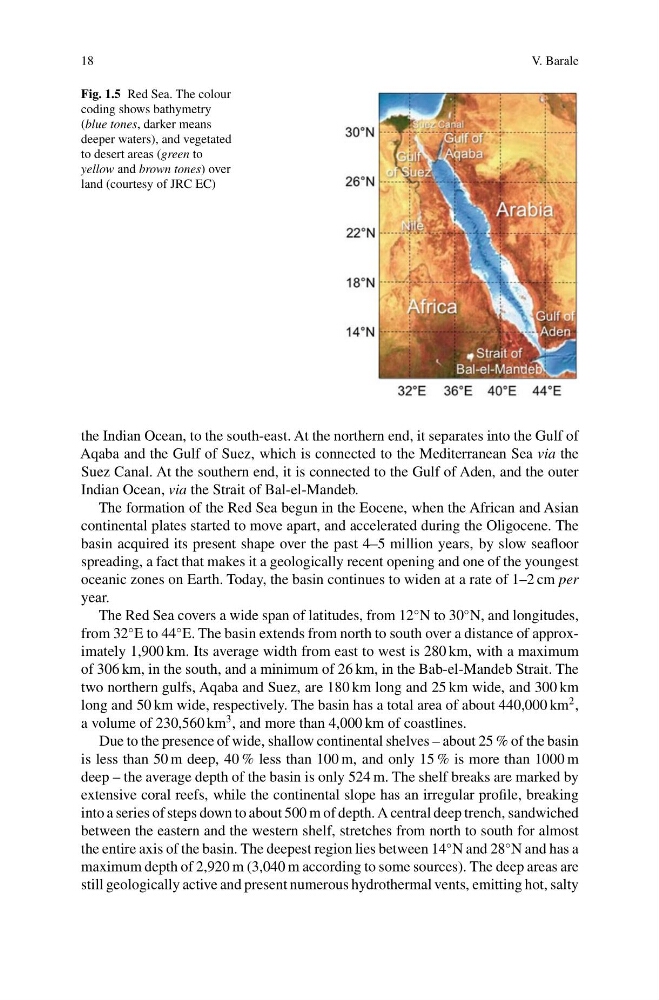
Fig. 1.5 Red Sea. The colour
coding shows bathymetry
(blue tones, darker means
deeper waters), and vegetated
to desert areas (green to
yellow and brown tones) over
land (courtesy of JRC EC)
the Indian Ocean, to the south-east. At the northern end, it separates into the Gulf of
Aqaba and the Gulf of Suez, which is connected to the Mediterranean Sea via the
Suez Canal. At the southern end, it is connected to the Gulf of Aden, and the outer
Indian Ocean, via the Strait of Bal-el-Mandeb.
The formation of the Red Sea begun in the Eocene, when the African and Asian
continental plates started to move apart, and accelerated during the Oligocene. The
basin acquired its present shape over the past 4–5 million years, by slow seafloor
spreading, a fact that makes it a geologically recent opening and one of the youngest
oceanic zones on Earth. Today, the basin continues to widen at a rate of 1–2 cm per
year.
The Red Sea covers a wide span of latitudes, from 12
◦ N to 30
◦ N, and longitudes,
from 32
◦ E to 44
◦ E. The basin extends from north to south over a distance of approximately 1,900 km. Its average width from east to west is 280 km, with a maximum
of 306 km, in the south, and a minimum of 26 km, in the Bab-el-Mandeb Strait. The
two northern gulfs, Aqaba and Suez, are 180 km long and 25 km wide, and 300 km
long and 50 km wide, respectively. The basin has a total area of about 440,000 km
2 ,
a volume of 230,560 km
3 , and more than 4,000 km of coastlines.
Due to the presence of wide, shallow continental shelves – about 25 % of the basin
is less than 50 m deep, 40 % less than 100 m, and only 15 % is more than 1000 m
deep – the average depth of the basin is only 524 m. The shelf breaks are marked by
extensive coral reefs, while the continental slope has an irregular profile, breaking
into a series of steps down to about 500 m of depth. A central deep trench, sandwiched
between the eastern and the western shelf, stretches from north to south for almost
the entire axis of the basin. The deepest region lies between 14
◦ N and 28
◦ N and has a
maximum depth of 2,920 m (3,040 m according to some sources). The deep areas are
still geologically active and present numerous hydrothermal vents, emitting hot, salty
V. Barale
Fig. 1.5 Red Sea. The colour
coding shows bathymetry
(blue tones, darker means
deeper waters), and vegetated
to desert areas (green to
yellow and brown tones) over
land (courtesy of JRC EC)
the Indian Ocean, to the south-east. At the northern end, it separates into the Gulf of
Aqaba and the Gulf of Suez, which is connected to the Mediterranean Sea via the
Suez Canal. At the southern end, it is connected to the Gulf of Aden, and the outer
Indian Ocean, via the Strait of Bal-el-Mandeb.
The formation of the Red Sea begun in the Eocene, when the African and Asian
continental plates started to move apart, and accelerated during the Oligocene. The
basin acquired its present shape over the past 4–5 million years, by slow seafloor
spreading, a fact that makes it a geologically recent opening and one of the youngest
oceanic zones on Earth. Today, the basin continues to widen at a rate of 1–2 cm per
year.
The Red Sea covers a wide span of latitudes, from 12
◦ N to 30
◦ N, and longitudes,
from 32
◦ E to 44
◦ E. The basin extends from north to south over a distance of approximately 1,900 km. Its average width from east to west is 280 km, with a maximum
of 306 km, in the south, and a minimum of 26 km, in the Bab-el-Mandeb Strait. The
two northern gulfs, Aqaba and Suez, are 180 km long and 25 km wide, and 300 km
long and 50 km wide, respectively. The basin has a total area of about 440,000 km
2 ,
a volume of 230,560 km
3 , and more than 4,000 km of coastlines.
Due to the presence of wide, shallow continental shelves – about 25 % of the basin
is less than 50 m deep, 40 % less than 100 m, and only 15 % is more than 1000 m
deep – the average depth of the basin is only 524 m. The shelf breaks are marked by
extensive coral reefs, while the continental slope has an irregular profile, breaking
into a series of steps down to about 500 m of depth. A central deep trench, sandwiched
between the eastern and the western shelf, stretches from north to south for almost
the entire axis of the basin. The deepest region lies between 14
◦ N and 28
◦ N and has a
maximum depth of 2,920 m (3,040 m according to some sources). The deep areas are
still geologically active and present numerous hydrothermal vents, emitting hot, salty