

338
V. Barale and M. Gade
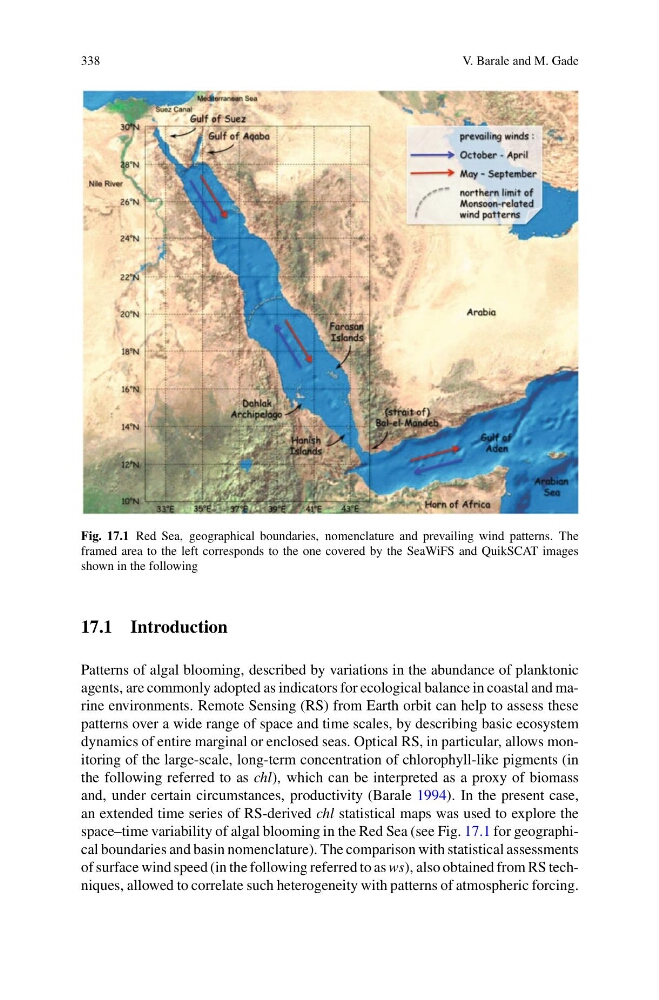
Fig. 17.1 Red Sea, geographical boundaries, nomenclature and prevailing wind patterns. The
framed area to the left corresponds to the one covered by the SeaWiFS and QuikSCAT images
shown in the following
17.1 Introduction
Patterns of algal blooming, described by variations in the abundance of planktonic
agents, are commonly adopted as indicators for ecological balance in coastal and marine environments. Remote Sensing (RS) from Earth orbit can help to assess these
patterns over a wide range of space and time scales, by describing basic ecosystem
dynamics of entire marginal or enclosed seas. Optical RS, in particular, allows monitoring of the large-scale, long-term concentration of chlorophyll-like pigments (in
the following referred to as chl), which can be interpreted as a proxy of biomass
and, under certain circumstances, productivity (Barale 1994). In the present case,
an extended time series of RS-derived chl statistical maps was used to explore the
space–time variability of algal blooming in the Red Sea (see Fig. 17.1 for geographical boundaries and basin nomenclature). The comparison with statistical assessments
of surface wind speed (in the following referred to as ws), also obtained from RS techniques, allowed to correlate such heterogeneity with patterns of atmospheric forcing.
V. Barale and M. Gade
Fig. 17.1 Red Sea, geographical boundaries, nomenclature and prevailing wind patterns. The
framed area to the left corresponds to the one covered by the SeaWiFS and QuikSCAT images
shown in the following
17.1 Introduction
Patterns of algal blooming, described by variations in the abundance of planktonic
agents, are commonly adopted as indicators for ecological balance in coastal and marine environments. Remote Sensing (RS) from Earth orbit can help to assess these
patterns over a wide range of space and time scales, by describing basic ecosystem
dynamics of entire marginal or enclosed seas. Optical RS, in particular, allows monitoring of the large-scale, long-term concentration of chlorophyll-like pigments (in
the following referred to as chl), which can be interpreted as a proxy of biomass
and, under certain circumstances, productivity (Barale 1994). In the present case,
an extended time series of RS-derived chl statistical maps was used to explore the
space–time variability of algal blooming in the Red Sea (see Fig. 17.1 for geographical boundaries and basin nomenclature). The comparison with statistical assessments
of surface wind speed (in the following referred to as ws), also obtained from RS techniques, allowed to correlate such heterogeneity with patterns of atmospheric forcing.