

16 Remote Sensing of Coral Reefs and Their Environments . . .
325
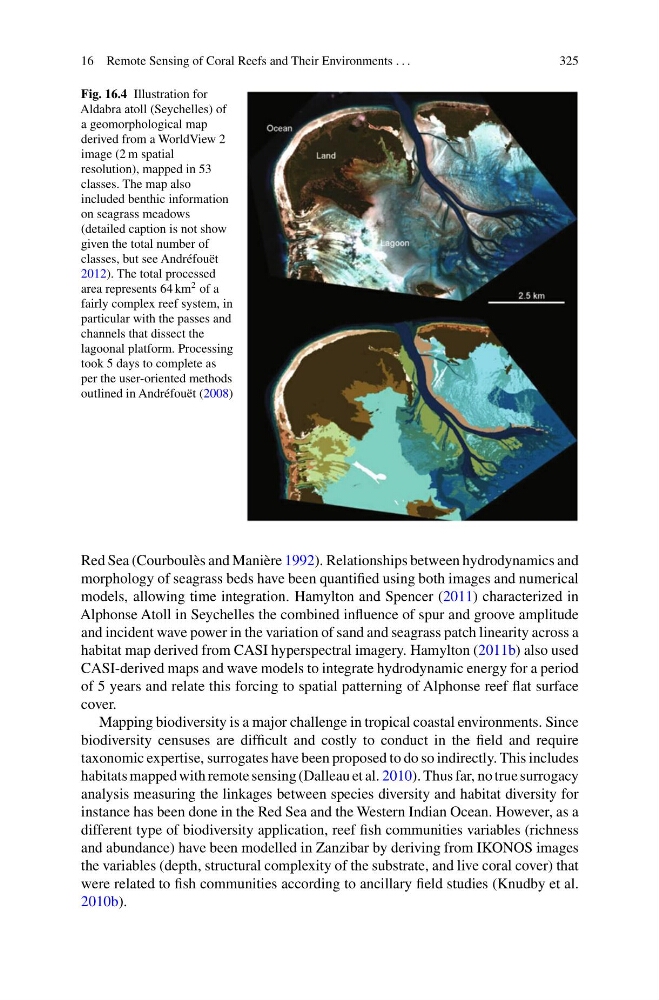
Fig. 16.4 Illustration for
Aldabra atoll (Seychelles) of
a geomorphological map
derived from a WorldView 2
image (2 m spatial
resolution), mapped in 53
classes. The map also
included benthic information
on seagrass meadows
(detailed caption is not show
given the total number of
classes, but see Andréfouët
2012). The total processed
area represents 64 km
2 of a
fairly complex reef system, in
particular with the passes and
channels that dissect the
lagoonal platform. Processing
took 5 days to complete as
per the user-oriented methods
outlined in Andréfouët (2008)
Red Sea (Courboulès and Manière 1992). Relationships between hydrodynamics and
morphology of seagrass beds have been quantified using both images and numerical
models, allowing time integration. Hamylton and Spencer (2011) characterized in
Alphonse Atoll in Seychelles the combined influence of spur and groove amplitude
and incident wave power in the variation of sand and seagrass patch linearity across a
habitat map derived from CASI hyperspectral imagery. Hamylton (2011b) also used
CASI-derived maps and wave models to integrate hydrodynamic energy for a period
of 5 years and relate this forcing to spatial patterning of Alphonse reef flat surface
cover.
Mapping biodiversity is a major challenge in tropical coastal environments. Since
biodiversity censuses are difficult and costly to conduct in the field and require
taxonomic expertise, surrogates have been proposed to do so indirectly. This includes
habitats mapped with remote sensing (Dalleau et al. 2010). Thus far, no true surrogacy
analysis measuring the linkages between species diversity and habitat diversity for
instance has been done in the Red Sea and the Western Indian Ocean. However, as a
different type of biodiversity application, reef fish communities variables (richness
and abundance) have been modelled in Zanzibar by deriving from IKONOS images
the variables (depth, structural complexity of the substrate, and live coral cover) that
were related to fish communities according to ancillary field studies (Knudby et al.
2010b).
325
Fig. 16.4 Illustration for
Aldabra atoll (Seychelles) of
a geomorphological map
derived from a WorldView 2
image (2 m spatial
resolution), mapped in 53
classes. The map also
included benthic information
on seagrass meadows
(detailed caption is not show
given the total number of
classes, but see Andréfouët
2012). The total processed
area represents 64 km
2 of a
fairly complex reef system, in
particular with the passes and
channels that dissect the
lagoonal platform. Processing
took 5 days to complete as
per the user-oriented methods
outlined in Andréfouët (2008)
Red Sea (Courboulès and Manière 1992). Relationships between hydrodynamics and
morphology of seagrass beds have been quantified using both images and numerical
models, allowing time integration. Hamylton and Spencer (2011) characterized in
Alphonse Atoll in Seychelles the combined influence of spur and groove amplitude
and incident wave power in the variation of sand and seagrass patch linearity across a
habitat map derived from CASI hyperspectral imagery. Hamylton (2011b) also used
CASI-derived maps and wave models to integrate hydrodynamic energy for a period
of 5 years and relate this forcing to spatial patterning of Alphonse reef flat surface
cover.
Mapping biodiversity is a major challenge in tropical coastal environments. Since
biodiversity censuses are difficult and costly to conduct in the field and require
taxonomic expertise, surrogates have been proposed to do so indirectly. This includes
habitats mapped with remote sensing (Dalleau et al. 2010). Thus far, no true surrogacy
analysis measuring the linkages between species diversity and habitat diversity for
instance has been done in the Red Sea and the Western Indian Ocean. However, as a
different type of biodiversity application, reef fish communities variables (richness
and abundance) have been modelled in Zanzibar by deriving from IKONOS images
the variables (depth, structural complexity of the substrate, and live coral cover) that
were related to fish communities according to ancillary field studies (Knudby et al.
2010b).