

1 The African Marginal and Enclosed Seas: An Overview
7
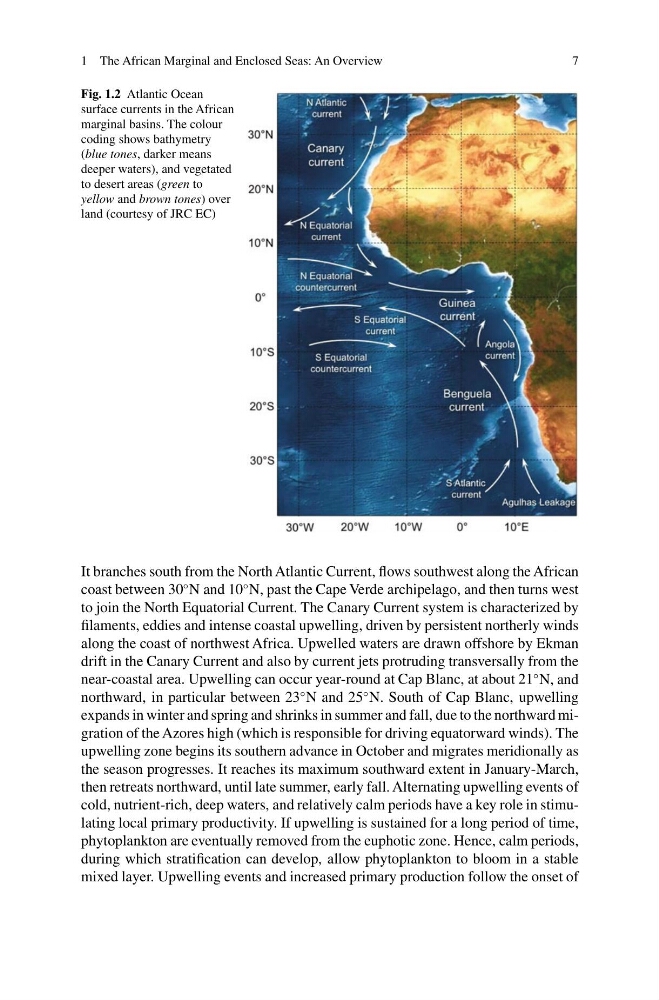
Fig. 1.2 Atlantic Ocean
surface currents in the African
marginal basins. The colour
coding shows bathymetry
(blue tones, darker means
deeper waters), and vegetated
to desert areas (green to
yellow and brown tones) over
land (courtesy of JRC EC)
It branches south from the North Atlantic Current, flows southwest along the African
coast between 30
◦ N and 10
◦ N, past the Cape Verde archipelago, and then turns west
to join the North Equatorial Current. The Canary Current system is characterized by
filaments, eddies and intense coastal upwelling, driven by persistent northerly winds
along the coast of northwest Africa. Upwelled waters are drawn offshore by Ekman
drift in the Canary Current and also by current jets protruding transversally from the
near-coastal area. Upwelling can occur year-round at Cap Blanc, at about 21
◦ N, and
northward, in particular between 23
◦ N and 25
◦ N. South of Cap Blanc, upwelling
expands in winter and spring and shrinks in summer and fall, due to the northward migration of the Azores high (which is responsible for driving equatorward winds). The
upwelling zone begins its southern advance in October and migrates meridionally as
the season progresses. It reaches its maximum southward extent in January-March,
then retreats northward, until late summer, early fall. Alternating upwelling events of
cold, nutrient-rich, deep waters, and relatively calm periods have a key role in stimulating local primary productivity. If upwelling is sustained for a long period of time,
phytoplankton are eventually removed from the euphotic zone. Hence, calm periods,
during which stratification can develop, allow phytoplankton to bloom in a stable
mixed layer. Upwelling events and increased primary production follow the onset of
7
Fig. 1.2 Atlantic Ocean
surface currents in the African
marginal basins. The colour
coding shows bathymetry
(blue tones, darker means
deeper waters), and vegetated
to desert areas (green to
yellow and brown tones) over
land (courtesy of JRC EC)
It branches south from the North Atlantic Current, flows southwest along the African
coast between 30
◦ N and 10
◦ N, past the Cape Verde archipelago, and then turns west
to join the North Equatorial Current. The Canary Current system is characterized by
filaments, eddies and intense coastal upwelling, driven by persistent northerly winds
along the coast of northwest Africa. Upwelled waters are drawn offshore by Ekman
drift in the Canary Current and also by current jets protruding transversally from the
near-coastal area. Upwelling can occur year-round at Cap Blanc, at about 21
◦ N, and
northward, in particular between 23
◦ N and 25
◦ N. South of Cap Blanc, upwelling
expands in winter and spring and shrinks in summer and fall, due to the northward migration of the Azores high (which is responsible for driving equatorward winds). The
upwelling zone begins its southern advance in October and migrates meridionally as
the season progresses. It reaches its maximum southward extent in January-March,
then retreats northward, until late summer, early fall. Alternating upwelling events of
cold, nutrient-rich, deep waters, and relatively calm periods have a key role in stimulating local primary productivity. If upwelling is sustained for a long period of time,
phytoplankton are eventually removed from the euphotic zone. Hence, calm periods,
during which stratification can develop, allow phytoplankton to bloom in a stable
mixed layer. Upwelling events and increased primary production follow the onset of