

274
J. M. Magalhaes et al.
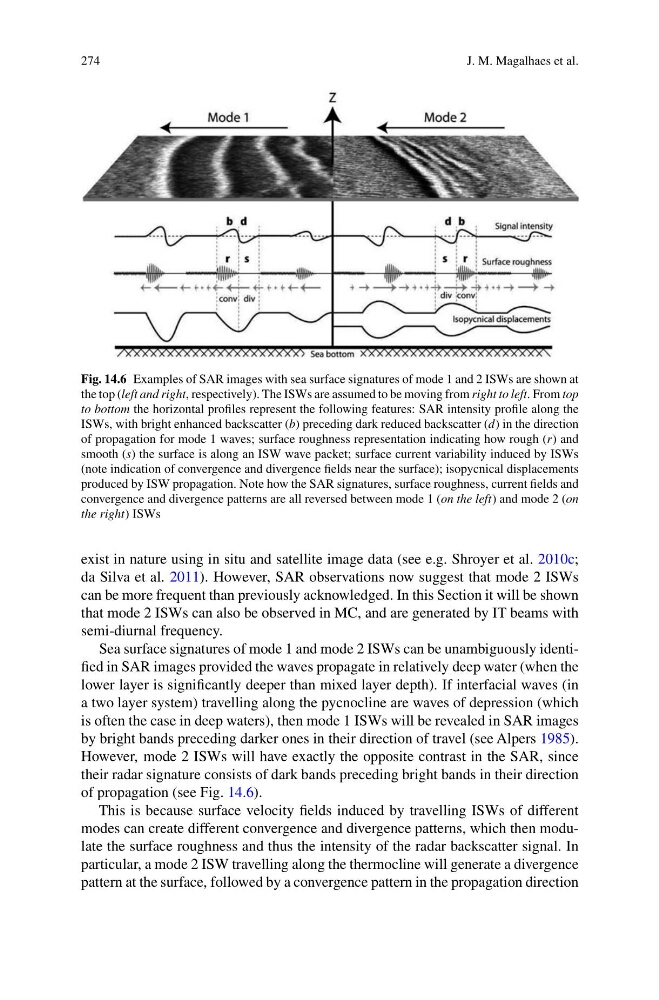
Fig. 14.6 Examples of SAR images with sea surface signatures of mode 1 and 2 ISWs are shown at
the top (left and right, respectively). The ISWs are assumed to be moving from right to left. From top
to bottom the horizontal profiles represent the following features: SAR intensity profile along the
ISWs, with bright enhanced backscatter (b) preceding dark reduced backscatter (d) in the direction
of propagation for mode 1 waves; surface roughness representation indicating how rough (r) and
smooth (s) the surface is along an ISW wave packet; surface current variability induced by ISWs
(note indication of convergence and divergence fields near the surface); isopycnical displacements
produced by ISW propagation. Note how the SAR signatures, surface roughness, current fields and
convergence and divergence patterns are all reversed between mode 1 (on the left) and mode 2 (on
the right) ISWs
exist in nature using in situ and satellite image data (see e.g. Shroyer et al. 2010c;
da Silva et al. 2011). However, SAR observations now suggest that mode 2 ISWs
can be more frequent than previously acknowledged. In this Section it will be shown
that mode 2 ISWs can also be observed in MC, and are generated by IT beams with
semi-diurnal frequency.
Sea surface signatures of mode 1 and mode 2 ISWs can be unambiguously identified in SAR images provided the waves propagate in relatively deep water (when the
lower layer is significantly deeper than mixed layer depth). If interfacial waves (in
a two layer system) travelling along the pycnocline are waves of depression (which
is often the case in deep waters), then mode 1 ISWs will be revealed in SAR images
by bright bands preceding darker ones in their direction of travel (see Alpers 1985).
However, mode 2 ISWs will have exactly the opposite contrast in the SAR, since
their radar signature consists of dark bands preceding bright bands in their direction
of propagation (see Fig. 14.6).
This is because surface velocity fields induced by travelling ISWs of different
modes can create different convergence and divergence patterns, which then modulate the surface roughness and thus the intensity of the radar backscatter signal. In
particular, a mode 2 ISW travelling along the thermocline will generate a divergence
pattern at the surface, followed by a convergence pattern in the propagation direction
J. M. Magalhaes et al.
Fig. 14.6 Examples of SAR images with sea surface signatures of mode 1 and 2 ISWs are shown at
the top (left and right, respectively). The ISWs are assumed to be moving from right to left. From top
to bottom the horizontal profiles represent the following features: SAR intensity profile along the
ISWs, with bright enhanced backscatter (b) preceding dark reduced backscatter (d) in the direction
of propagation for mode 1 waves; surface roughness representation indicating how rough (r) and
smooth (s) the surface is along an ISW wave packet; surface current variability induced by ISWs
(note indication of convergence and divergence fields near the surface); isopycnical displacements
produced by ISW propagation. Note how the SAR signatures, surface roughness, current fields and
convergence and divergence patterns are all reversed between mode 1 (on the left) and mode 2 (on
the right) ISWs
exist in nature using in situ and satellite image data (see e.g. Shroyer et al. 2010c;
da Silva et al. 2011). However, SAR observations now suggest that mode 2 ISWs
can be more frequent than previously acknowledged. In this Section it will be shown
that mode 2 ISWs can also be observed in MC, and are generated by IT beams with
semi-diurnal frequency.
Sea surface signatures of mode 1 and mode 2 ISWs can be unambiguously identified in SAR images provided the waves propagate in relatively deep water (when the
lower layer is significantly deeper than mixed layer depth). If interfacial waves (in
a two layer system) travelling along the pycnocline are waves of depression (which
is often the case in deep waters), then mode 1 ISWs will be revealed in SAR images
by bright bands preceding darker ones in their direction of travel (see Alpers 1985).
However, mode 2 ISWs will have exactly the opposite contrast in the SAR, since
their radar signature consists of dark bands preceding bright bands in their direction
of propagation (see Fig. 14.6).
This is because surface velocity fields induced by travelling ISWs of different
modes can create different convergence and divergence patterns, which then modulate the surface roughness and thus the intensity of the radar backscatter signal. In
particular, a mode 2 ISW travelling along the thermocline will generate a divergence
pattern at the surface, followed by a convergence pattern in the propagation direction