

4
V. Barale
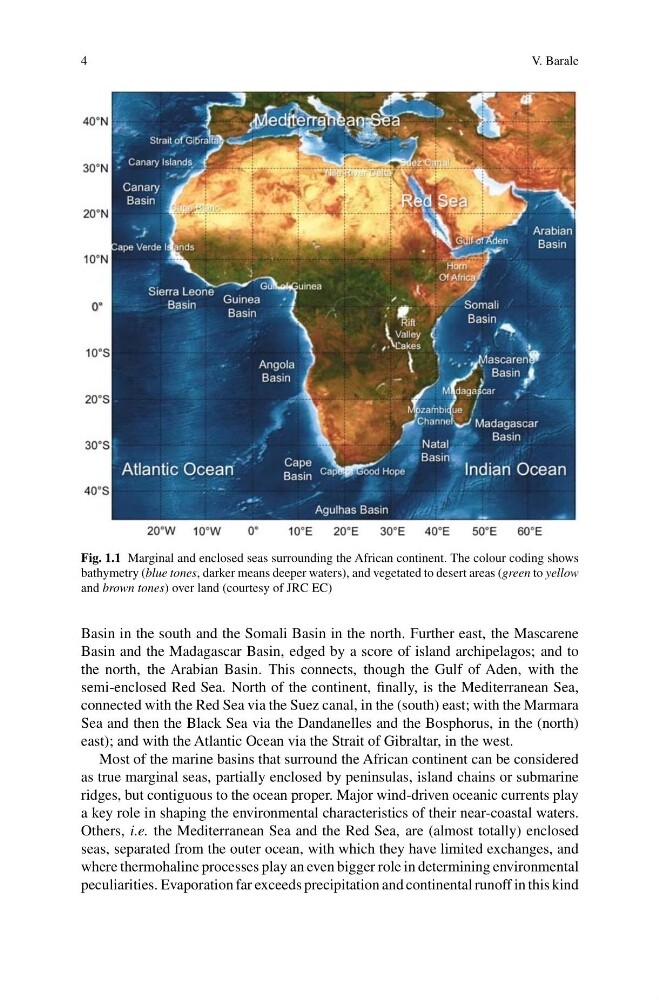
Fig. 1.1 Marginal and enclosed seas surrounding the African continent. The colour coding shows
bathymetry (blue tones, darker means deeper waters), and vegetated to desert areas (green to yellow
and brown tones) over land (courtesy of JRC EC)
Basin in the south and the Somali Basin in the north. Further east, the Mascarene
Basin and the Madagascar Basin, edged by a score of island archipelagos; and to
the north, the Arabian Basin. This connects, though the Gulf of Aden, with the
semi-enclosed Red Sea. North of the continent, finally, is the Mediterranean Sea,
connected with the Red Sea via the Suez canal, in the (south) east; with the Marmara
Sea and then the Black Sea via the Dandanelles and the Bosphorus, in the (north)
east); and with the Atlantic Ocean via the Strait of Gibraltar, in the west.
Most of the marine basins that surround the African continent can be considered
as true marginal seas, partially enclosed by peninsulas, island chains or submarine
ridges, but contiguous to the ocean proper. Major wind-driven oceanic currents play
a key role in shaping the environmental characteristics of their near-coastal waters.
Others, i.e. the Mediterranean Sea and the Red Sea, are (almost totally) enclosed
seas, separated from the outer ocean, with which they have limited exchanges, and
where thermohaline processes play an even bigger role in determining environmental
peculiarities. Evaporation far exceeds precipitation and continental runoff in this kind
V. Barale
Fig. 1.1 Marginal and enclosed seas surrounding the African continent. The colour coding shows
bathymetry (blue tones, darker means deeper waters), and vegetated to desert areas (green to yellow
and brown tones) over land (courtesy of JRC EC)
Basin in the south and the Somali Basin in the north. Further east, the Mascarene
Basin and the Madagascar Basin, edged by a score of island archipelagos; and to
the north, the Arabian Basin. This connects, though the Gulf of Aden, with the
semi-enclosed Red Sea. North of the continent, finally, is the Mediterranean Sea,
connected with the Red Sea via the Suez canal, in the (south) east; with the Marmara
Sea and then the Black Sea via the Dandanelles and the Bosphorus, in the (north)
east); and with the Atlantic Ocean via the Strait of Gibraltar, in the west.
Most of the marine basins that surround the African continent can be considered
as true marginal seas, partially enclosed by peninsulas, island chains or submarine
ridges, but contiguous to the ocean proper. Major wind-driven oceanic currents play
a key role in shaping the environmental characteristics of their near-coastal waters.
Others, i.e. the Mediterranean Sea and the Red Sea, are (almost totally) enclosed
seas, separated from the outer ocean, with which they have limited exchanges, and
where thermohaline processes play an even bigger role in determining environmental
peculiarities. Evaporation far exceeds precipitation and continental runoff in this kind