

254
J. A. Johannessen et al.
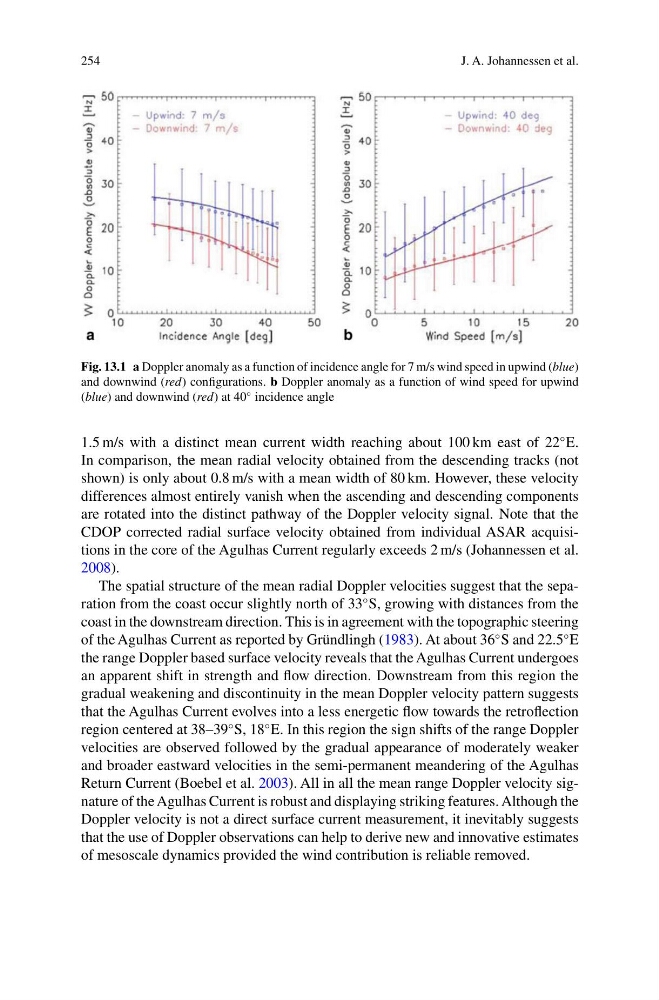
Fig. 13.1 a Doppler anomaly as a function of incidence angle for 7 m/s wind speed in upwind (blue)
and downwind (red) configurations. b Doppler anomaly as a function of wind speed for upwind
(blue) and downwind (red) at 40
◦ incidence angle
1.5 m/s with a distinct mean current width reaching about 100 km east of 22
◦ E.
In comparison, the mean radial velocity obtained from the descending tracks (not
shown) is only about 0.8 m/s with a mean width of 80 km. However, these velocity
differences almost entirely vanish when the ascending and descending components
are rotated into the distinct pathway of the Doppler velocity signal. Note that the
CDOP corrected radial surface velocity obtained from individual ASAR acquisitions in the core of the Agulhas Current regularly exceeds 2 m/s (Johannessen et al.
2008).
The spatial structure of the mean radial Doppler velocities suggest that the separation from the coast occur slightly north of 33
◦ S, growing with distances from the
coast in the downstream direction. This is in agreement with the topographic steering
of the Agulhas Current as reported by Gründlingh (1983). At about 36
◦ S and 22.5
◦ E
the range Doppler based surface velocity reveals that the Agulhas Current undergoes
an apparent shift in strength and flow direction. Downstream from this region the
gradual weakening and discontinuity in the mean Doppler velocity pattern suggests
that the Agulhas Current evolves into a less energetic flow towards the retroflection
region centered at 38–39
◦ S, 18
◦ E. In this region the sign shifts of the range Doppler
velocities are observed followed by the gradual appearance of moderately weaker
and broader eastward velocities in the semi-permanent meandering of the Agulhas
Return Current (Boebel et al. 2003). All in all the mean range Doppler velocity signature of the Agulhas Current is robust and displaying striking features. Although the
Doppler velocity is not a direct surface current measurement, it inevitably suggests
that the use of Doppler observations can help to derive new and innovative estimates
of mesoscale dynamics provided the wind contribution is reliable removed.
J. A. Johannessen et al.
Fig. 13.1 a Doppler anomaly as a function of incidence angle for 7 m/s wind speed in upwind (blue)
and downwind (red) configurations. b Doppler anomaly as a function of wind speed for upwind
(blue) and downwind (red) at 40
◦ incidence angle
1.5 m/s with a distinct mean current width reaching about 100 km east of 22
◦ E.
In comparison, the mean radial velocity obtained from the descending tracks (not
shown) is only about 0.8 m/s with a mean width of 80 km. However, these velocity
differences almost entirely vanish when the ascending and descending components
are rotated into the distinct pathway of the Doppler velocity signal. Note that the
CDOP corrected radial surface velocity obtained from individual ASAR acquisitions in the core of the Agulhas Current regularly exceeds 2 m/s (Johannessen et al.
2008).
The spatial structure of the mean radial Doppler velocities suggest that the separation from the coast occur slightly north of 33
◦ S, growing with distances from the
coast in the downstream direction. This is in agreement with the topographic steering
of the Agulhas Current as reported by Gründlingh (1983). At about 36
◦ S and 22.5
◦ E
the range Doppler based surface velocity reveals that the Agulhas Current undergoes
an apparent shift in strength and flow direction. Downstream from this region the
gradual weakening and discontinuity in the mean Doppler velocity pattern suggests
that the Agulhas Current evolves into a less energetic flow towards the retroflection
region centered at 38–39
◦ S, 18
◦ E. In this region the sign shifts of the range Doppler
velocities are observed followed by the gradual appearance of moderately weaker
and broader eastward velocities in the semi-permanent meandering of the Agulhas
Return Current (Boebel et al. 2003). All in all the mean range Doppler velocity signature of the Agulhas Current is robust and displaying striking features. Although the
Doppler velocity is not a direct surface current measurement, it inevitably suggests
that the use of Doppler observations can help to derive new and innovative estimates
of mesoscale dynamics provided the wind contribution is reliable removed.