

10 Ocean Colour Remote Sensing of Harmful Algal Blooms in the Benguela System
191
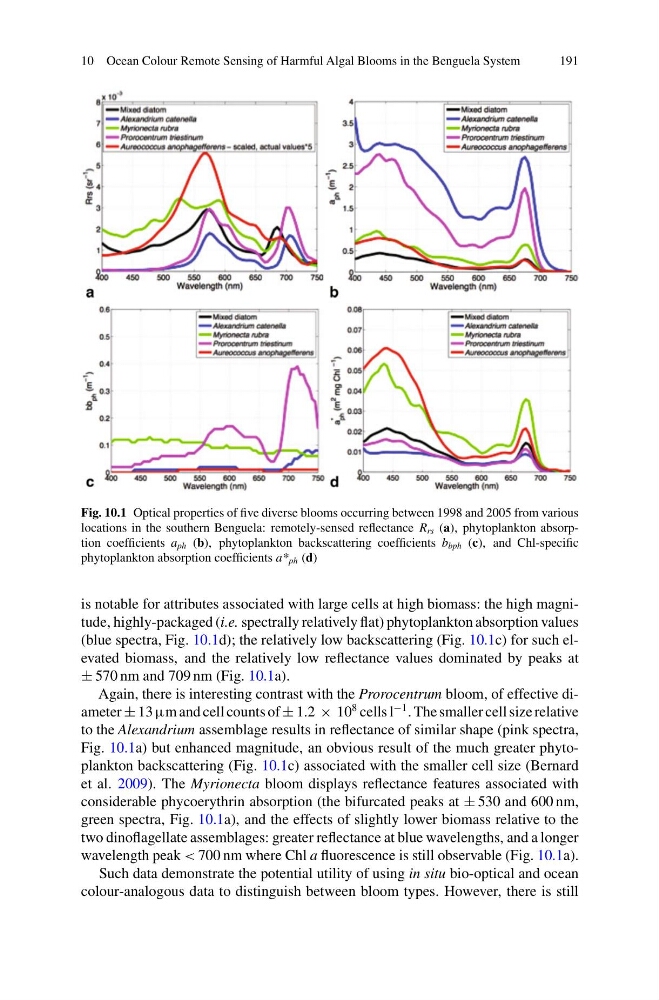
Fig. 10.1 Optical properties of five diverse blooms occurring between 1998 and 2005 from various
locations in the southern Benguela: remotely-sensed reflectance R rs (a), phytoplankton absorption coefficients a ph (b), phytoplankton backscattering coefficients b bph (c), and Chl-specific
phytoplankton absorption coefficients a* ph (d)
is notable for attributes associated with large cells at high biomass: the high magnitude, highly-packaged (i.e. spectrally relatively flat) phytoplankton absorption values
(blue spectra, Fig. 10.1d); the relatively low backscattering (Fig. 10.1c) for such elevated biomass, and the relatively low reflectance values dominated by peaks at
± 570 nm and 709 nm (Fig. 10.1a).
Again, there is interesting contrast with the Prorocentrum bloom, of effective diameter ± 13 μm and cell counts of ± 1.2 × 10
8 cells l
−1 . The smaller cell size relative
to the Alexandrium assemblage results in reflectance of similar shape (pink spectra,
Fig. 10.1a) but enhanced magnitude, an obvious result of the much greater phytoplankton backscattering (Fig. 10.1c) associated with the smaller cell size (Bernard
et al. 2009). The Myrionecta bloom displays reflectance features associated with
considerable phycoerythrin absorption (the bifurcated peaks at ± 530 and 600 nm,
green spectra, Fig. 10.1a), and the effects of slightly lower biomass relative to the
two dinoflagellate assemblages: greater reflectance at blue wavelengths, and a longer
wavelength peak < 700 nm where Chl a fluorescence is still observable (Fig. 10.1a).
Such data demonstrate the potential utility of using in situ bio-optical and ocean
colour-analogous data to distinguish between bloom types. However, there is still
191
Fig. 10.1 Optical properties of five diverse blooms occurring between 1998 and 2005 from various
locations in the southern Benguela: remotely-sensed reflectance R rs (a), phytoplankton absorption coefficients a ph (b), phytoplankton backscattering coefficients b bph (c), and Chl-specific
phytoplankton absorption coefficients a* ph (d)
is notable for attributes associated with large cells at high biomass: the high magnitude, highly-packaged (i.e. spectrally relatively flat) phytoplankton absorption values
(blue spectra, Fig. 10.1d); the relatively low backscattering (Fig. 10.1c) for such elevated biomass, and the relatively low reflectance values dominated by peaks at
± 570 nm and 709 nm (Fig. 10.1a).
Again, there is interesting contrast with the Prorocentrum bloom, of effective diameter ± 13 μm and cell counts of ± 1.2 × 10
8 cells l
−1 . The smaller cell size relative
to the Alexandrium assemblage results in reflectance of similar shape (pink spectra,
Fig. 10.1a) but enhanced magnitude, an obvious result of the much greater phytoplankton backscattering (Fig. 10.1c) associated with the smaller cell size (Bernard
et al. 2009). The Myrionecta bloom displays reflectance features associated with
considerable phycoerythrin absorption (the bifurcated peaks at ± 530 and 600 nm,
green spectra, Fig. 10.1a), and the effects of slightly lower biomass relative to the
two dinoflagellate assemblages: greater reflectance at blue wavelengths, and a longer
wavelength peak < 700 nm where Chl a fluorescence is still observable (Fig. 10.1a).
Such data demonstrate the potential utility of using in situ bio-optical and ocean
colour-analogous data to distinguish between bloom types. However, there is still