

172
H. Siegel et al.
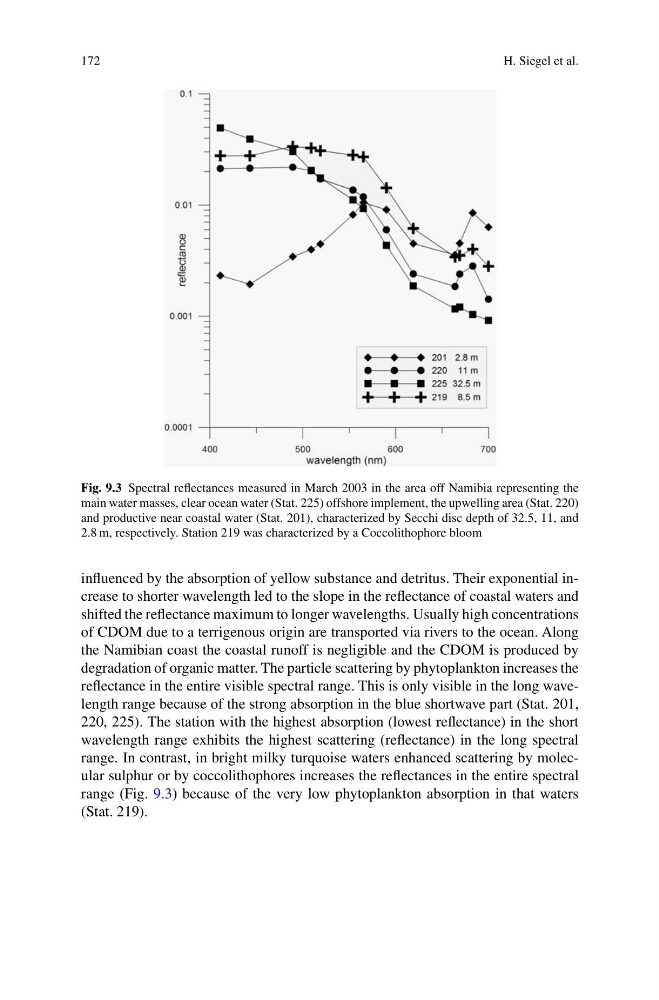
Fig. 9.3 Spectral reflectances measured in March 2003 in the area off Namibia representing the
main water masses, clear ocean water (Stat. 225) offshore implement, the upwelling area (Stat. 220)
and productive near coastal water (Stat. 201), characterized by Secchi disc depth of 32.5, 11, and
2.8 m, respectively. Station 219 was characterized by a Coccolithophore bloom
influenced by the absorption of yellow substance and detritus. Their exponential increase to shorter wavelength led to the slope in the reflectance of coastal waters and
shifted the reflectance maximum to longer wavelengths. Usually high concentrations
of CDOM due to a terrigenous origin are transported via rivers to the ocean. Along
the Namibian coast the coastal runoff is negligible and the CDOM is produced by
degradation of organic matter. The particle scattering by phytoplankton increases the
reflectance in the entire visible spectral range. This is only visible in the long wavelength range because of the strong absorption in the blue shortwave part (Stat. 201,
220, 225). The station with the highest absorption (lowest reflectance) in the short
wavelength range exhibits the highest scattering (reflectance) in the long spectral
range. In contrast, in bright milky turquoise waters enhanced scattering by molecular sulphur or by coccolithophores increases the reflectances in the entire spectral
range (Fig. 9.3) because of the very low phytoplankton absorption in that waters
(Stat. 219).
H. Siegel et al.
Fig. 9.3 Spectral reflectances measured in March 2003 in the area off Namibia representing the
main water masses, clear ocean water (Stat. 225) offshore implement, the upwelling area (Stat. 220)
and productive near coastal water (Stat. 201), characterized by Secchi disc depth of 32.5, 11, and
2.8 m, respectively. Station 219 was characterized by a Coccolithophore bloom
influenced by the absorption of yellow substance and detritus. Their exponential increase to shorter wavelength led to the slope in the reflectance of coastal waters and
shifted the reflectance maximum to longer wavelengths. Usually high concentrations
of CDOM due to a terrigenous origin are transported via rivers to the ocean. Along
the Namibian coast the coastal runoff is negligible and the CDOM is produced by
degradation of organic matter. The particle scattering by phytoplankton increases the
reflectance in the entire visible spectral range. This is only visible in the long wavelength range because of the strong absorption in the blue shortwave part (Stat. 201,
220, 225). The station with the highest absorption (lowest reflectance) in the short
wavelength range exhibits the highest scattering (reflectance) in the long spectral
range. In contrast, in bright milky turquoise waters enhanced scattering by molecular sulphur or by coccolithophores increases the reflectances in the entire spectral
range (Fig. 9.3) because of the very low phytoplankton absorption in that waters
(Stat. 219).