

7 Water Constituents Assessment at the Sassandra River Mouth (Côte d’Ivoire)
145
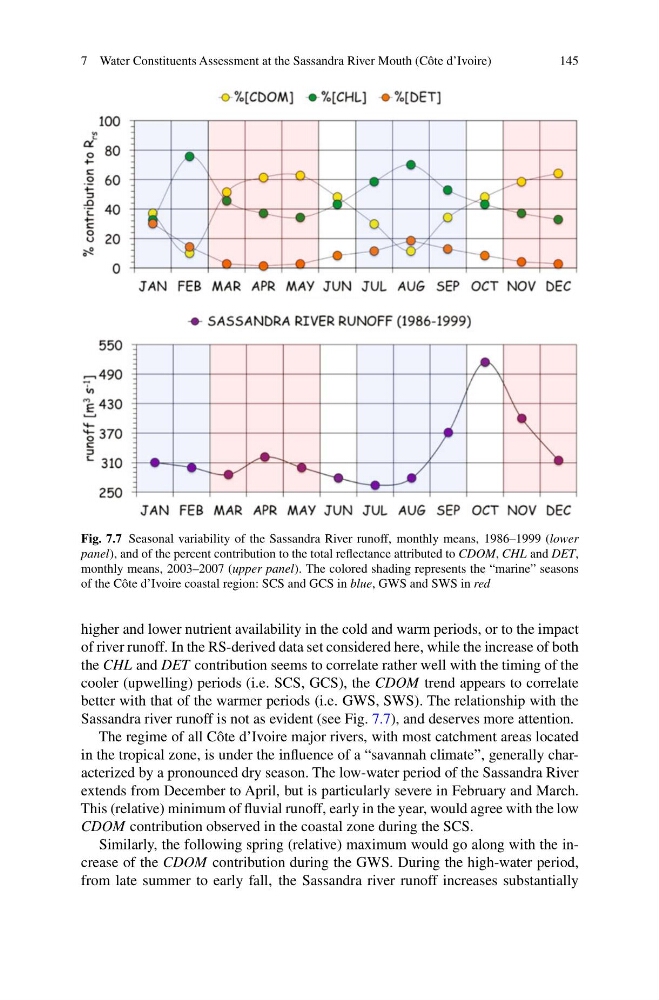
Fig. 7.7 Seasonal variability of the Sassandra River runoff, monthly means, 1986–1999 (lower
panel), and of the percent contribution to the total reflectance attributed to CDOM, CHL and DET,
monthly means, 2003–2007 (upper panel). The colored shading represents the “marine” seasons
of the Côte d’Ivoire coastal region: SCS and GCS in blue, GWS and SWS in red
higher and lower nutrient availability in the cold and warm periods, or to the impact
of river runoff. In the RS-derived data set considered here, while the increase of both
the CHL and DET contribution seems to correlate rather well with the timing of the
cooler (upwelling) periods (i.e. SCS, GCS), the CDOM trend appears to correlate
better with that of the warmer periods (i.e. GWS, SWS). The relationship with the
Sassandra river runoff is not as evident (see Fig. 7.7), and deserves more attention.
The regime of all Côte d’Ivoire major rivers, with most catchment areas located
in the tropical zone, is under the influence of a “savannah climate”, generally characterized by a pronounced dry season. The low-water period of the Sassandra River
extends from December to April, but is particularly severe in February and March.
This (relative) minimum of fluvial runoff, early in the year, would agree with the low
CDOM contribution observed in the coastal zone during the SCS.
Similarly, the following spring (relative) maximum would go along with the increase of the CDOM contribution during the GWS. During the high-water period,
from late summer to early fall, the Sassandra river runoff increases substantially
145
Fig. 7.7 Seasonal variability of the Sassandra River runoff, monthly means, 1986–1999 (lower
panel), and of the percent contribution to the total reflectance attributed to CDOM, CHL and DET,
monthly means, 2003–2007 (upper panel). The colored shading represents the “marine” seasons
of the Côte d’Ivoire coastal region: SCS and GCS in blue, GWS and SWS in red
higher and lower nutrient availability in the cold and warm periods, or to the impact
of river runoff. In the RS-derived data set considered here, while the increase of both
the CHL and DET contribution seems to correlate rather well with the timing of the
cooler (upwelling) periods (i.e. SCS, GCS), the CDOM trend appears to correlate
better with that of the warmer periods (i.e. GWS, SWS). The relationship with the
Sassandra river runoff is not as evident (see Fig. 7.7), and deserves more attention.
The regime of all Côte d’Ivoire major rivers, with most catchment areas located
in the tropical zone, is under the influence of a “savannah climate”, generally characterized by a pronounced dry season. The low-water period of the Sassandra River
extends from December to April, but is particularly severe in February and March.
This (relative) minimum of fluvial runoff, early in the year, would agree with the low
CDOM contribution observed in the coastal zone during the SCS.
Similarly, the following spring (relative) maximum would go along with the increase of the CDOM contribution during the GWS. During the high-water period,
from late summer to early fall, the Sassandra river runoff increases substantially