

5 Mesoscale Dynamics in the Canary Islands Area . . .
113
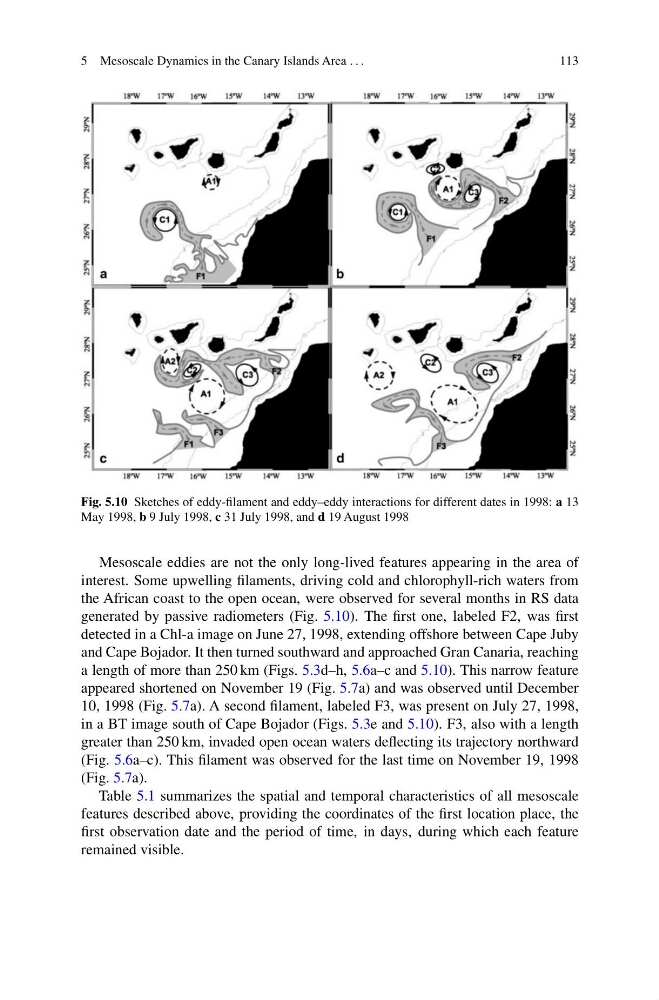
Fig. 5.10 Sketches of eddy-filament and eddy–eddy interactions for different dates in 1998: a 13
May 1998, b 9 July 1998, c 31 July 1998, and d 19 August 1998
Mesoscale eddies are not the only long-lived features appearing in the area of
interest. Some upwelling filaments, driving cold and chlorophyll-rich waters from
the African coast to the open ocean, were observed for several months in RS data
generated by passive radiometers (Fig. 5.10). The first one, labeled F2, was first
detected in a Chl-a image on June 27, 1998, extending offshore between Cape Juby
and Cape Bojador. It then turned southward and approached Gran Canaria, reaching
a length of more than 250 km (Figs. 5.3d–h, 5.6a–c and 5.10). This narrow feature
appeared shortened on November 19 (Fig. 5.7a) and was observed until December
10, 1998 (Fig. 5.7a). A second filament, labeled F3, was present on July 27, 1998,
in a BT image south of Cape Bojador (Figs. 5.3e and 5.10). F3, also with a length
greater than 250 km, invaded open ocean waters deflecting its trajectory northward
(Fig. 5.6a–c). This filament was observed for the last time on November 19, 1998
(Fig. 5.7a).
Table 5.1 summarizes the spatial and temporal characteristics of all mesoscale
features described above, providing the coordinates of the first location place, the
first observation date and the period of time, in days, during which each feature
remained visible.
113
Fig. 5.10 Sketches of eddy-filament and eddy–eddy interactions for different dates in 1998: a 13
May 1998, b 9 July 1998, c 31 July 1998, and d 19 August 1998
Mesoscale eddies are not the only long-lived features appearing in the area of
interest. Some upwelling filaments, driving cold and chlorophyll-rich waters from
the African coast to the open ocean, were observed for several months in RS data
generated by passive radiometers (Fig. 5.10). The first one, labeled F2, was first
detected in a Chl-a image on June 27, 1998, extending offshore between Cape Juby
and Cape Bojador. It then turned southward and approached Gran Canaria, reaching
a length of more than 250 km (Figs. 5.3d–h, 5.6a–c and 5.10). This narrow feature
appeared shortened on November 19 (Fig. 5.7a) and was observed until December
10, 1998 (Fig. 5.7a). A second filament, labeled F3, was present on July 27, 1998,
in a BT image south of Cape Bojador (Figs. 5.3e and 5.10). F3, also with a length
greater than 250 km, invaded open ocean waters deflecting its trajectory northward
(Fig. 5.6a–c). This filament was observed for the last time on November 19, 1998
(Fig. 5.7a).
Table 5.1 summarizes the spatial and temporal characteristics of all mesoscale
features described above, providing the coordinates of the first location place, the
first observation date and the period of time, in days, during which each feature
remained visible.