

76
5. Impact of Fishing Pressure on Mean Length of Fish
SHORTMORTALITY 0 1 SHORTMORTALITY 12
SHORTMORTALITY 12
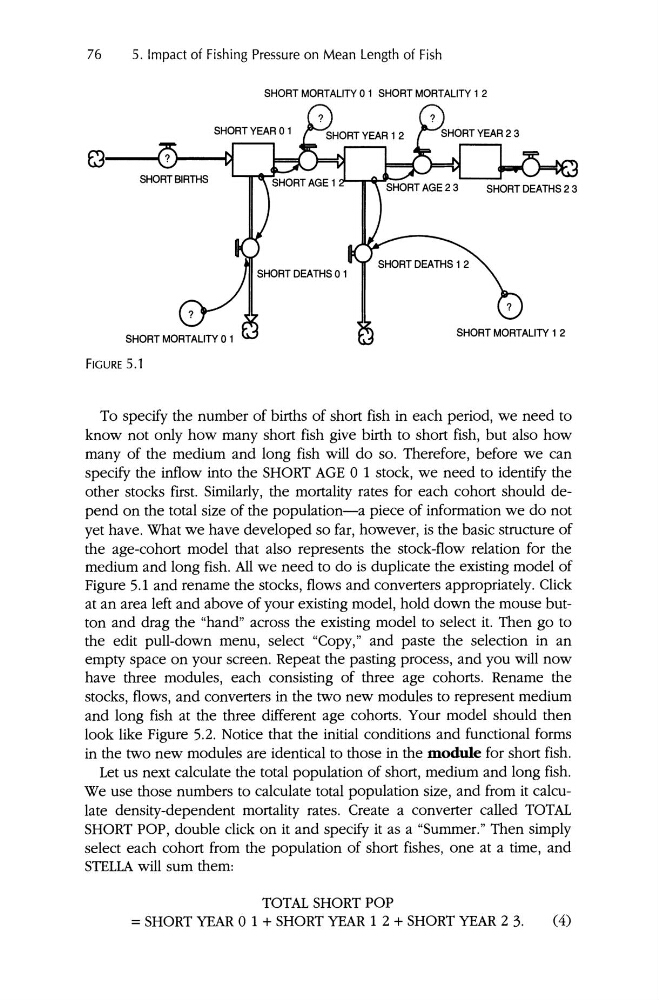
FIGURE 5.1
To specify the number of births of short fish in each period, we need to
know not only how many short fish give birth to short fish, but also how
many of the medium and long fish will do so. Therefore, before we can
specify the inflow into the SHORT AGE 0 1 stock, we need to identify the
other stocks first. Similarly, the mortality rates for each cohort should depend on the total size of the population-a piece of information we do not
yet have . What we have developed so far, however, is the basic structure of
the age-cohort model that also represents the stock-flow relation for the
medium and long fish. All we need to do is duplicate the existing model of
Figure 5.1 and rename the stocks, flows and converters appropriately. Click
at an area left and above of your existing model, hold down the mouse button and drag the "hand " across the existing model to select it. Then go to
the edit pull-down menu, select "Copy," and paste the selection in an
empty space on your screen . Repeat the pasting process, and you will now
have three modules, each consisting of three age cohorts . Rename the
stocks, flows, and converters in the two new modules to repre sent medium
and long fish at the three different age cohorts . Your model should then
look like Figure 5.2. Notice that the initial conditions and functional forms
in the two new modules are identical to those in the module for short fish.
Let us next calculate the total population of short, medium and long fish.
We use those numbers to calculate total population size, and from it calculate density-dependent mortality rates. Create a converter called TOTAL
SHORT POP, double click on it and specify it as a "Summer." Then simply
select each cohort from the population of short fishes, one at a time, and
STELLA will sum them:
TOTAL SHORT POP
= SHORT YEAR 0 1 + SHORT YEAR 1 2 + SHORT YEAR 2 3.
(4)
5. Impact of Fishing Pressure on Mean Length of Fish
SHORTMORTALITY 0 1 SHORTMORTALITY 12
SHORTMORTALITY 12
FIGURE 5.1
To specify the number of births of short fish in each period, we need to
know not only how many short fish give birth to short fish, but also how
many of the medium and long fish will do so. Therefore, before we can
specify the inflow into the SHORT AGE 0 1 stock, we need to identify the
other stocks first. Similarly, the mortality rates for each cohort should depend on the total size of the population-a piece of information we do not
yet have . What we have developed so far, however, is the basic structure of
the age-cohort model that also represents the stock-flow relation for the
medium and long fish. All we need to do is duplicate the existing model of
Figure 5.1 and rename the stocks, flows and converters appropriately. Click
at an area left and above of your existing model, hold down the mouse button and drag the "hand " across the existing model to select it. Then go to
the edit pull-down menu, select "Copy," and paste the selection in an
empty space on your screen . Repeat the pasting process, and you will now
have three modules, each consisting of three age cohorts . Rename the
stocks, flows, and converters in the two new modules to repre sent medium
and long fish at the three different age cohorts . Your model should then
look like Figure 5.2. Notice that the initial conditions and functional forms
in the two new modules are identical to those in the module for short fish.
Let us next calculate the total population of short, medium and long fish.
We use those numbers to calculate total population size, and from it calculate density-dependent mortality rates. Create a converter called TOTAL
SHORT POP, double click on it and specify it as a "Summer." Then simply
select each cohort from the population of short fishes, one at a time, and
STELLA will sum them:
TOTAL SHORT POP
= SHORT YEAR 0 1 + SHORT YEAR 1 2 + SHORT YEAR 2 3.
(4)