

64
4. Epidemics in the Marine System
Uariation Type:
p LI
a Incremental
@ Distribution
a Ad hoc
Min: II
MaH: I
i:i::::=====
F======
Seed: 1 ....
_
FIGURE 4.11
number sequence in subsequent sensitivity runs. If you do not specify a
seed, then subsequent runs of your model will likely be different because
each time a different series of random numbers is used for the calculations.
That makes comparisons of your model results difficult-it is not immediately obvious whether the differences among model runs differ because of
the choice of another parameter or initial condition, or whether that difference is because of the use of different random numbers.
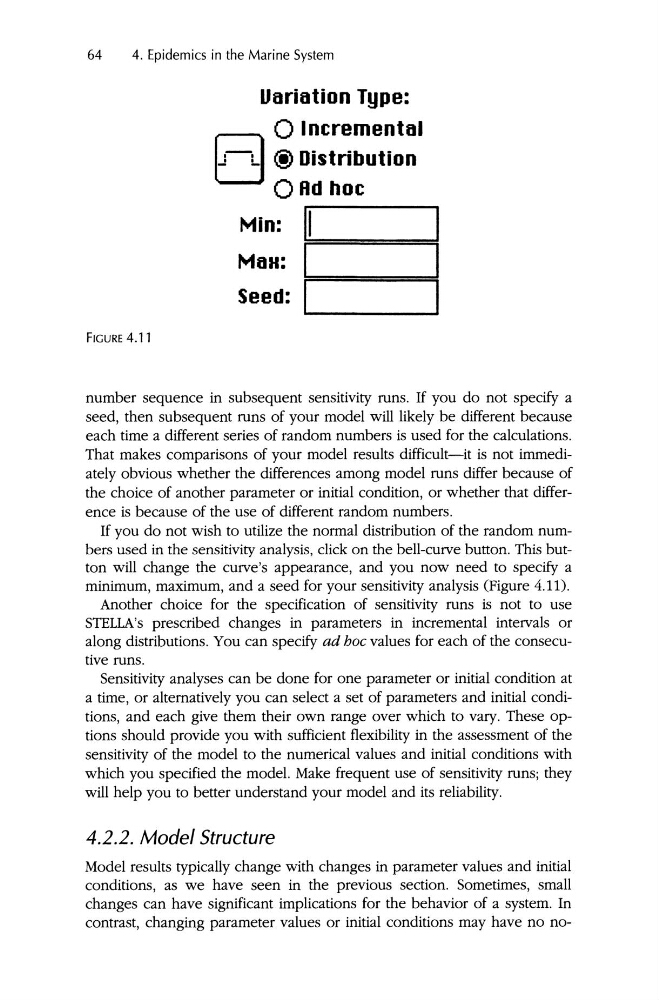
If you do not wish to utilize the normal distribution of the random numbers used in the sensitivity analysis, dick on the bell-curve button. This button will change the curve's appearance, and you now need to specify a
minimum, maximum, and a seed for your sensitivity analysis (Figure 4.11).
Another choice for the specification of sensitivity runs is not to use
STELLA's prescribed changes in parameters in incremental intervals or
along distributions. You can specify ad hoc values for each of the consecutive runs.
Sensitivity analyses can be done for one parameter or initial condition at
a time, or alternatively you can select a set of parameters and initial conditions, and each give them their own range over which to vary. These options should provide you with sufficient flexibility in the assessment of the
sensitivity of the model to the numerical values and initial conditions with
which you specified the model. Make frequent use of sensitivity runs; they
will help you to better understand your model and its reliability.
4.2.2. Model Structure
Model results typically change with changes in parameter values and initial
conditions, as we have seen in the previous section . Sometimes, small
changes can have significant implications for the behavior of a system. In
contrast, changing parameter values or initial conditions may have no no-
4. Epidemics in the Marine System
Uariation Type:
p LI
a Incremental
@ Distribution
a Ad hoc
Min: II
MaH: I
i:i::::=====
F======
Seed: 1 ....
_
FIGURE 4.11
number sequence in subsequent sensitivity runs. If you do not specify a
seed, then subsequent runs of your model will likely be different because
each time a different series of random numbers is used for the calculations.
That makes comparisons of your model results difficult-it is not immediately obvious whether the differences among model runs differ because of
the choice of another parameter or initial condition, or whether that difference is because of the use of different random numbers.
If you do not wish to utilize the normal distribution of the random numbers used in the sensitivity analysis, dick on the bell-curve button. This button will change the curve's appearance, and you now need to specify a
minimum, maximum, and a seed for your sensitivity analysis (Figure 4.11).
Another choice for the specification of sensitivity runs is not to use
STELLA's prescribed changes in parameters in incremental intervals or
along distributions. You can specify ad hoc values for each of the consecutive runs.
Sensitivity analyses can be done for one parameter or initial condition at
a time, or alternatively you can select a set of parameters and initial conditions, and each give them their own range over which to vary. These options should provide you with sufficient flexibility in the assessment of the
sensitivity of the model to the numerical values and initial conditions with
which you specified the model. Make frequent use of sensitivity runs; they
will help you to better understand your model and its reliability.
4.2.2. Model Structure
Model results typically change with changes in parameter values and initial
conditions, as we have seen in the previous section . Sometimes, small
changes can have significant implications for the behavior of a system. In
contrast, changing parameter values or initial conditions may have no no-