

2.2. Closing a Model
27
2.2. Closing a Model
Let us refine the model of the previous section by determining the REPRODUCTION RATE inside the model, rather than postulating it as a parameter
that is given as exogenous, or "from the outside." This process of endogenizing exogenously given parameters is useful if those parameters are
functions of the dynamics of the system itself. A model that has each parameter determined within itself as a function of other entities in the model is
called a "closed" model. In contrast, a model is called "open" if some of the
parameters of the model are exogenously given .
Whether to endogenize a parameter or not depends on whether its value
is influenced by the modeled system components within the time frame of
interest. Let us assume in our humpback whale model of the previous section that the rate of reproduction is a function of population densities . Since
we don't explicitly model the area in which the whales reside , we may assume that the REPRODUCTION RATE is a function of the stock of WHALES.
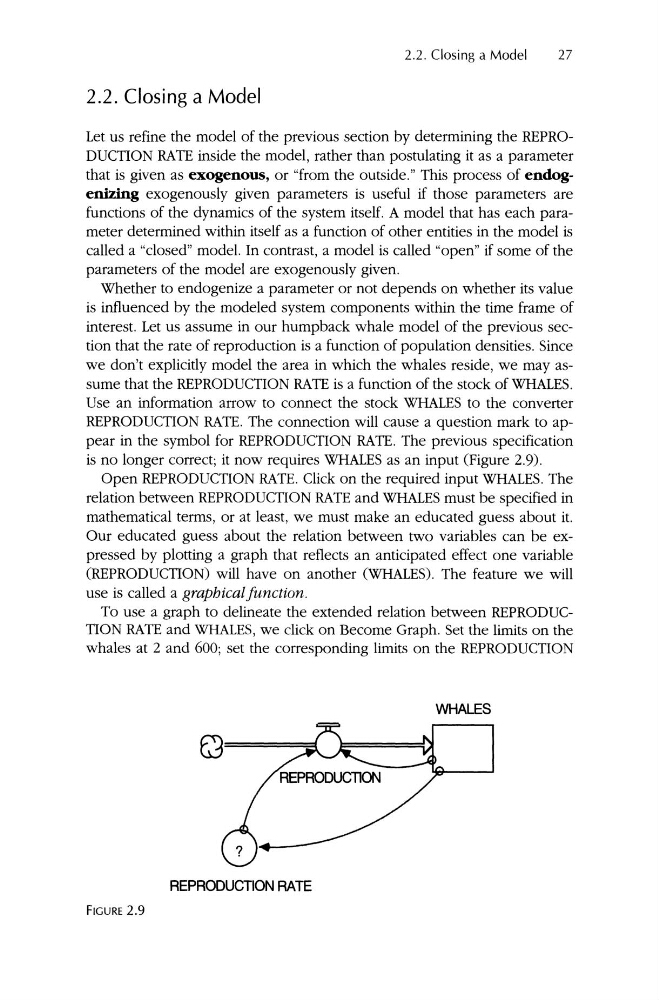
Use an information arrow to connect the stock WHALES to the converter
REPRODUCTION RATE. The connection will cause a question mark to appear in the symbol for REPRODUCTION RATE. The previous specification
is no longer correct ; it now requires WHALES as an input (Figure 2.9).
Open REPRODUCTION RATE. Click on the required input WHALES. The
relation between REPRODUCTION RATE and WHALES must be specified in
mathematical terms, or at least, we must make an educated guess about it.
Our educated guess about the relation between two variables can be expressed by plotting a graph that reflects an anticipated effect one variable
(REPRODUCTION) will have on another (WHALES). The feature we will
use is called a graphical junction.
To use a graph to delineate the extended relation between REPRODUCTION RATE and WHALES, we click on Become Graph . Set the limits on the
whales at 2 and 600; set the corresponding limits on the REPRODUCTION
WHALES
REPRODUCTION RATE
FIGURE 2.9
27
2.2. Closing a Model
Let us refine the model of the previous section by determining the REPRODUCTION RATE inside the model, rather than postulating it as a parameter
that is given as exogenous, or "from the outside." This process of endogenizing exogenously given parameters is useful if those parameters are
functions of the dynamics of the system itself. A model that has each parameter determined within itself as a function of other entities in the model is
called a "closed" model. In contrast, a model is called "open" if some of the
parameters of the model are exogenously given .
Whether to endogenize a parameter or not depends on whether its value
is influenced by the modeled system components within the time frame of
interest. Let us assume in our humpback whale model of the previous section that the rate of reproduction is a function of population densities . Since
we don't explicitly model the area in which the whales reside , we may assume that the REPRODUCTION RATE is a function of the stock of WHALES.
Use an information arrow to connect the stock WHALES to the converter
REPRODUCTION RATE. The connection will cause a question mark to appear in the symbol for REPRODUCTION RATE. The previous specification
is no longer correct ; it now requires WHALES as an input (Figure 2.9).
Open REPRODUCTION RATE. Click on the required input WHALES. The
relation between REPRODUCTION RATE and WHALES must be specified in
mathematical terms, or at least, we must make an educated guess about it.
Our educated guess about the relation between two variables can be expressed by plotting a graph that reflects an anticipated effect one variable
(REPRODUCTION) will have on another (WHALES). The feature we will
use is called a graphical junction.
To use a graph to delineate the extended relation between REPRODUCTION RATE and WHALES, we click on Become Graph . Set the limits on the
whales at 2 and 600; set the corresponding limits on the REPRODUCTION
WHALES
REPRODUCTION RATE
FIGURE 2.9