

396
18. The Global Shrimp Market
2,500
2,000
en
t:
.8
'C
a;
1,500
E
"' 5
en
0
1,000
0
q
0
500
an
I'Cl)
I'Cl)
an
co
co
Cl)
I'Cl)
C')
Cl)
Cl)
.,....
co
co
C')
Cl)
.,....
Cl)
an
Cl)
Cl)
I'Cl)
Cl)
.,....
Cl)
.,.....,....
Cl)
Date
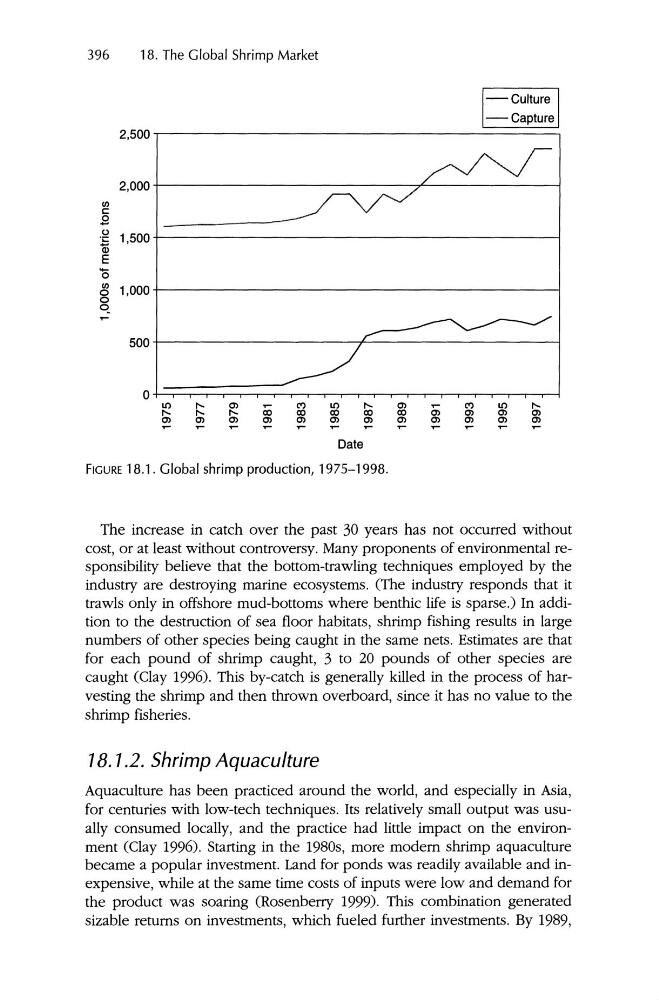
FIGURE 18.1. Global shrimp production, 1975-1998.
The increase in catch over the past 30 years has not occurred without
cost, or at least without controversy. Many proponents of environmental responsibility believe that the bottom-trawling techniques employed by the
industry are destroying marine ecosystems. (The industry responds that it
trawls only in offshore mud-bottoms where benthic life is sparse .) In addition to the destruction of sea floor habitats, shrimp fishing results in large
numbers of other species being caught in the same nets . Estimates are that
for each pound of shrimp caught, 3 to 20 pounds of other species are
caught (Clay 1996). This by-catch is generally killed in the process of harvesting the shrimp and then thrown overboard, since it has no value to the
shrimp fisheries.
78.7.2. Shrimp Aquaculture
Aquaculture has been practiced around the world, and especially in Asia,
for centuries with low-tech techniques. Its relatively small output was usually consumed locally, and the practice had little impact on the environment (Clay 1996). Starting in the 1980s, more modern shrimp aquaculture
became a popular investment. Land for ponds was readily available and inexpensive, while at the same time costs of inputs were low and demand for
the product was soaring (Rosenberry 1999). This combination generated
sizable returns on investments, which fueled further investments. By 1989,
18. The Global Shrimp Market
2,500
2,000
en
t:
.8
'C
a;
1,500
E
"' 5
en
0
1,000
0
q
0
500
an
I'Cl)
I'Cl)
an
co
co
Cl)
I'Cl)
C')
Cl)
Cl)
.,....
co
co
C')
Cl)
.,....
Cl)
an
Cl)
Cl)
I'Cl)
Cl)
.,....
Cl)
.,.....,....
Cl)
Date
FIGURE 18.1. Global shrimp production, 1975-1998.
The increase in catch over the past 30 years has not occurred without
cost, or at least without controversy. Many proponents of environmental responsibility believe that the bottom-trawling techniques employed by the
industry are destroying marine ecosystems. (The industry responds that it
trawls only in offshore mud-bottoms where benthic life is sparse .) In addition to the destruction of sea floor habitats, shrimp fishing results in large
numbers of other species being caught in the same nets . Estimates are that
for each pound of shrimp caught, 3 to 20 pounds of other species are
caught (Clay 1996). This by-catch is generally killed in the process of harvesting the shrimp and then thrown overboard, since it has no value to the
shrimp fisheries.
78.7.2. Shrimp Aquaculture
Aquaculture has been practiced around the world, and especially in Asia,
for centuries with low-tech techniques. Its relatively small output was usually consumed locally, and the practice had little impact on the environment (Clay 1996). Starting in the 1980s, more modern shrimp aquaculture
became a popular investment. Land for ponds was readily available and inexpensive, while at the same time costs of inputs were low and demand for
the product was soaring (Rosenberry 1999). This combination generated
sizable returns on investments, which fueled further investments. By 1989,