

17.3. Hatchery Sector
379
FINANCIAL FLOW
DEBT
NEW DEBTLOSSES
ANNUALPAYMENT
o
INITIALLOAN AMOUNT
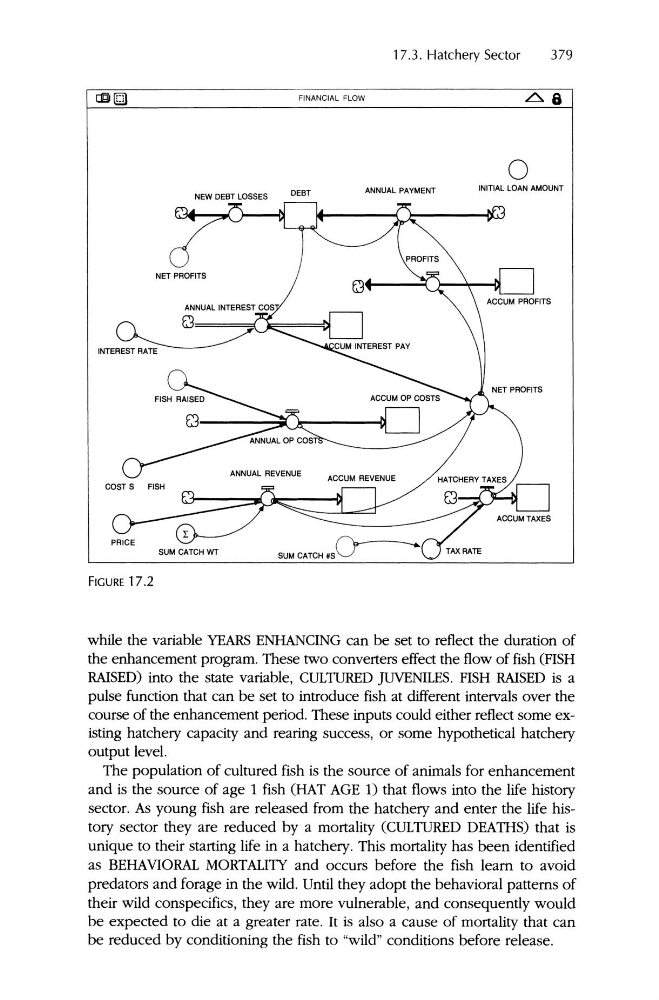
FIGURE 17.2
while the variable YEARS ENHANCING can be set to reflect the duration of
the enhancement program . These two converters effect the flow of fish (FISH
RAISED) into the state variable, CULTIJRED JUVENILES. FISH RAISED is a
pulse function that can be set to introduce fish at different intervals over the
course of the enhancement period . These inputs could either reflect some existing hatchery capacity and rearing success, or some hypothetical hatchery
output level.
The population of cultured fish is the source of animals for enhancement
and is the source of age 1 fish (HAT AGE 1) that flows into the life history
sector . As young fish are released from the hatchery and enter the life history sector they are reduced by a mortality (CULTURED DEATHS) that is
unique to their starting life in a hatchery. This mortality has been identified
as BEHAVIORAL MORTALI1Y and occurs before the fish learn to avoid
predators and forage in the wild. Until they adopt the behavioral patterns of
their wild conspecifics, they are more vulnerable, and consequently would
be expected to die at a greater rate. It is also a cause of mortality that can
be reduced by conditioning the fish to "wild" conditions before release .
379
FINANCIAL FLOW
DEBT
NEW DEBTLOSSES
ANNUALPAYMENT
o
INITIALLOAN AMOUNT
FIGURE 17.2
while the variable YEARS ENHANCING can be set to reflect the duration of
the enhancement program . These two converters effect the flow of fish (FISH
RAISED) into the state variable, CULTIJRED JUVENILES. FISH RAISED is a
pulse function that can be set to introduce fish at different intervals over the
course of the enhancement period . These inputs could either reflect some existing hatchery capacity and rearing success, or some hypothetical hatchery
output level.
The population of cultured fish is the source of animals for enhancement
and is the source of age 1 fish (HAT AGE 1) that flows into the life history
sector . As young fish are released from the hatchery and enter the life history sector they are reduced by a mortality (CULTURED DEATHS) that is
unique to their starting life in a hatchery. This mortality has been identified
as BEHAVIORAL MORTALI1Y and occurs before the fish learn to avoid
predators and forage in the wild. Until they adopt the behavioral patterns of
their wild conspecifics, they are more vulnerable, and consequently would
be expected to die at a greater rate. It is also a cause of mortality that can
be reduced by conditioning the fish to "wild" conditions before release .