

364
16. Managementof the Commons
N
Fd
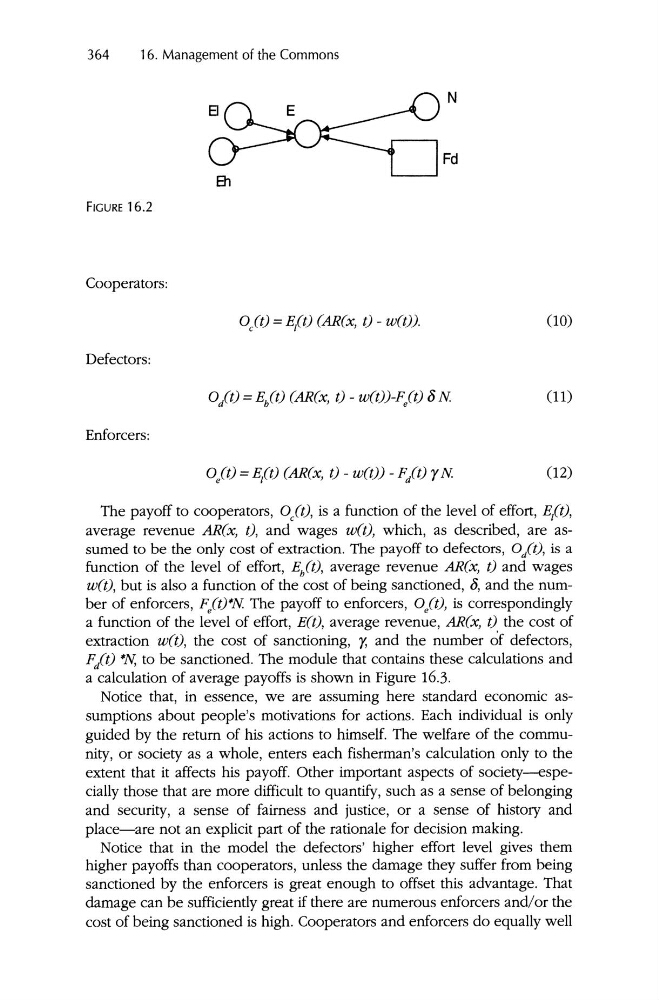
FIGURE 16.2
Cooperators:
0/0 =E/O (AR(x, 0 - w(O).
(0)
Defectors :
0iO =ElO (AR(x, 0 - w(tJ)-F/O 0 N
(11)
Enforcers:
0/0 =E/O (AR(x, 0 - w(tJ) - FiO r N
(2)
The payoff to cooperators, 0/0, is a function of the level of effort, E/O,
average revenue AR(x, 0, and wages uxt), which, as described, are assumed to be the only cost of extraction. The payoff to defectors, 0d(O, is a
function of the level of effort, Eb(tJ, average revenue AR(x, 0 and wages
uxt), but is also a function of the cost of being sanctioned, 0, and the number of enforcers, F/OW The payoff to enforcers, 0/0, is correspondingly
a function of the level of effort, E(tJ, average revenue, AR(x, 0 the cost of
extraction uxt), the cost of sanctioning, y, and the number of defectors,
Fd(tJ *N, to be sanctioned. The module that contains these calculations and
a calculation of average payoffs is shown in Figure 16.3.
Notice that, in essence, we are assuming here standard economic assumptions about people's motivations for actions. Each individual is only
guided by the return of his actions to himself. The welfare of the community, or society as a whole, enters each fisherman 's calculation only to the
extent that it affects his payoff. Other important aspects of society-especially those that are more difficult to quantify, such as a sense of belonging
and security, a sense of fairness and justice, or a sense of history and
place-are not an explicit part of the rationale for decision making .
Notice that in the model the defectors' higher effort level gives them
higher payoffs than cooperators, unless the damage they suffer from being
sanctioned by the enforcers is great enough to offset this advantage. That
damage can be sufficiently great if there are numerous enforcers and /or the
cost of being sanctioned is high. Cooperators and enforcers do equally well
16. Managementof the Commons
N
Fd
FIGURE 16.2
Cooperators:
0/0 =E/O (AR(x, 0 - w(O).
(0)
Defectors :
0iO =ElO (AR(x, 0 - w(tJ)-F/O 0 N
(11)
Enforcers:
0/0 =E/O (AR(x, 0 - w(tJ) - FiO r N
(2)
The payoff to cooperators, 0/0, is a function of the level of effort, E/O,
average revenue AR(x, 0, and wages uxt), which, as described, are assumed to be the only cost of extraction. The payoff to defectors, 0d(O, is a
function of the level of effort, Eb(tJ, average revenue AR(x, 0 and wages
uxt), but is also a function of the cost of being sanctioned, 0, and the number of enforcers, F/OW The payoff to enforcers, 0/0, is correspondingly
a function of the level of effort, E(tJ, average revenue, AR(x, 0 the cost of
extraction uxt), the cost of sanctioning, y, and the number of defectors,
Fd(tJ *N, to be sanctioned. The module that contains these calculations and
a calculation of average payoffs is shown in Figure 16.3.
Notice that, in essence, we are assuming here standard economic assumptions about people's motivations for actions. Each individual is only
guided by the return of his actions to himself. The welfare of the community, or society as a whole, enters each fisherman 's calculation only to the
extent that it affects his payoff. Other important aspects of society-especially those that are more difficult to quantify, such as a sense of belonging
and security, a sense of fairness and justice, or a sense of history and
place-are not an explicit part of the rationale for decision making .
Notice that in the model the defectors' higher effort level gives them
higher payoffs than cooperators, unless the damage they suffer from being
sanctioned by the enforcers is great enough to offset this advantage. That
damage can be sufficiently great if there are numerous enforcers and /or the
cost of being sanctioned is high. Cooperators and enforcers do equally well