

322
14. Dynamics of Multiple Fish Species
The model indicates drastic decrease s in population sizes that start before the turn of the century, and ultimately lead to the collapse of the fishery as catch and biomass are nearly equal in size. The effect that technological change has on fish population sizes is reduced in the light of
population effects on catchability. The biological collapse of the fishery
will be delayed if catchability declines as populations decline. However ,
economic collapse is likely to be experienced well before fish populations
are depleted.
Collapse of the fishery is taken here as the eradication of at least one of
the three popul ations from the ecosystem. Eradication of individual populations from Georges Bank is not unpre cedented. Herring, once abundant
on Georges Bank, virtually disappeared by the 1970s in response to increased fishing pressure. Once one species is lost, the computer model is
stopped because from that point onward interspecies relations are fundamentally altered and projections for the fate of the remaining populations
cannot be made in a meaningful way. We return to this issue below.
Reductions in the spawning stock biomass are accompanied by changes
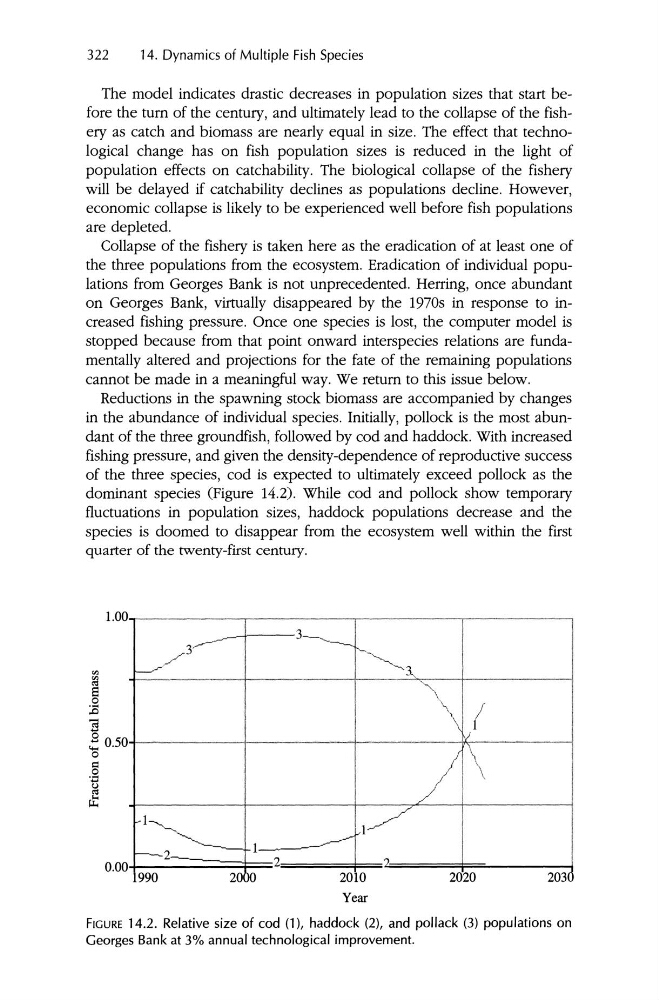
in the abund ance of individual species. Initially, pollock is the most abundant of the three groundfish, followed by cod and haddock. With increased
fishing pressure, and given the density-dependence of reproductive success
of the three species, cod is expected to ultimately exceed pollock as the
dominant species (Figure 14.2). While cod and pollock show temporary
fluctuations in population sizes, haddock populations decrease and the
species is doomed to disappear from the ecosystem well within the first
quarter of the twenty-first century.
1.00
/ 3
I--""
til
§
:0
'5
0.50
o
.g
g
3_____________
1'-,
" --1,
" \
\ 'If
/
\
\
1
--:1:
1
0.00
2
990
20 )0
2010
20'20
203d
Year
FIGURE 14.2. Relative size of cod (1), haddock (2), and pollack (3) populations on
Georges Bank at 3% annual technological improvement.
\
14. Dynamics of Multiple Fish Species
The model indicates drastic decrease s in population sizes that start before the turn of the century, and ultimately lead to the collapse of the fishery as catch and biomass are nearly equal in size. The effect that technological change has on fish population sizes is reduced in the light of
population effects on catchability. The biological collapse of the fishery
will be delayed if catchability declines as populations decline. However ,
economic collapse is likely to be experienced well before fish populations
are depleted.
Collapse of the fishery is taken here as the eradication of at least one of
the three popul ations from the ecosystem. Eradication of individual populations from Georges Bank is not unpre cedented. Herring, once abundant
on Georges Bank, virtually disappeared by the 1970s in response to increased fishing pressure. Once one species is lost, the computer model is
stopped because from that point onward interspecies relations are fundamentally altered and projections for the fate of the remaining populations
cannot be made in a meaningful way. We return to this issue below.
Reductions in the spawning stock biomass are accompanied by changes
in the abund ance of individual species. Initially, pollock is the most abundant of the three groundfish, followed by cod and haddock. With increased
fishing pressure, and given the density-dependence of reproductive success
of the three species, cod is expected to ultimately exceed pollock as the
dominant species (Figure 14.2). While cod and pollock show temporary
fluctuations in population sizes, haddock populations decrease and the
species is doomed to disappear from the ecosystem well within the first
quarter of the twenty-first century.
1.00
/ 3
I--""
til
§
:0
'5
0.50
o
.g
g
3_____________
1'-,
" --1,
" \
\ 'If
/
\
\
1
--:1:
1
0.00
2
990
20 )0
2010
20'20
203d
Year
FIGURE 14.2. Relative size of cod (1), haddock (2), and pollack (3) populations on
Georges Bank at 3% annual technological improvement.
\