

14.3. Key Parameters, Initi al Condi tio ns and Assumptio ns
3 19
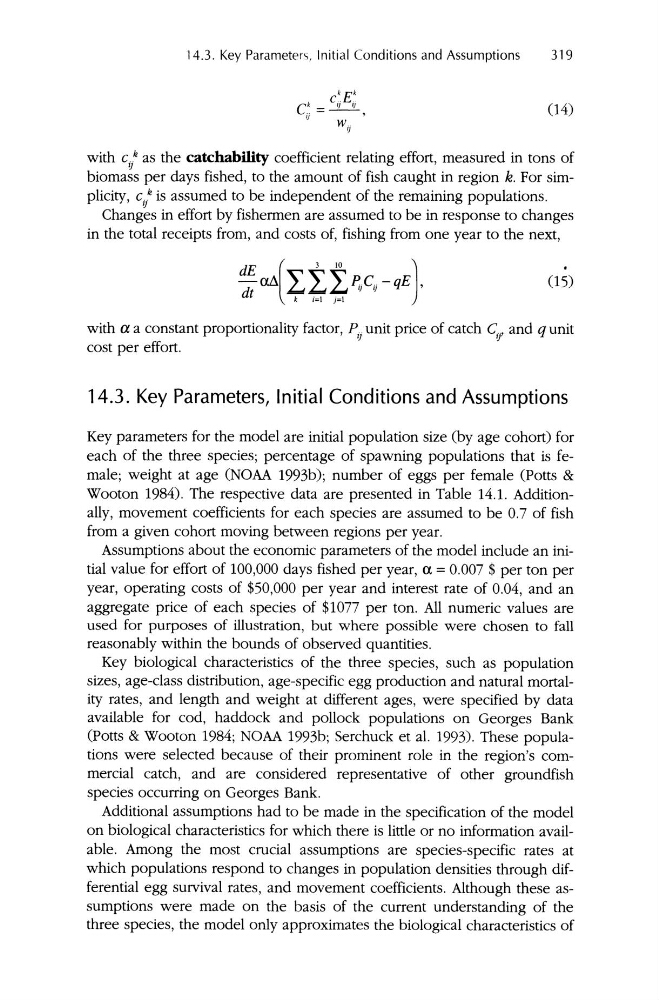
with G/ as the catchabllity coefficient relating effort, measured in tons of
i
biomass per days fished , to the amou nt of fish caught in region k. For simplicity, G ; / is assumed to be independent of the remaining populations.
Changes in effort by fishermen are assumed to be in response to changes
in the total receipts from, and costs of, fishing from one year to the next ,
OS)
with a a constant proportionality factor, Pij unit price of catch Cif and q unit
cost per effort.
14.3. Key Parameters, Initial Conditions and Assumptions
Key parameters for the model are initial popul ation size (by age cohort) for
each of the three species; percentage of spawning popul ations that is female; weight at age (NOAA 1993b); number of eggs per female (Potts &
Wooton 1984). The respective data are presented in Table 14.1. Additionally, movement coefficients for each species are assumed to be 0.7 of fish
from a given cohort moving between regions per year.
Assumptions abo ut the economic parameters of the model include an initial value for effort of 100,000 days fished per year, a =0.007 $ per ton per
year, ope rating costs of $50,000 per year and interest rate of 0.04, and an
aggregate price of each species of $1077 per ton . All numeric values are
used for purposes of illustration , but where possible were chosen to fall
reasonably within the bounds of obse rved quantities.
Key biological characteristics of the three species , such as populati on
sizes, age-class distribution , age-specific egg produ ction and natural mortality rates, and length and weight at different ages, were specified by data
available for cod, haddock and pollock popul ations on Georges Bank
(Potts & Wooton 1984; NOAA 1993b; Serchuck et al. 1993). These populations were selected because of their prominent role in the region 's commercial catch, and are conside red repre sentative of other groundfish
species occurring on Georges Bank.
Additional assumptions had to be made in the specification of the mod el
on biological characteristics for which there is little or no information available. Among the most crucial assumptions are species-specific rates at
which populations respond to changes in popul ation densities through differential egg survival rates, and movement coefficients. Although these assumptions were made on the basis of the current und erstand ing of the
three species, the model only approximates the biological characteristics of
3 19
with G/ as the catchabllity coefficient relating effort, measured in tons of
i
biomass per days fished , to the amou nt of fish caught in region k. For simplicity, G ; / is assumed to be independent of the remaining populations.
Changes in effort by fishermen are assumed to be in response to changes
in the total receipts from, and costs of, fishing from one year to the next ,
OS)
with a a constant proportionality factor, Pij unit price of catch Cif and q unit
cost per effort.
14.3. Key Parameters, Initial Conditions and Assumptions
Key parameters for the model are initial popul ation size (by age cohort) for
each of the three species; percentage of spawning popul ations that is female; weight at age (NOAA 1993b); number of eggs per female (Potts &
Wooton 1984). The respective data are presented in Table 14.1. Additionally, movement coefficients for each species are assumed to be 0.7 of fish
from a given cohort moving between regions per year.
Assumptions abo ut the economic parameters of the model include an initial value for effort of 100,000 days fished per year, a =0.007 $ per ton per
year, ope rating costs of $50,000 per year and interest rate of 0.04, and an
aggregate price of each species of $1077 per ton . All numeric values are
used for purposes of illustration , but where possible were chosen to fall
reasonably within the bounds of obse rved quantities.
Key biological characteristics of the three species , such as populati on
sizes, age-class distribution , age-specific egg produ ction and natural mortality rates, and length and weight at different ages, were specified by data
available for cod, haddock and pollock popul ations on Georges Bank
(Potts & Wooton 1984; NOAA 1993b; Serchuck et al. 1993). These populations were selected because of their prominent role in the region 's commercial catch, and are conside red repre sentative of other groundfish
species occurring on Georges Bank.
Additional assumptions had to be made in the specification of the mod el
on biological characteristics for which there is little or no information available. Among the most crucial assumptions are species-specific rates at
which populations respond to changes in popul ation densities through differential egg survival rates, and movement coefficients. Although these assumptions were made on the basis of the current und erstand ing of the
three species, the model only approximates the biological characteristics of