

16
1. Introduction
is useful in helping us make decisions. If, for example, the system exhibits
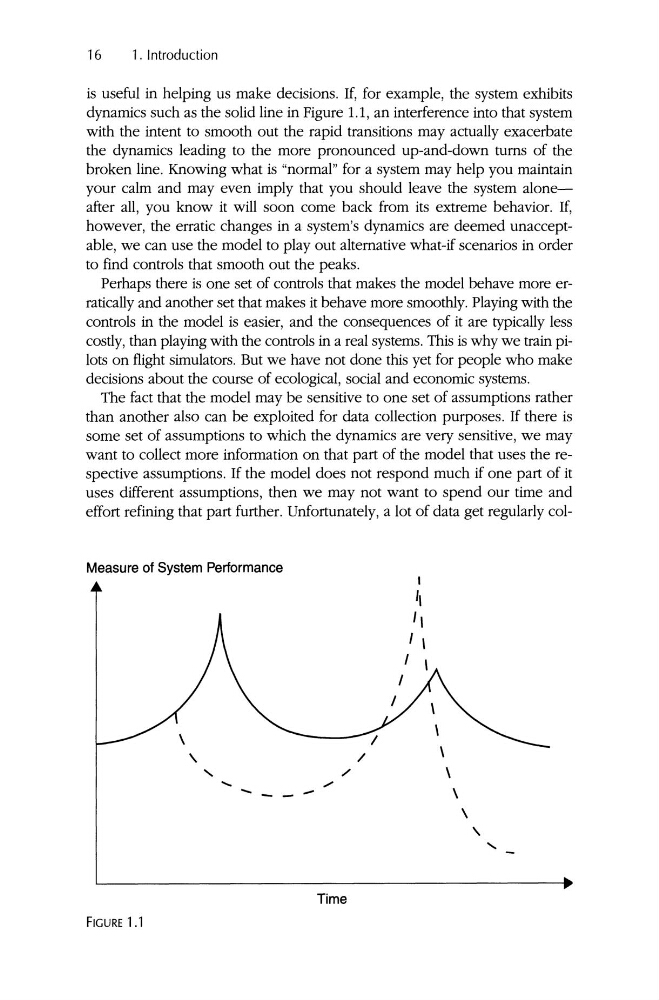
dynamics such as the solid line in Figure 1.1, an interference into that system
with the intent to smooth out the rapid transitions may actually exacerbate
the dynamics leading to the more pronounced up-and-down turns of the
broken line. Knowing what is "normal" for a system may help you maintain
your calm and may even imply that you should leave the system aloneafter all, you know it will soon come back from its extreme behavior. If,
however, the erratic changes in a system's dynamics are deemed unacceptable, we can use the model to play out alternative what-if scenarios in order
to find controls that smooth out the peaks.
Perhaps there is one set of controls that makes the model behave more erratically and another set that makes it behave more smoothly. Playingwith the
controls in the model is easier, and the consequences of it are typically less
costly, than playing with the controls in a real systems. This is why we train pilots on flight simulators. But we have not done this yet for people who make
decisions about the course of ecological, social and economic systems.
The fact that the model may be sensitive to one set of assumptions rather
than another also can be exploited for data collection purposes. If there is
some set of assumptions to which the dynamics are very sensitive, we may
want to collect more information on that part of the model that uses the respective assumptions. If the model does not respond much if one part of it
uses different assumptions, then we may not want to spend our time and
effort refining that part further. Unfortunately, a lot of data get regularly colMeasure of System Performance
I
"
I ,
"
I ,
I
/
........ __ ......
Time
FIGURE 1.1
1. Introduction
is useful in helping us make decisions. If, for example, the system exhibits
dynamics such as the solid line in Figure 1.1, an interference into that system
with the intent to smooth out the rapid transitions may actually exacerbate
the dynamics leading to the more pronounced up-and-down turns of the
broken line. Knowing what is "normal" for a system may help you maintain
your calm and may even imply that you should leave the system aloneafter all, you know it will soon come back from its extreme behavior. If,
however, the erratic changes in a system's dynamics are deemed unacceptable, we can use the model to play out alternative what-if scenarios in order
to find controls that smooth out the peaks.
Perhaps there is one set of controls that makes the model behave more erratically and another set that makes it behave more smoothly. Playingwith the
controls in the model is easier, and the consequences of it are typically less
costly, than playing with the controls in a real systems. This is why we train pilots on flight simulators. But we have not done this yet for people who make
decisions about the course of ecological, social and economic systems.
The fact that the model may be sensitive to one set of assumptions rather
than another also can be exploited for data collection purposes. If there is
some set of assumptions to which the dynamics are very sensitive, we may
want to collect more information on that part of the model that uses the respective assumptions. If the model does not respond much if one part of it
uses different assumptions, then we may not want to spend our time and
effort refining that part further. Unfortunately, a lot of data get regularly colMeasure of System Performance
I
"
I ,
"
I ,
I
/
........ __ ......
Time
FIGURE 1.1