

13.2. The Model
273
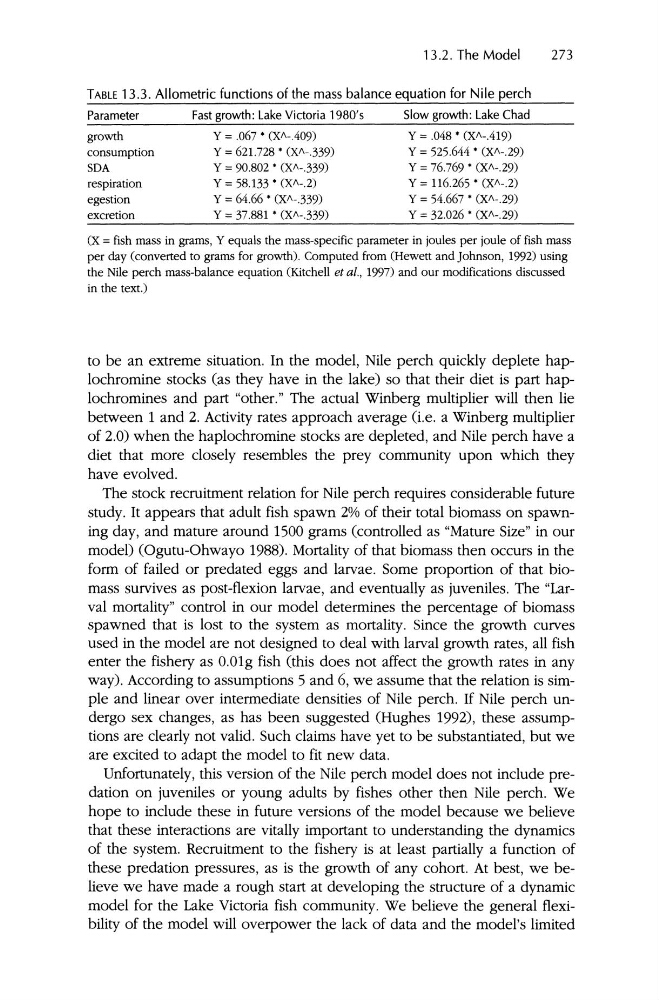
Parameter
growth
consumption
SDA
respiration
egestion
excretion
Fast growth: LakeVictoria 1980's
Y = .067 • (XA-.409)
Y = 621.728 • (XA-.339)
Y = 90.802 • (XA-.339)
Y = 58.133 • (XA-.2)
Y =64.66 • (XA-.339)
Y = 37.881 • (XA-.339)
Slow growth: LakeChad
Y = .048 • (XA-.419)
Y = 525.644 • (XA-.29)
Y = 76.769 • (XA-.29)
Y = 116.265 • (XA-.2)
Y =54.667 • (XA-.29)
Y = 32.026 • (XA-.29)
(X =fish mass in grams, Y equals the mass-specific parameter in joules per joule of fish mass
per day (converted to grams for growth) . Computed from (Hewett and Johnson, 1992) using
the Nile perch mass-balance equation (Kitchell et al., 1997) and our modifications discussed
in the text.)
to be an extreme situation . In the model , Nile perch quickly deplete haplochromine stocks (as they have in the lake) so that their diet is part haplochromines and part "other." The actual Winberg multiplier will then lie
between 1 and 2. Activity rates approach average (i.e. a Winberg multiplier
of 2.0) when the haplochromine stocks are depleted, and Nile perch have a
diet that more closely resembles the prey community upon which they
have evolved.
The stock recruitment relation for Nile perch requires considerable future
study . It appears that adult fish spawn 2% of their total biomass on spawning day, and mature around 1500 grams (controlled as "Mature Size" in our
model) (Ogutu-Ohwayo 1988). Mortality of that biomass then occurs in the
form of failed or predated eggs and larvae. Some proportion of that biomass survives as post-flexion larvae, and eventually as juveniles. The "Larval mortality" control in our model determines the percentage of biomass
spawned that is lost to the system as mortality. Since the growth curves
used in the model are not designed to deal with larval growth rates , all fish
enter the fishery as O.Olg fish (this does not affect the growth rates in any
way) . According to assumptions 5 and 6, we assume that the relation is simple and linear over intermediate densities of Nile perch. If Nile perch undergo sex changes, as has been suggested (Hughes 1992), these assumptions are clearly not valid. Such claims have yet to be substantiated, but we
are excited to adapt the model to fit new data .
Unfortunately, this version of the Nile perch model does not include predation on juveniles or young adults by fishes other then Nile perch. We
hope to include these in future versions of the model because we believe
that these interactions are vitally important to understanding the dynamics
of the system. Recruitment to the fishery is at least partially a function of
these predation pressures, as is the growth of any cohort. At best , we believe we have made a rough start at developing the structure of a dynamic
model for the Lake Victoria fish community. We believe the general flexibility of the model will overpower the lack of data and the model 's limited
273
Parameter
growth
consumption
SDA
respiration
egestion
excretion
Fast growth: LakeVictoria 1980's
Y = .067 • (XA-.409)
Y = 621.728 • (XA-.339)
Y = 90.802 • (XA-.339)
Y = 58.133 • (XA-.2)
Y =64.66 • (XA-.339)
Y = 37.881 • (XA-.339)
Slow growth: LakeChad
Y = .048 • (XA-.419)
Y = 525.644 • (XA-.29)
Y = 76.769 • (XA-.29)
Y = 116.265 • (XA-.2)
Y =54.667 • (XA-.29)
Y = 32.026 • (XA-.29)
(X =fish mass in grams, Y equals the mass-specific parameter in joules per joule of fish mass
per day (converted to grams for growth) . Computed from (Hewett and Johnson, 1992) using
the Nile perch mass-balance equation (Kitchell et al., 1997) and our modifications discussed
in the text.)
to be an extreme situation . In the model , Nile perch quickly deplete haplochromine stocks (as they have in the lake) so that their diet is part haplochromines and part "other." The actual Winberg multiplier will then lie
between 1 and 2. Activity rates approach average (i.e. a Winberg multiplier
of 2.0) when the haplochromine stocks are depleted, and Nile perch have a
diet that more closely resembles the prey community upon which they
have evolved.
The stock recruitment relation for Nile perch requires considerable future
study . It appears that adult fish spawn 2% of their total biomass on spawning day, and mature around 1500 grams (controlled as "Mature Size" in our
model) (Ogutu-Ohwayo 1988). Mortality of that biomass then occurs in the
form of failed or predated eggs and larvae. Some proportion of that biomass survives as post-flexion larvae, and eventually as juveniles. The "Larval mortality" control in our model determines the percentage of biomass
spawned that is lost to the system as mortality. Since the growth curves
used in the model are not designed to deal with larval growth rates , all fish
enter the fishery as O.Olg fish (this does not affect the growth rates in any
way) . According to assumptions 5 and 6, we assume that the relation is simple and linear over intermediate densities of Nile perch. If Nile perch undergo sex changes, as has been suggested (Hughes 1992), these assumptions are clearly not valid. Such claims have yet to be substantiated, but we
are excited to adapt the model to fit new data .
Unfortunately, this version of the Nile perch model does not include predation on juveniles or young adults by fishes other then Nile perch. We
hope to include these in future versions of the model because we believe
that these interactions are vitally important to understanding the dynamics
of the system. Recruitment to the fishery is at least partially a function of
these predation pressures, as is the growth of any cohort. At best , we believe we have made a rough start at developing the structure of a dynamic
model for the Lake Victoria fish community. We believe the general flexibility of the model will overpower the lack of data and the model 's limited