

260
13. Nile Perch Population Dynamics in Lake Victoria :
the Nile perch population is being lost as heat due to the changes in the prey
community. Both fishery managers and conservation biologists should be disappointed with this end-point. Most are not even aware of it. Instead, managers are attempting to manage the system as a three-species fishery, allowing Nile perch to inefficiently dominate, and perhaps even assuming that Nile
perch and the Nile perch population might both be growing at the same rate
they did during the initial boom .
Might the gain in productivity of keeping Nile perch populations in
check (and thus allowing for large haplochromine populations to persist)
outweigh the benefits of allowing Nile perch populations to explode? If
populations are not kept in check , growth rates will be lower (Hughes
1992; Ogutu-Ohwayo 1999), and the loss of haplochromine stocks is inevitable. The fishery is vital to the economy of East Africa, and to the feeding of its people. Is there a management regime that will address the concerns of both conservation biologists and fishery managers?
We have developed a mass-balance dynamic pool model for Nile perch
to begin to investigate these questions. "Pool model " is the classic term for
models wherein stocks are represented as sinks of biomass between which
energy (mass) can be transferred. Our model allows the user to determine
the relative consequences of various management decisions for a hypothetical community . The model's performance suggests that the sustainability
and productivity of the fishery are dependant upon conservation focus of
the management regime. They also suggest that managers must be highly
adaptive if wild and expensive swings in the fishery are to be avoided .
13.2. The Model
73.2.7. Model Structure and Development
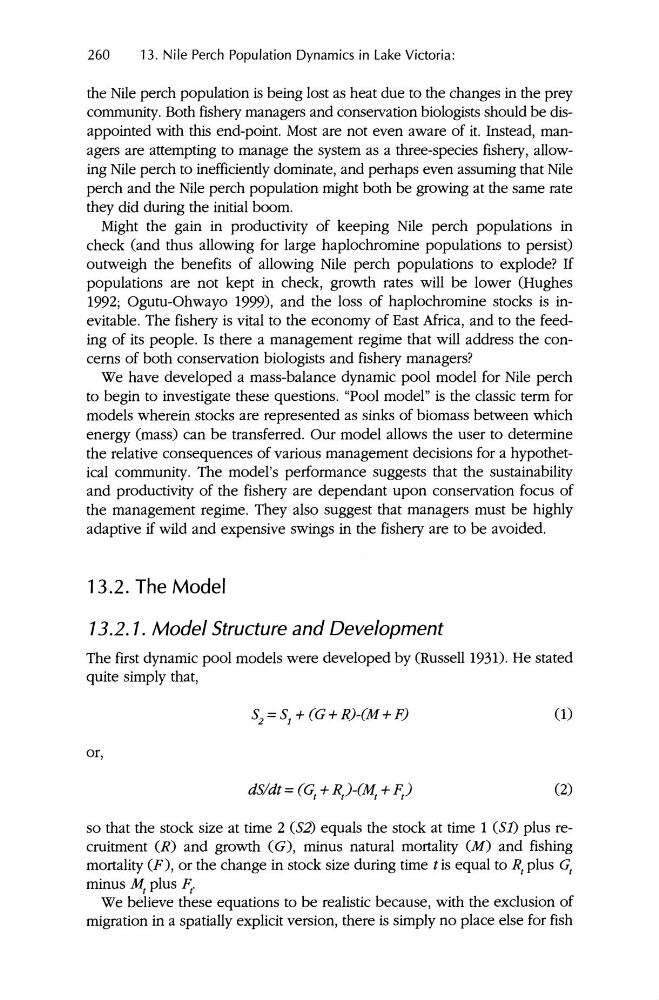
The first dynamic pool models were developed by (Russell 1931). He stated
quite simply that,
5 2=51 + (G+R)-(M +F)
(1)
or,
ds/dt =(G t + R,J-(M, + F,)
(2)
so that the stock size at time 2 (52) equals the stock at time 1 (51) plus recruitment (R) and growth (G) , minus natural mortality (M) and fishing
mortality (F), or the change in stock size during time t is equal to R,plus G,
minus M, plus F,.
We believe these equations to be realistic because, with the exclusion of
migration in a spatially explicit version, there is simply no place else for fish
13. Nile Perch Population Dynamics in Lake Victoria :
the Nile perch population is being lost as heat due to the changes in the prey
community. Both fishery managers and conservation biologists should be disappointed with this end-point. Most are not even aware of it. Instead, managers are attempting to manage the system as a three-species fishery, allowing Nile perch to inefficiently dominate, and perhaps even assuming that Nile
perch and the Nile perch population might both be growing at the same rate
they did during the initial boom .
Might the gain in productivity of keeping Nile perch populations in
check (and thus allowing for large haplochromine populations to persist)
outweigh the benefits of allowing Nile perch populations to explode? If
populations are not kept in check , growth rates will be lower (Hughes
1992; Ogutu-Ohwayo 1999), and the loss of haplochromine stocks is inevitable. The fishery is vital to the economy of East Africa, and to the feeding of its people. Is there a management regime that will address the concerns of both conservation biologists and fishery managers?
We have developed a mass-balance dynamic pool model for Nile perch
to begin to investigate these questions. "Pool model " is the classic term for
models wherein stocks are represented as sinks of biomass between which
energy (mass) can be transferred. Our model allows the user to determine
the relative consequences of various management decisions for a hypothetical community . The model's performance suggests that the sustainability
and productivity of the fishery are dependant upon conservation focus of
the management regime. They also suggest that managers must be highly
adaptive if wild and expensive swings in the fishery are to be avoided .
13.2. The Model
73.2.7. Model Structure and Development
The first dynamic pool models were developed by (Russell 1931). He stated
quite simply that,
5 2=51 + (G+R)-(M +F)
(1)
or,
ds/dt =(G t + R,J-(M, + F,)
(2)
so that the stock size at time 2 (52) equals the stock at time 1 (51) plus recruitment (R) and growth (G) , minus natural mortality (M) and fishing
mortality (F), or the change in stock size during time t is equal to R,plus G,
minus M, plus F,.
We believe these equations to be realistic because, with the exclusion of
migration in a spatially explicit version, there is simply no place else for fish