

10.2. Life-Stage-Based Invertebrate M odel
199
PJUVENILES
P JUV IMMIGRANTS l = ====l
PADULT
P MATURE IMMIGRANT ADULTS :===:::
P ADULT IMMIGRANTS
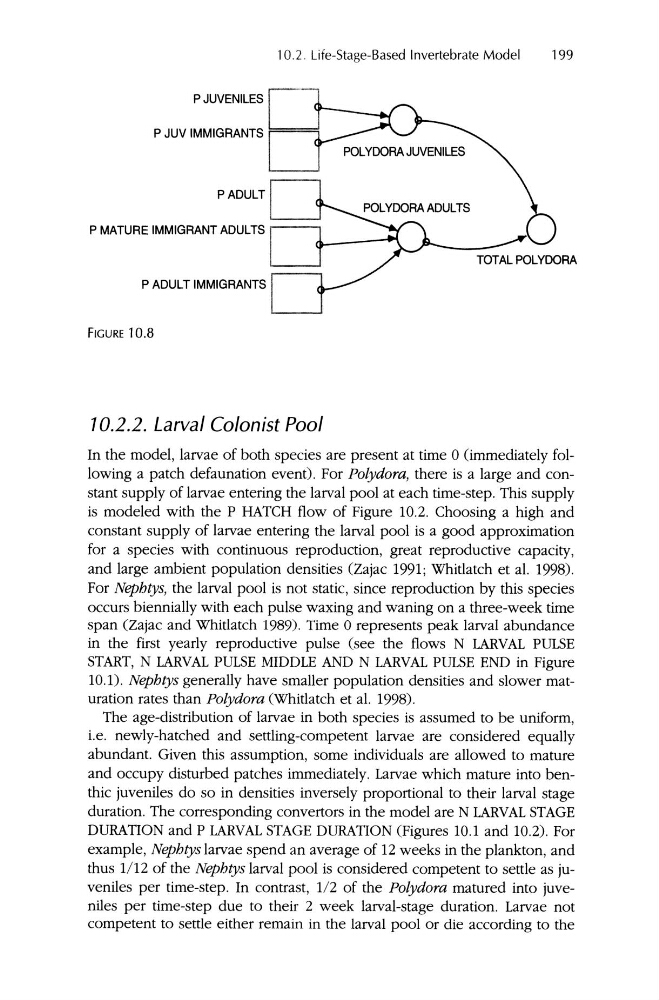
FIGURE 10.8
10.2.2. Larval Colonist Pool
In the model , larvae of both species are present at time 0 (immediatel y following a patch defaun ation event). For Polydora, there is a large and constant supply of larvae entering the larval pool at each time-step . This supply
is modeled with the P HATCH flow of Figure 10.2. Choos ing a high and
constant supply of larvae entering the larval pool is a good approximation
for a species with continuous reproduc tion, great reproductive capacity,
and large ambient popul ation de nsities (Zajac 1991; Whitlatch et al. 1998).
For Nepbtys, the larval pool is not static, since rep roduction by this species
occurs biennially with each pulse waxing and waning on a three-week time
span (Zajac and Whitlatch 1989). Time 0 represents peak larval abundance
in the first yearly reproductive pulse (see the flows N LARVAL PULSE
START, N LARVAL PULSE MIDDLE AND N LARVAL PULSE END in Figure
10.1). Nep btys generally have smaller popul ation densities and slower maturation rates than Polydora (Whitlatch et al. 1998).
The age-distribution of larvae in both species is assumed to be uniform ,
i.e. newly-hatched and settling-competent larvae are considered equally
abundant. Given this assumption, some individuals are allowe d to mature
and occupy disturbed patches immediately. Larvae which mature into benthic juveniles do so in densities inversely proportional to their larval stage
duration . The correspo nding convertors in the model are N LARVAL STAGE
DURATION and P LARVAL STAGE DURATION (Figures 10.1 and 10.2). For
example, Nepbtys larvae spe nd an average of 12 weeks in the plankton , and
thus 1/ 12 of the Nepbtys larval pool is considered competent to settle as juveniles per time-step . In contrast, 1/2 of the Poly dora matured into juveniles per time-step due to their 2 week larval-stage duration. Larvae not
compe tent to settle either remain in the larval pool or die according to the
199
PJUVENILES
P JUV IMMIGRANTS l = ====l
PADULT
P MATURE IMMIGRANT ADULTS :===:::
P ADULT IMMIGRANTS
FIGURE 10.8
10.2.2. Larval Colonist Pool
In the model , larvae of both species are present at time 0 (immediatel y following a patch defaun ation event). For Polydora, there is a large and constant supply of larvae entering the larval pool at each time-step . This supply
is modeled with the P HATCH flow of Figure 10.2. Choos ing a high and
constant supply of larvae entering the larval pool is a good approximation
for a species with continuous reproduc tion, great reproductive capacity,
and large ambient popul ation de nsities (Zajac 1991; Whitlatch et al. 1998).
For Nepbtys, the larval pool is not static, since rep roduction by this species
occurs biennially with each pulse waxing and waning on a three-week time
span (Zajac and Whitlatch 1989). Time 0 represents peak larval abundance
in the first yearly reproductive pulse (see the flows N LARVAL PULSE
START, N LARVAL PULSE MIDDLE AND N LARVAL PULSE END in Figure
10.1). Nep btys generally have smaller popul ation densities and slower maturation rates than Polydora (Whitlatch et al. 1998).
The age-distribution of larvae in both species is assumed to be uniform ,
i.e. newly-hatched and settling-competent larvae are considered equally
abundant. Given this assumption, some individuals are allowe d to mature
and occupy disturbed patches immediately. Larvae which mature into benthic juveniles do so in densities inversely proportional to their larval stage
duration . The correspo nding convertors in the model are N LARVAL STAGE
DURATION and P LARVAL STAGE DURATION (Figures 10.1 and 10.2). For
example, Nepbtys larvae spe nd an average of 12 weeks in the plankton , and
thus 1/ 12 of the Nepbtys larval pool is considered competent to settle as juveniles per time-step . In contrast, 1/2 of the Poly dora matured into juveniles per time-step due to their 2 week larval-stage duration. Larvae not
compe tent to settle either remain in the larval pool or die according to the