

9.3. Plant Model Simulations
175
3 .0 =corrects for the skewed distribution of distance
between nodes on the rhizomes (per day)
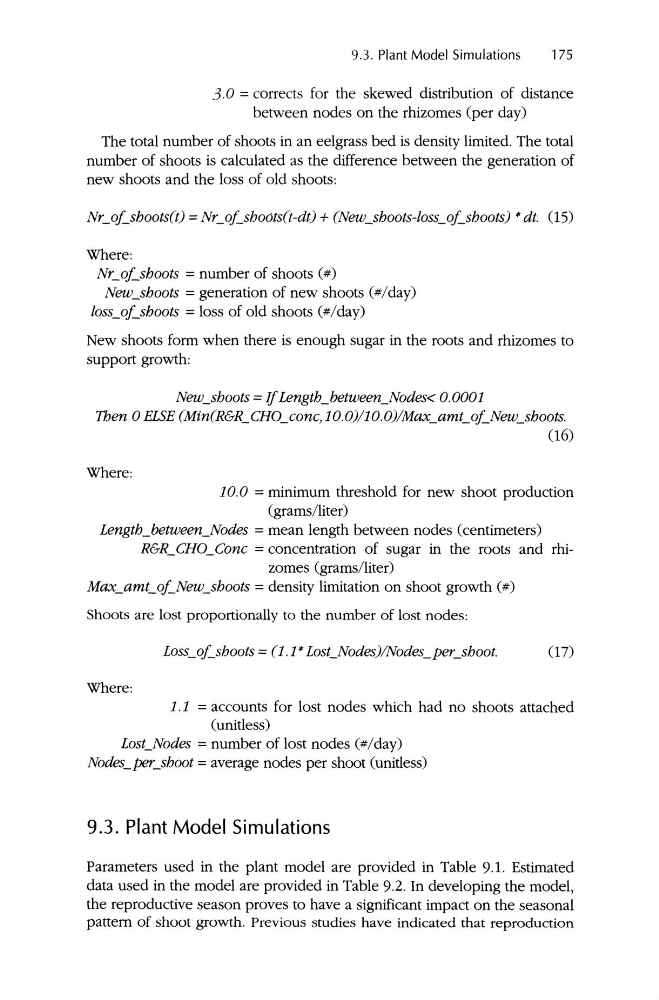
The total number of shoots in an eelgrass bed is density limited. The total
number of shoots is calculated as the difference between the generation of
new shoots and the loss of old shoots :
Nr_oLshoots(tJ =Nrofshootsct-dt) + (Neio sboots-Ioss ofsboots) *dt. (15)
Where :
Nrofsboots = number of shoots (#)
New_shoots =generation of new shoots (#/day)
loss cfsboots =loss of old shoots (#/day)
New shoots form when there is enough sugar in the roots and rhizomes to
support growth :
New_shoots =IfLength_between_Nodes< 0.0001
Then 0 ELSE (Min(R&R_CHOJonc, 10 .0)/1 O.O)/Max_amcoLNew_shoots.
(16)
Where :
10.0 = minimum threshold for new shoot production
(grams/liter)
Length_between_Nodes = mean length between nodes (centimeters)
R&R_CHO_Conc =concentration of sugar in the roots and rhizomes (grams/liter)
Max_amCoLNew_shoots =density limitation on shoot growth (#)
Shoots are lost proportionally to the number of lost nodes :
Loss_ofsboots =0 .1*LostNodesl/Nodesj per_shoot.
(17)
Where :
1.1 =accounts for lost nodes which had no shoots attached
(unitless)
LostNodes = number of lost nodes (#/day)
Nodes_per_shoot =average nodes per shoot (unitless)
9.3. Plant Model Simulations
Parameters used in the plant model are provided in Table 9.1. Estimated
data used in the model are provided in Table 9.2. In developing the model ,
the reproductive season proves to have a significant impact on the seasonal
pattern of shoot growth. Previous studies have indicated that reproduction
175
3 .0 =corrects for the skewed distribution of distance
between nodes on the rhizomes (per day)
The total number of shoots in an eelgrass bed is density limited. The total
number of shoots is calculated as the difference between the generation of
new shoots and the loss of old shoots :
Nr_oLshoots(tJ =Nrofshootsct-dt) + (Neio sboots-Ioss ofsboots) *dt. (15)
Where :
Nrofsboots = number of shoots (#)
New_shoots =generation of new shoots (#/day)
loss cfsboots =loss of old shoots (#/day)
New shoots form when there is enough sugar in the roots and rhizomes to
support growth :
New_shoots =IfLength_between_Nodes< 0.0001
Then 0 ELSE (Min(R&R_CHOJonc, 10 .0)/1 O.O)/Max_amcoLNew_shoots.
(16)
Where :
10.0 = minimum threshold for new shoot production
(grams/liter)
Length_between_Nodes = mean length between nodes (centimeters)
R&R_CHO_Conc =concentration of sugar in the roots and rhizomes (grams/liter)
Max_amCoLNew_shoots =density limitation on shoot growth (#)
Shoots are lost proportionally to the number of lost nodes :
Loss_ofsboots =0 .1*LostNodesl/Nodesj per_shoot.
(17)
Where :
1.1 =accounts for lost nodes which had no shoots attached
(unitless)
LostNodes = number of lost nodes (#/day)
Nodes_per_shoot =average nodes per shoot (unitless)
9.3. Plant Model Simulations
Parameters used in the plant model are provided in Table 9.1. Estimated
data used in the model are provided in Table 9.2. In developing the model ,
the reproductive season proves to have a significant impact on the seasonal
pattern of shoot growth. Previous studies have indicated that reproduction