

8.5. Questions and Tasks
159
2. Use the built-in PULSE function to examine the effects of pulsed nutrients , rather than changing the nutrient ratios as discussed earlier in the
chapter.
3. The model follows the dynamics in a 1 m 3 parcel of water (i.e , one depth
at a time). How would you change the model to provide the depthintegrated response (i.e. the entire water column at a given time) of
these phytoplankton communities to different nutrients?
4. The present model includes two phytoplankton species-diatoms and
dinoflagellates-and two nutrients. Add either a third competitor or a
third nutrient to the model. How do the resulting dynamics change?
5. Explore ways to add phytoplankton grazers (zooplankton) to the model ,
where, for example, the grazer's feeding efficiency is based on the number of phytoplankton cells, the size and/or type of phytopl ankton. How
do the effects of changes in nutrient and light regimes now affect phytoplankton dynamics?
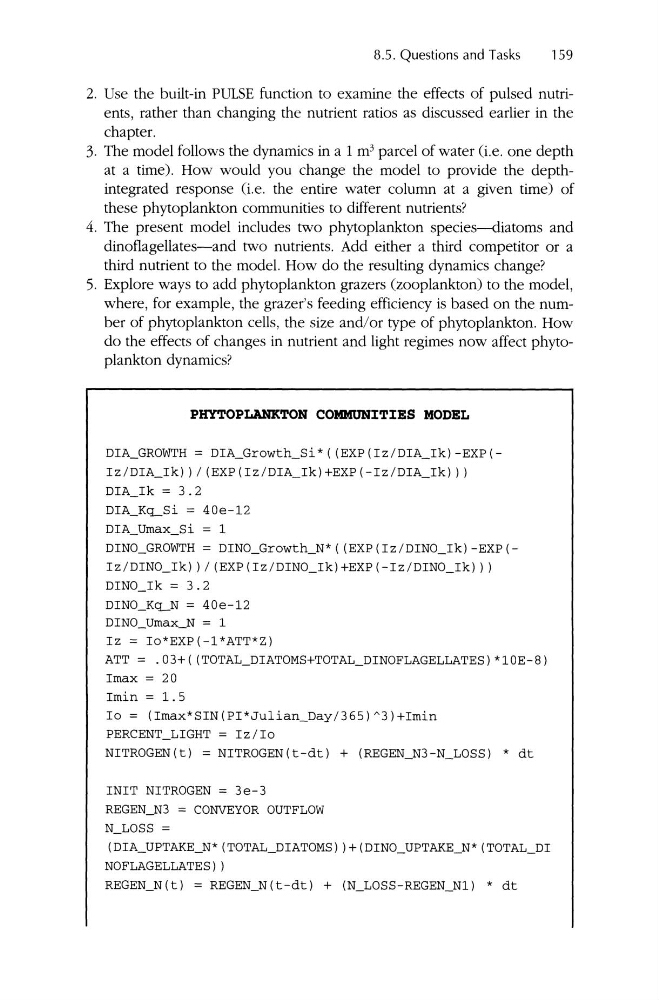
PHYTOPLANKTON COMMUNITIES MODEL
DIA_GROWTH = DIA_Growth_Si*{{EXP(Iz /DIA_Ik) -EXP{Iz /DIA_Ik)) !(EXP(Iz /DIA_Ik)+EXP{-Iz !DIA_Ik) ))
DI A_Ik = 3.2
= 40e-12
DIA_Umax_Si = 1
DINO_GROWTH = DINO_Growth_N*({EXP{Iz /DINO_Ik)-EXP{Iz /DINO_Ik)) /{EXP{Iz /DINO_Ik)+EXP{-Iz /DINO_Ik)))
DINO_Ik = 3 .2
= 4 0e - 1 2
DINO_Umax_N = 1
Iz = Io*EXP{-l* ATT*Z)
ATT = .03+{(TOTAL_DIATOMS+TOTAL_DINOFLAGELLATES)*10E-8)
Imax = 20
Imin = 1.5
10 = (Imax*SIN{PI*Ju1ian_Day / 3 65) A3)+Imin
PERCENT_LIGHT = Iz /Io
NITROGEN{t) = NITROGEN{t-dt) + (REGEN_N3-N_LOSS) * dt
INIT NITROGEN = 3e -3
REGEN_N3 = CONVEYOR OUTFLOW
N_LOSS =
(DIA_UPTAKE_N*(TOTAL_DIATOMS))+{DINO_UPTAKE_N*(TOTAL_DI
NOFLAGELLATES) )
REGEN_N(t) = REGEN_N{t-dt) + (N_LOSS-REGEN_N1) * dt
159
2. Use the built-in PULSE function to examine the effects of pulsed nutrients , rather than changing the nutrient ratios as discussed earlier in the
chapter.
3. The model follows the dynamics in a 1 m 3 parcel of water (i.e , one depth
at a time). How would you change the model to provide the depthintegrated response (i.e. the entire water column at a given time) of
these phytoplankton communities to different nutrients?
4. The present model includes two phytoplankton species-diatoms and
dinoflagellates-and two nutrients. Add either a third competitor or a
third nutrient to the model. How do the resulting dynamics change?
5. Explore ways to add phytoplankton grazers (zooplankton) to the model ,
where, for example, the grazer's feeding efficiency is based on the number of phytoplankton cells, the size and/or type of phytopl ankton. How
do the effects of changes in nutrient and light regimes now affect phytoplankton dynamics?
PHYTOPLANKTON COMMUNITIES MODEL
DIA_GROWTH = DIA_Growth_Si*{{EXP(Iz /DIA_Ik) -EXP{Iz /DIA_Ik)) !(EXP(Iz /DIA_Ik)+EXP{-Iz !DIA_Ik) ))
DI A_Ik = 3.2
= 40e-12
DIA_Umax_Si = 1
DINO_GROWTH = DINO_Growth_N*({EXP{Iz /DINO_Ik)-EXP{Iz /DINO_Ik)) /{EXP{Iz /DINO_Ik)+EXP{-Iz /DINO_Ik)))
DINO_Ik = 3 .2
= 4 0e - 1 2
DINO_Umax_N = 1
Iz = Io*EXP{-l* ATT*Z)
ATT = .03+{(TOTAL_DIATOMS+TOTAL_DINOFLAGELLATES)*10E-8)
Imax = 20
Imin = 1.5
10 = (Imax*SIN{PI*Ju1ian_Day / 3 65) A3)+Imin
PERCENT_LIGHT = Iz /Io
NITROGEN{t) = NITROGEN{t-dt) + (REGEN_N3-N_LOSS) * dt
INIT NITROGEN = 3e -3
REGEN_N3 = CONVEYOR OUTFLOW
N_LOSS =
(DIA_UPTAKE_N*(TOTAL_DIATOMS))+{DINO_UPTAKE_N*(TOTAL_DI
NOFLAGELLATES) )
REGEN_N(t) = REGEN_N{t-dt) + (N_LOSS-REGEN_N1) * dt