

152
8. Impact of Dynamic Light and Nutrient Environments
8.3. Model Results
The results discussed in this section have been derived under a set of simplifying assumptions. Specifically, the present model examines dynamics
with two phytoplankton groups . As with any marine environment, there are
more than two phytoplankton groups , and within groups, phytoplankton
species have significantly different responses to both light and nutrients.
Phytoplankton in the natural environment are always subject to grazing
pressure from zooplankton. Inclusion of grazing in this model would add
another dynamic variable affecting the number of phytoplankton cells and
increasing the regeneration time of N. The addition of more than two nutrients would add further realism to the model.
8.3.1. Physical Dynamics
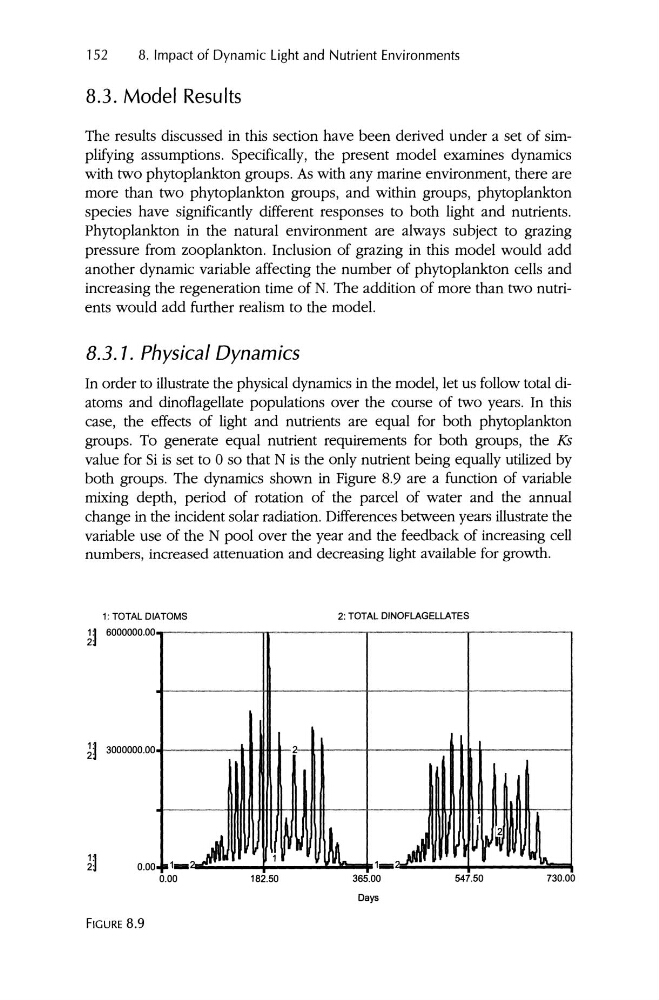
In order to illustrate the physical dynamics in the model, let us follow total diatoms and dinoflagellate populations over the course of two years. In this
case, the effects of light and nutrients are equal for both phytoplankton
groups. To generate equal nutrient requirements for both groups, the Ks
value for Si is set to 0 so that N is the only nutrient being equally utilized by
both groups. The dynamics shown in Figure 8.9 are a function of variable
mixing depth, period of rotation of the parcel of water and the annual
change in the incident solar radiation. Differences between years illustrate the
variable use of the N pool over the year and the feedback of increasing cell
numbers, increased attenuation and decreasing light available for growth.
2: TOTAL DINOFLAGELLATES
1: TOTAL DIATOMS
6000000 .00
3000000.00
2
I
1
182.50
l_JJJN
365.00
2:1
0.00
0.00
II\.
730.00
547.50
Days
FIGURE 8.9
8. Impact of Dynamic Light and Nutrient Environments
8.3. Model Results
The results discussed in this section have been derived under a set of simplifying assumptions. Specifically, the present model examines dynamics
with two phytoplankton groups . As with any marine environment, there are
more than two phytoplankton groups , and within groups, phytoplankton
species have significantly different responses to both light and nutrients.
Phytoplankton in the natural environment are always subject to grazing
pressure from zooplankton. Inclusion of grazing in this model would add
another dynamic variable affecting the number of phytoplankton cells and
increasing the regeneration time of N. The addition of more than two nutrients would add further realism to the model.
8.3.1. Physical Dynamics
In order to illustrate the physical dynamics in the model, let us follow total diatoms and dinoflagellate populations over the course of two years. In this
case, the effects of light and nutrients are equal for both phytoplankton
groups. To generate equal nutrient requirements for both groups, the Ks
value for Si is set to 0 so that N is the only nutrient being equally utilized by
both groups. The dynamics shown in Figure 8.9 are a function of variable
mixing depth, period of rotation of the parcel of water and the annual
change in the incident solar radiation. Differences between years illustrate the
variable use of the N pool over the year and the feedback of increasing cell
numbers, increased attenuation and decreasing light available for growth.
2: TOTAL DINOFLAGELLATES
1: TOTAL DIATOMS
6000000 .00
3000000.00
2
I
1
182.50
l_JJJN
365.00
2:1
0.00
0.00
II\.
730.00
547.50
Days
FIGURE 8.9