

7.4. Atmosphere-Ocean Interaction Model
129
7.4.1. Inorganic Carbon Fluxes
When the processes of photosynthesis and respiration are balanced in the
biosphere the concentration of atmospheric CO 2 is regulated by equilibration with the ocean surface water [pCO). Equilibrium between atmosphere
and surface water [C0 2
) is achieved through the exchange of carbon dioxide across the air-sea interface and is governed by the difference in partial
pressure between the atmosphere and ocean surface waters and the piston
velocity (r)-a measure of the diffusivity of CO 2 and surface water mixing:
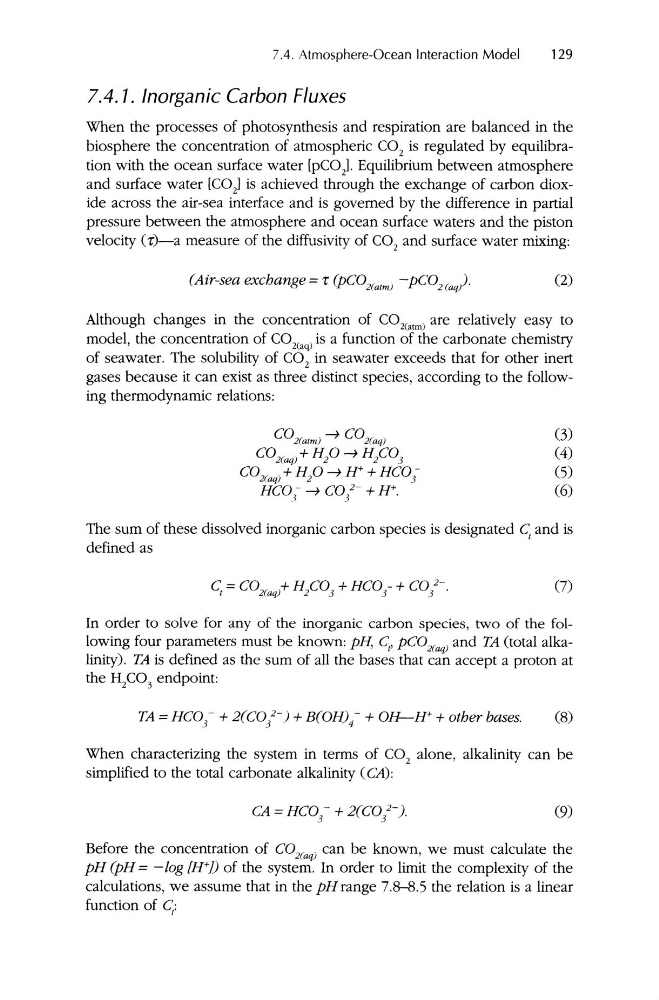
(Air-sea exchange =r (pC0 2 (a l m) -pC0 2 (aq) .
(2)
Although changes in the concentration of CO 2
(atmJ are relatively easy to
model, the concentration of CO 2
(aqJ is a function of the carbonate chemistry
of seawater. The solubility of CO 2 in seawater exceeds that for other inert
gases because it can exist as three distinct species, according to the following thermodynamic relations:
co2(alm)
CO 2 (aq) + H 20
CO 2
(aq) + H 20
CO2(aq)
H 2COj
H+ + HCO j -
HCO,CO/ - + H+.
The sum of these dissolved inorganic carbon species is designated C
I
defined as
(3)
(4)
(5)
(6)
and is
(7)
In order to solve for any of the inorganic carbon species, two of the following four parameters must be known: pH, C I
' pC0 2
(aq) and TA (total alkalinity). TA is defined as the sum of all the bases that can accept a proton at
the H 2C03 endpoint:
TA =HCO j
- + 2(CO/ -) + B(OH)4- + OH-H++ other bases.
(8)
When characterizing the system in terms of CO 2 alone, alkalinity can be
simplified to the total carbonate alkalinity (CA) :
(9)
Before the concentration of CO 2
(aq) can be known, we must calculate the
pH (pH = -log [H+j) of the system . In order to limit the complexity of the
calculations, we assume that in the pH range 7.8-8.5 the relation is a linear
function of C/:
129
7.4.1. Inorganic Carbon Fluxes
When the processes of photosynthesis and respiration are balanced in the
biosphere the concentration of atmospheric CO 2 is regulated by equilibration with the ocean surface water [pCO). Equilibrium between atmosphere
and surface water [C0 2
) is achieved through the exchange of carbon dioxide across the air-sea interface and is governed by the difference in partial
pressure between the atmosphere and ocean surface waters and the piston
velocity (r)-a measure of the diffusivity of CO 2 and surface water mixing:
(Air-sea exchange =r (pC0 2 (a l m) -pC0 2 (aq) .
(2)
Although changes in the concentration of CO 2
(atmJ are relatively easy to
model, the concentration of CO 2
(aqJ is a function of the carbonate chemistry
of seawater. The solubility of CO 2 in seawater exceeds that for other inert
gases because it can exist as three distinct species, according to the following thermodynamic relations:
co2(alm)
CO 2 (aq) + H 20
CO 2
(aq) + H 20
CO2(aq)
H 2COj
H+ + HCO j -
HCO,CO/ - + H+.
The sum of these dissolved inorganic carbon species is designated C
I
defined as
(3)
(4)
(5)
(6)
and is
(7)
In order to solve for any of the inorganic carbon species, two of the following four parameters must be known: pH, C I
' pC0 2
(aq) and TA (total alkalinity). TA is defined as the sum of all the bases that can accept a proton at
the H 2C03 endpoint:
TA =HCO j
- + 2(CO/ -) + B(OH)4- + OH-H++ other bases.
(8)
When characterizing the system in terms of CO 2 alone, alkalinity can be
simplified to the total carbonate alkalinity (CA) :
(9)
Before the concentration of CO 2
(aq) can be known, we must calculate the
pH (pH = -log [H+j) of the system . In order to limit the complexity of the
calculations, we assume that in the pH range 7.8-8.5 the relation is a linear
function of C/: