

126
7. Modeling Atmosphere-Ocean Interactions and Primary Productivity
ocean and terrestrial plant productivity has become the focus of much scientific research.
The purpose of this chapter is to demonstrate the relations between the
atmosphere-ocean CO 2 system and marine primary productivity as it is regulated by the supply of two essential nutrients: nitrogen (most importantly
in the form of nitrate, N0 3 -) and iron (Fe). The model developed in this
chapter draws on concepts from many aspects of oceanography. It is based
on fundamental concepts in equilibrium chemistry (the carbonate system),
biology and ecology (nutrient kinetics and primary production). The model
is heuristic and not a quantitative estimate of the impacts of anthropogenic
CO 2 increases and Fe limitation on primary productivity. Rather, the
model 's primary purpose is to demonstrate the coupling between partial
pressure of CO 2 [pCO) in the atmosp here, ocean chem istry and biology,
and to exp lore changes in atmospheric [pCOJ
7.2. Greenhouse Gases and Climate
Our current understanding of the ocean-atmosphere system and how anthropogenic activities will affect future climate changes relies heavily on our
understanding of past perturbations of global climate dete cted in the geological record . Measurements of CO 2 conce ntrations in air bubbles trapped
in polar ice cores have demonstrated that atmospheric CO 2 fluctuations of
approximately 80 ppm (Petit et aI. 1999) accompanied temperature fluctuations during the most recent Quaternary glacial-interglacial transition (12 ,000
years ago) on a time scale of 10 3_104 years. Whether present increases in atmospheric CO 2 will result in similarly drastic changes in global climate requires greater knowledge to what degree the ocean, the largest reservoir of
inorganic carbon, will act to buffer atmospheric increases.
Because the vast majority of the combined atmosphere-o cean inorganic
carbon pool resides in the subsurface ocean (Sarmiento & Orr 1991), fluctuations in atmospheric CO 2 concentrations and the resulting shifts in global
climate are thought to be forced by changes in the oceanic carbon cycle
(Sundquist & Broecker 1985). Today , surface ocean CO 2 concentrations are
in equilibrium with the atmosphere, while the deep ocean contains more
CO 2 then could result from air-sea gas exchange alone (Broecker, Peng &
Engh 1980). The surp lus of CO 2 in the deep ocean is maintained by a mechanism referred to as the biological pump (Sarmiento & Bender 1994). The
biological pump sequesters CO 2 from the atmosphere through the reduction of CO 2 by photoautotrophic organisms. In surface waters of the
oceans, these organisms fix inorganic carbon (along with other nutrients)
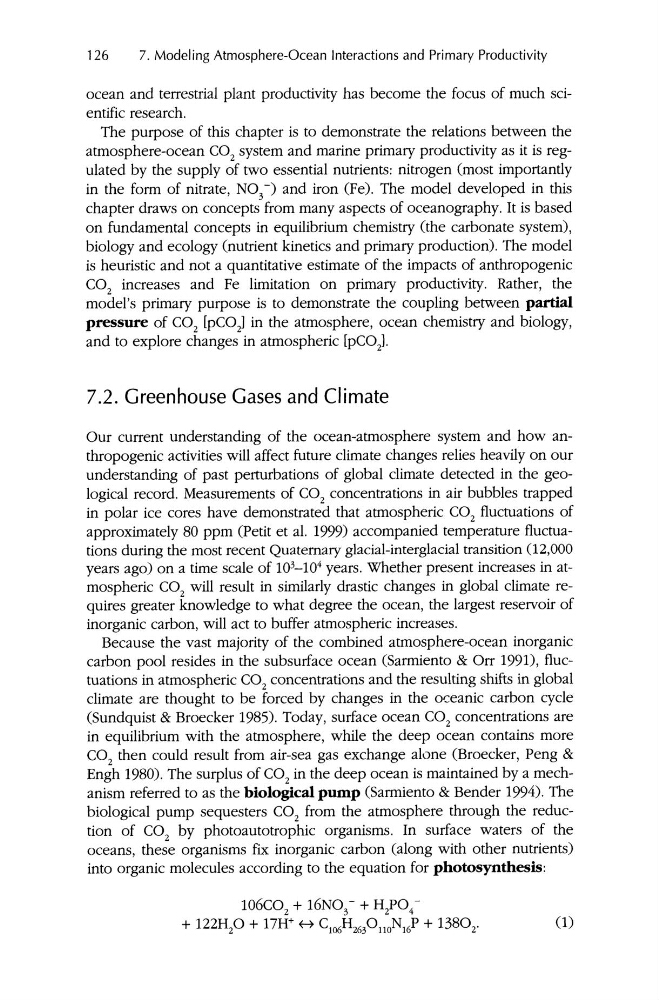
into organic molecules according to the equation for photosynthesis:
106C0 2 + 16N0 3 - + Hl0 4
-
+ 122Hp + 17H+H CI06H263011ONIl + 13802'
(1 )
7. Modeling Atmosphere-Ocean Interactions and Primary Productivity
ocean and terrestrial plant productivity has become the focus of much scientific research.
The purpose of this chapter is to demonstrate the relations between the
atmosphere-ocean CO 2 system and marine primary productivity as it is regulated by the supply of two essential nutrients: nitrogen (most importantly
in the form of nitrate, N0 3 -) and iron (Fe). The model developed in this
chapter draws on concepts from many aspects of oceanography. It is based
on fundamental concepts in equilibrium chemistry (the carbonate system),
biology and ecology (nutrient kinetics and primary production). The model
is heuristic and not a quantitative estimate of the impacts of anthropogenic
CO 2 increases and Fe limitation on primary productivity. Rather, the
model 's primary purpose is to demonstrate the coupling between partial
pressure of CO 2 [pCO) in the atmosp here, ocean chem istry and biology,
and to exp lore changes in atmospheric [pCOJ
7.2. Greenhouse Gases and Climate
Our current understanding of the ocean-atmosphere system and how anthropogenic activities will affect future climate changes relies heavily on our
understanding of past perturbations of global climate dete cted in the geological record . Measurements of CO 2 conce ntrations in air bubbles trapped
in polar ice cores have demonstrated that atmospheric CO 2 fluctuations of
approximately 80 ppm (Petit et aI. 1999) accompanied temperature fluctuations during the most recent Quaternary glacial-interglacial transition (12 ,000
years ago) on a time scale of 10 3_104 years. Whether present increases in atmospheric CO 2 will result in similarly drastic changes in global climate requires greater knowledge to what degree the ocean, the largest reservoir of
inorganic carbon, will act to buffer atmospheric increases.
Because the vast majority of the combined atmosphere-o cean inorganic
carbon pool resides in the subsurface ocean (Sarmiento & Orr 1991), fluctuations in atmospheric CO 2 concentrations and the resulting shifts in global
climate are thought to be forced by changes in the oceanic carbon cycle
(Sundquist & Broecker 1985). Today , surface ocean CO 2 concentrations are
in equilibrium with the atmosphere, while the deep ocean contains more
CO 2 then could result from air-sea gas exchange alone (Broecker, Peng &
Engh 1980). The surp lus of CO 2 in the deep ocean is maintained by a mechanism referred to as the biological pump (Sarmiento & Bender 1994). The
biological pump sequesters CO 2 from the atmosphere through the reduction of CO 2 by photoautotrophic organisms. In surface waters of the
oceans, these organisms fix inorganic carbon (along with other nutrients)
into organic molecules according to the equation for photosynthesis:
106C0 2 + 16N0 3 - + Hl0 4
-
+ 122Hp + 17H+H CI06H263011ONIl + 13802'
(1 )