

2 Monitoring of Marine Aquaculture
69
Two terms are employed to adjust monitoring depending on the impact at the
site: the degree of exploitation and the level of monitoring. The degree of exploitation is an expression of the amount of impact from the fish farm compared with the
holding capacity of the site. The site is overexploited if the holding capacity is
exceeded and the division between acceptable and unacceptable sedimentary conditions is set as the highest level of accumulation within which burrowing bottom
fauna can survive in the sediment. The higher the degree of exploitation at a site,
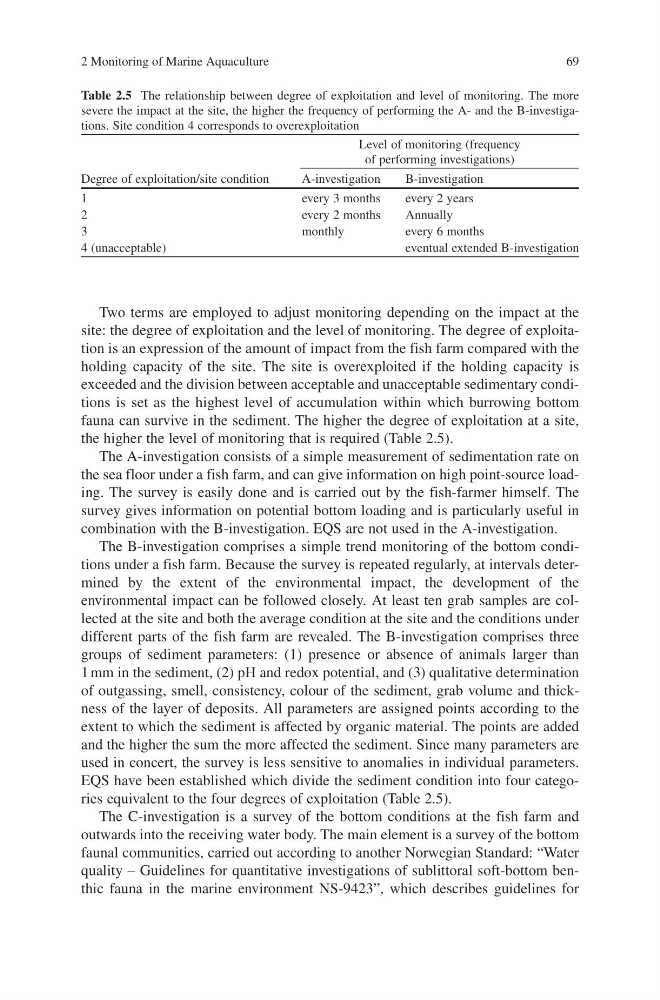
the higher the level of monitoring that is required (Table 2.5).
The A-investigation consists of a simple measurement of sedimentation rate on
the sea floor under a fish farm, and can give information on high point-source loading. The survey is easily done and is carried out by the fish-farmer himself. The
survey gives information on potential bottom loading and is particularly useful in
combination with the B-investigation. EQS are not used in the A-investigation.
The B-investigation comprises a simple trend monitoring of the bottom conditions under a fish farm. Because the survey is repeated regularly, at intervals determined by the extent of the environmental impact, the development of the
environmental impact can be followed closely. At least ten grab samples are collected at the site and both the average condition at the site and the conditions under
different parts of the fish farm are revealed. The B-investigation comprises three
groups of sediment parameters: (1) presence or absence of animals larger than
1 mm in the sediment, (2) pH and redox potential, and (3) qualitative determination
of outgassing, smell, consistency, colour of the sediment, grab volume and thickness of the layer of deposits. All parameters are assigned points according to the
extent to which the sediment is affected by organic material. The points are added
and the higher the sum the more affected the sediment. Since many parameters are
used in concert, the survey is less sensitive to anomalies in individual parameters.
EQS have been established which divide the sediment condition into four categories equivalent to the four degrees of exploitation (Table 2.5).
The C-investigation is a survey of the bottom conditions at the fish farm and
outwards into the receiving water body. The main element is a survey of the bottom
faunal communities, carried out according to another Norwegian Standard: “Water
quality – Guidelines for quantitative investigations of sublittoral soft-bottom benthic fauna in the marine environment NS-9423”, which describes guidelines for
Table 2.5 The relationship between degree of exploitation and level of monitoring. The more
severe the impact at the site, the higher the frequency of performing the A- and the B-investigations. Site condition 4 corresponds to overexploitation
Level of monitoring (frequency
of performing investigations)
Degree of exploitation/site condition
A-investigation
B-investigation
1
every 3 months
every 2 years
2
every 2 months
Annually
3
monthly
every 6 months
4 (unacceptable)
eventual extended B-investigation
69
Two terms are employed to adjust monitoring depending on the impact at the
site: the degree of exploitation and the level of monitoring. The degree of exploitation is an expression of the amount of impact from the fish farm compared with the
holding capacity of the site. The site is overexploited if the holding capacity is
exceeded and the division between acceptable and unacceptable sedimentary conditions is set as the highest level of accumulation within which burrowing bottom
fauna can survive in the sediment. The higher the degree of exploitation at a site,
the higher the level of monitoring that is required (Table 2.5).
The A-investigation consists of a simple measurement of sedimentation rate on
the sea floor under a fish farm, and can give information on high point-source loading. The survey is easily done and is carried out by the fish-farmer himself. The
survey gives information on potential bottom loading and is particularly useful in
combination with the B-investigation. EQS are not used in the A-investigation.
The B-investigation comprises a simple trend monitoring of the bottom conditions under a fish farm. Because the survey is repeated regularly, at intervals determined by the extent of the environmental impact, the development of the
environmental impact can be followed closely. At least ten grab samples are collected at the site and both the average condition at the site and the conditions under
different parts of the fish farm are revealed. The B-investigation comprises three
groups of sediment parameters: (1) presence or absence of animals larger than
1 mm in the sediment, (2) pH and redox potential, and (3) qualitative determination
of outgassing, smell, consistency, colour of the sediment, grab volume and thickness of the layer of deposits. All parameters are assigned points according to the
extent to which the sediment is affected by organic material. The points are added
and the higher the sum the more affected the sediment. Since many parameters are
used in concert, the survey is less sensitive to anomalies in individual parameters.
EQS have been established which divide the sediment condition into four categories equivalent to the four degrees of exploitation (Table 2.5).
The C-investigation is a survey of the bottom conditions at the fish farm and
outwards into the receiving water body. The main element is a survey of the bottom
faunal communities, carried out according to another Norwegian Standard: “Water
quality – Guidelines for quantitative investigations of sublittoral soft-bottom benthic fauna in the marine environment NS-9423”, which describes guidelines for
Table 2.5 The relationship between degree of exploitation and level of monitoring. The more
severe the impact at the site, the higher the frequency of performing the A- and the B-investigations. Site condition 4 corresponds to overexploitation
Level of monitoring (frequency
of performing investigations)
Degree of exploitation/site condition
A-investigation
B-investigation
1
every 3 months
every 2 years
2
every 2 months
Annually
3
monthly
every 6 months
4 (unacceptable)
eventual extended B-investigation