

50
M. Holmer et al.
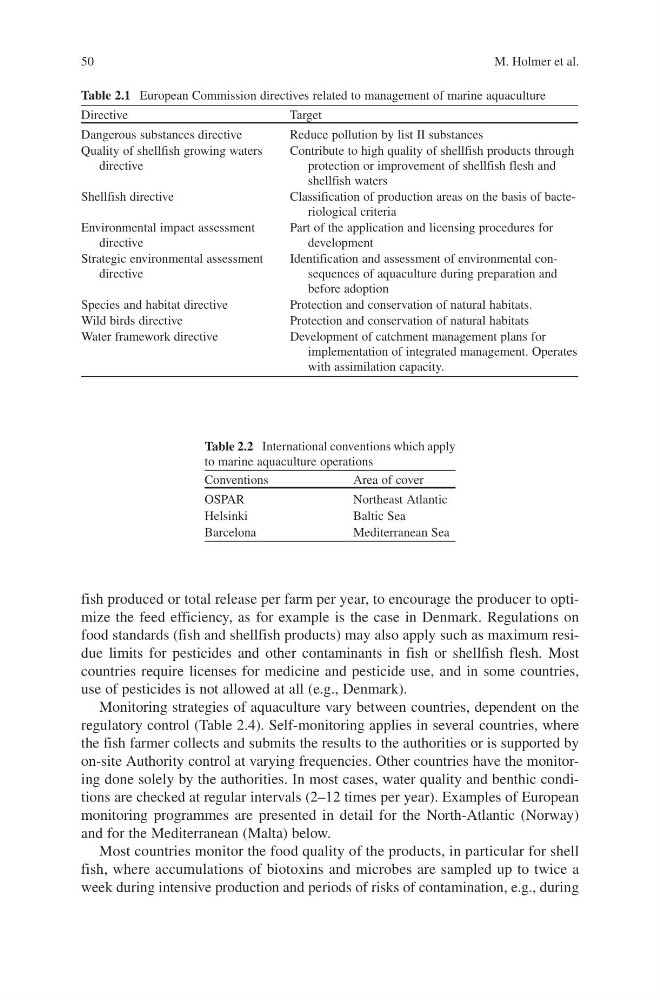
Table 2.1 European Commission directives related to management of marine aquaculture
Directive
Target
Dangerous substances directive
Reduce pollution by list II substances
Quality of shellfish growing waters
directive
Contribute to high quality of shellfish products through
protection or improvement of shellfish flesh and
shellfish waters
Shellfish directive
Classification of production areas on the basis of bacteriological criteria
Environmental impact assessment
directive
Part of the application and licensing procedures for
development
Strategic environmental assessment
directive
Identification and assessment of environmental consequences of aquaculture during preparation and
before adoption
Species and habitat directive
Protection and conservation of natural habitats.
Wild birds directive
Protection and conservation of natural habitats
Water framework directive
Development of catchment management plans for
implementation of integrated management. Operates
with assimilation capacity.
Table 2.2 International conventions which apply
to marine aquaculture operations
Conventions
Area of cover
OSPAR
Northeast Atlantic
Helsinki
Baltic Sea
Barcelona
Mediterranean Sea
fish produced or total release per farm per year, to encourage the producer to optimize the feed efficiency, as for example is the case in Denmark. Regulations on
food standards (fish and shellfish products) may also apply such as maximum residue limits for pesticides and other contaminants in fish or shellfish flesh. Most
countries require licenses for medicine and pesticide use, and in some countries,
use of pesticides is not allowed at all (e.g., Denmark).
Monitoring strategies of aquaculture vary between countries, dependent on the
regulatory control (Table 2.4). Self-monitoring applies in several countries, where
the fish farmer collects and submits the results to the authorities or is supported by
on-site Authority control at varying frequencies. Other countries have the monitoring done solely by the authorities. In most cases, water quality and benthic conditions are checked at regular intervals (2–12 times per year). Examples of European
monitoring programmes are presented in detail for the North-Atlantic (Norway)
and for the Mediterranean (Malta) below.
Most countries monitor the food quality of the products, in particular for shell
fish, where accumulations of biotoxins and microbes are sampled up to twice a
week during intensive production and periods of risks of contamination, e.g., during
M. Holmer et al.
Table 2.1 European Commission directives related to management of marine aquaculture
Directive
Target
Dangerous substances directive
Reduce pollution by list II substances
Quality of shellfish growing waters
directive
Contribute to high quality of shellfish products through
protection or improvement of shellfish flesh and
shellfish waters
Shellfish directive
Classification of production areas on the basis of bacteriological criteria
Environmental impact assessment
directive
Part of the application and licensing procedures for
development
Strategic environmental assessment
directive
Identification and assessment of environmental consequences of aquaculture during preparation and
before adoption
Species and habitat directive
Protection and conservation of natural habitats.
Wild birds directive
Protection and conservation of natural habitats
Water framework directive
Development of catchment management plans for
implementation of integrated management. Operates
with assimilation capacity.
Table 2.2 International conventions which apply
to marine aquaculture operations
Conventions
Area of cover
OSPAR
Northeast Atlantic
Helsinki
Baltic Sea
Barcelona
Mediterranean Sea
fish produced or total release per farm per year, to encourage the producer to optimize the feed efficiency, as for example is the case in Denmark. Regulations on
food standards (fish and shellfish products) may also apply such as maximum residue limits for pesticides and other contaminants in fish or shellfish flesh. Most
countries require licenses for medicine and pesticide use, and in some countries,
use of pesticides is not allowed at all (e.g., Denmark).
Monitoring strategies of aquaculture vary between countries, dependent on the
regulatory control (Table 2.4). Self-monitoring applies in several countries, where
the fish farmer collects and submits the results to the authorities or is supported by
on-site Authority control at varying frequencies. Other countries have the monitoring done solely by the authorities. In most cases, water quality and benthic conditions are checked at regular intervals (2–12 times per year). Examples of European
monitoring programmes are presented in detail for the North-Atlantic (Norway)
and for the Mediterranean (Malta) below.
Most countries monitor the food quality of the products, in particular for shell
fish, where accumulations of biotoxins and microbes are sampled up to twice a
week during intensive production and periods of risks of contamination, e.g., during