

1 Fish Farm Wastes in the Ecosystem
23
17. “Surface water status” is the general expression of the status of a body of surface
water, determined by the poorer of its ecological status and its chemical status.
18. “Good surface water status” means the status achieved by a surface water body when
both its ecological status and its chemical status are at least “good”
21. “Ecological status” is an expression of the quality of the structure and functioning of
aquatic ecosystems associated with surface waters, classified in accordance with Annex V.
24. “Good surface water chemical status” means the chemical status required to meet the
environmental objectives for surface waters established in Article 4(1)(a).…
As before I have underlined the key point and novelty: the focus on ecosystem
structure and function. Details are given in Annex V, which is the longest single
part of the Directive and (in my view) provides its beating heart. The Annex defines
ecological status as consisting of biological elements, physico-chemical elements
supporting the biological elements and hydromorphological elements supporting
the biological elements. The biological quality elements for transitional and coastal
waters are: phytoplankton; macroalgae and angiosperms; benthic invertebrate
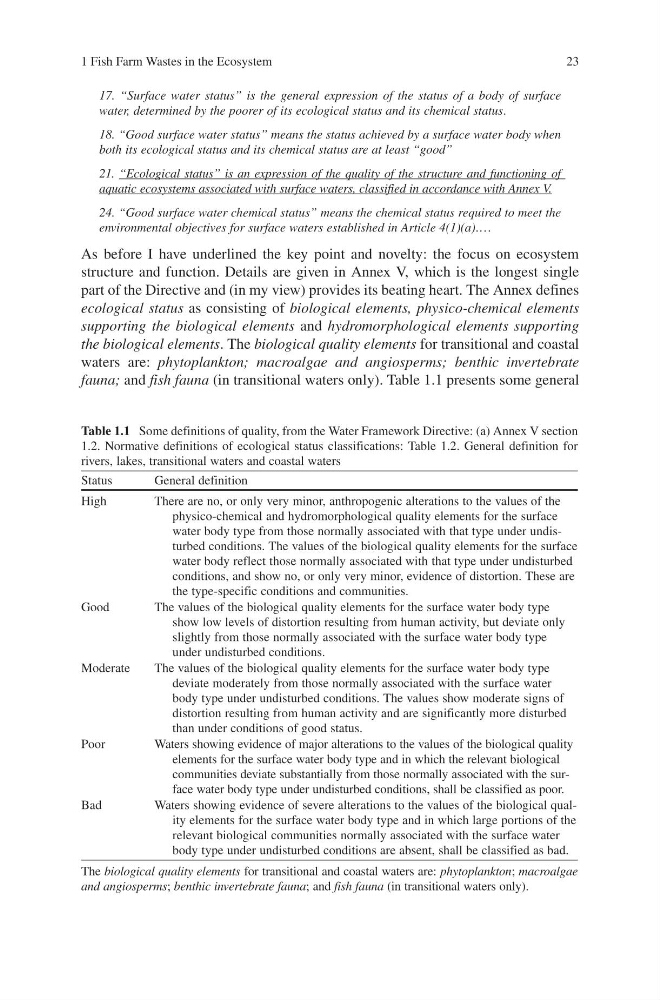
fauna; and fish fauna (in transitional waters only). Table 1.1 presents some general
Table 1.1 Some definitions of quality, from the Water Framework Directive: (a) Annex V section
1.2. Normative definitions of ecological status classifications: Table 1.2. General definition for
rivers, lakes, transitional waters and coastal waters
Status
General definition
High
There are no, or only very minor, anthropogenic alterations to the values of the
physico-chemical and hydromorphological quality elements for the surface
water body type from those normally associated with that type under undisturbed conditions. The values of the biological quality elements for the surface
water body reflect those normally associated with that type under undisturbed
conditions, and show no, or only very minor, evidence of distortion. These are
the type-specific conditions and communities.
Good
The values of the biological quality elements for the surface water body type
show low levels of distortion resulting from human activity, but deviate only
slightly from those normally associated with the surface water body type
under undisturbed conditions.
Moderate
The values of the biological quality elements for the surface water body type
deviate moderately from those normally associated with the surface water
body type under undisturbed conditions. The values show moderate signs of
distortion resulting from human activity and are significantly more disturbed
than under conditions of good status.
Poor
Waters showing evidence of major alterations to the values of the biological quality
elements for the surface water body type and in which the relevant biological
communities deviate substantially from those normally associated with the surface water body type under undisturbed conditions, shall be classified as poor.
Bad
Waters showing evidence of severe alterations to the values of the biological quality elements for the surface water body type and in which large portions of the
relevant biological communities normally associated with the surface water
body type under undisturbed conditions are absent, shall be classified as bad.
The biological quality elements for transitional and coastal waters are: phytoplankton; macroalgae
and angiosperms; benthic invertebrate fauna; and fish fauna (in transitional waters only).
23
17. “Surface water status” is the general expression of the status of a body of surface
water, determined by the poorer of its ecological status and its chemical status.
18. “Good surface water status” means the status achieved by a surface water body when
both its ecological status and its chemical status are at least “good”
21. “Ecological status” is an expression of the quality of the structure and functioning of
aquatic ecosystems associated with surface waters, classified in accordance with Annex V.
24. “Good surface water chemical status” means the chemical status required to meet the
environmental objectives for surface waters established in Article 4(1)(a).…
As before I have underlined the key point and novelty: the focus on ecosystem
structure and function. Details are given in Annex V, which is the longest single
part of the Directive and (in my view) provides its beating heart. The Annex defines
ecological status as consisting of biological elements, physico-chemical elements
supporting the biological elements and hydromorphological elements supporting
the biological elements. The biological quality elements for transitional and coastal
waters are: phytoplankton; macroalgae and angiosperms; benthic invertebrate
fauna; and fish fauna (in transitional waters only). Table 1.1 presents some general
Table 1.1 Some definitions of quality, from the Water Framework Directive: (a) Annex V section
1.2. Normative definitions of ecological status classifications: Table 1.2. General definition for
rivers, lakes, transitional waters and coastal waters
Status
General definition
High
There are no, or only very minor, anthropogenic alterations to the values of the
physico-chemical and hydromorphological quality elements for the surface
water body type from those normally associated with that type under undisturbed conditions. The values of the biological quality elements for the surface
water body reflect those normally associated with that type under undisturbed
conditions, and show no, or only very minor, evidence of distortion. These are
the type-specific conditions and communities.
Good
The values of the biological quality elements for the surface water body type
show low levels of distortion resulting from human activity, but deviate only
slightly from those normally associated with the surface water body type
under undisturbed conditions.
Moderate
The values of the biological quality elements for the surface water body type
deviate moderately from those normally associated with the surface water
body type under undisturbed conditions. The values show moderate signs of
distortion resulting from human activity and are significantly more disturbed
than under conditions of good status.
Poor
Waters showing evidence of major alterations to the values of the biological quality
elements for the surface water body type and in which the relevant biological
communities deviate substantially from those normally associated with the surface water body type under undisturbed conditions, shall be classified as poor.
Bad
Waters showing evidence of severe alterations to the values of the biological quality elements for the surface water body type and in which large portions of the
relevant biological communities normally associated with the surface water
body type under undisturbed conditions are absent, shall be classified as bad.
The biological quality elements for transitional and coastal waters are: phytoplankton; macroalgae
and angiosperms; benthic invertebrate fauna; and fish fauna (in transitional waters only).