

306
Y. Olsen et al.
attitude is that food is produced in too high amounts. The use of agricultural products
for fish feed tends already to be a more difficult issue in, for example, Vietnam and
China.
Some regions of the world’s oceans have large stocks of herbivore copepods and
krill that are abundant and potentially exploitable, depending on their distribution
in time and space. The standing stock biomass of Antarctic krill (Euphausia
superba) is estimated at 500 million tonnes (range 125–750) (Nicol and Endo
1997), meaning that the annual production must be over 100 million tonnes year
−1
(life span 6 years). The annual production of red feed (Calanus finmarchicus) in
Nordic Seas has been estimated to 74 million tonnes (Aksnes and Blindheim 1996).
Some 5–10% of the annual herbivore production is of comparable magnitude as the
entire production of zooplanktivore fish (1st carnivore), and 1% is still a significant
resource as compared with traditional regional fisheries. If zooplankton production
in the sea tends to be food limited, we may expect that moderate harvesting will
primarily result in less mortality of zooplankton and not necessarily in reduced
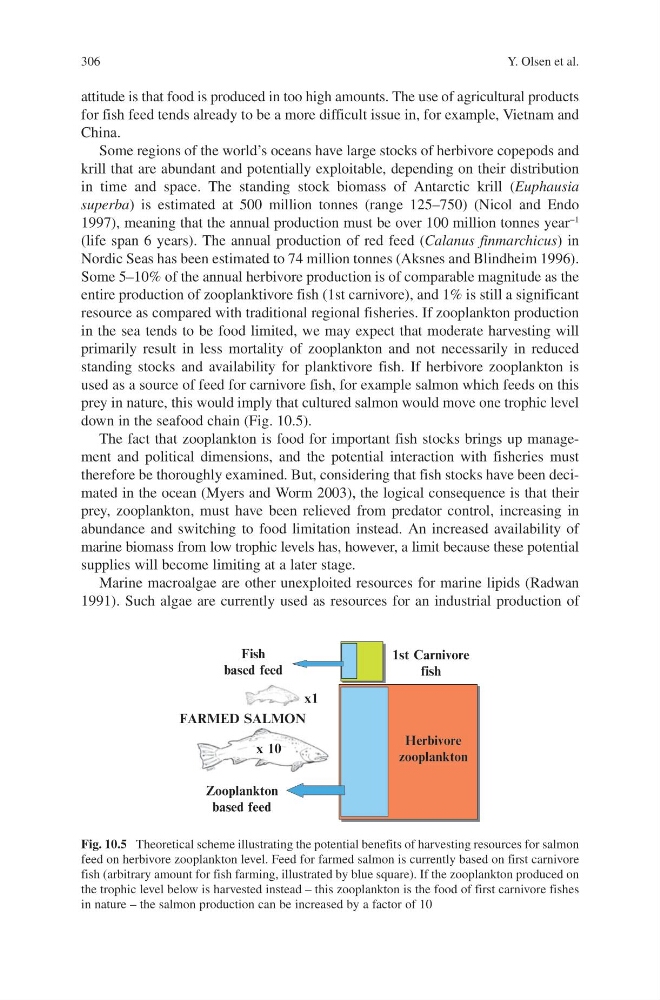
standing stocks and availability for planktivore fish. If herbivore zooplankton is
used as a source of feed for carnivore fish, for example salmon which feeds on this
prey in nature, this would imply that cultured salmon would move one trophic level
down in the seafood chain (Fig. 10.5).
The fact that zooplankton is food for important fish stocks brings up management and political dimensions, and the potential interaction with fisheries must
therefore be thoroughly examined. But, considering that fish stocks have been decimated in the ocean (Myers and Worm 2003), the logical consequence is that their
prey, zooplankton, must have been relieved from predator control, increasing in
abundance and switching to food limitation instead. An increased availability of
marine biomass from low trophic levels has, however, a limit because these potential
supplies will become limiting at a later stage.
Marine macroalgae are other unexploited resources for marine lipids (Radwan
1991). Such algae are currently used as resources for an industrial production of
Fig. 10.5 Theoretical scheme illustrating the potential benefits of harvesting resources for salmon
feed on herbivore zooplankton level. Feed for farmed salmon is currently based on first carnivore
fish (arbitrary amount for fish farming, illustrated by blue square). If the zooplankton produced on
the trophic level below is harvested instead – this zooplankton is the food of first carnivore fishes
in nature – the salmon production can be increased by a factor of 10
Herbivore
zooplankton
1st Carnivore
fish
x1
Zooplankton
based feed
Fish
based feed
FARMED SALMON
x 10
Y. Olsen et al.
attitude is that food is produced in too high amounts. The use of agricultural products
for fish feed tends already to be a more difficult issue in, for example, Vietnam and
China.
Some regions of the world’s oceans have large stocks of herbivore copepods and
krill that are abundant and potentially exploitable, depending on their distribution
in time and space. The standing stock biomass of Antarctic krill (Euphausia
superba) is estimated at 500 million tonnes (range 125–750) (Nicol and Endo
1997), meaning that the annual production must be over 100 million tonnes year
−1
(life span 6 years). The annual production of red feed (Calanus finmarchicus) in
Nordic Seas has been estimated to 74 million tonnes (Aksnes and Blindheim 1996).
Some 5–10% of the annual herbivore production is of comparable magnitude as the
entire production of zooplanktivore fish (1st carnivore), and 1% is still a significant
resource as compared with traditional regional fisheries. If zooplankton production
in the sea tends to be food limited, we may expect that moderate harvesting will
primarily result in less mortality of zooplankton and not necessarily in reduced
standing stocks and availability for planktivore fish. If herbivore zooplankton is
used as a source of feed for carnivore fish, for example salmon which feeds on this
prey in nature, this would imply that cultured salmon would move one trophic level
down in the seafood chain (Fig. 10.5).
The fact that zooplankton is food for important fish stocks brings up management and political dimensions, and the potential interaction with fisheries must
therefore be thoroughly examined. But, considering that fish stocks have been decimated in the ocean (Myers and Worm 2003), the logical consequence is that their
prey, zooplankton, must have been relieved from predator control, increasing in
abundance and switching to food limitation instead. An increased availability of
marine biomass from low trophic levels has, however, a limit because these potential
supplies will become limiting at a later stage.
Marine macroalgae are other unexploited resources for marine lipids (Radwan
1991). Such algae are currently used as resources for an industrial production of
Fig. 10.5 Theoretical scheme illustrating the potential benefits of harvesting resources for salmon
feed on herbivore zooplankton level. Feed for farmed salmon is currently based on first carnivore
fish (arbitrary amount for fish farming, illustrated by blue square). If the zooplankton produced on
the trophic level below is harvested instead – this zooplankton is the food of first carnivore fishes
in nature – the salmon production can be increased by a factor of 10
Herbivore
zooplankton
1st Carnivore
fish
x1
Zooplankton
based feed
Fish
based feed
FARMED SALMON
x 10