

268
D. Whitmarsh and M.G. Palmieri
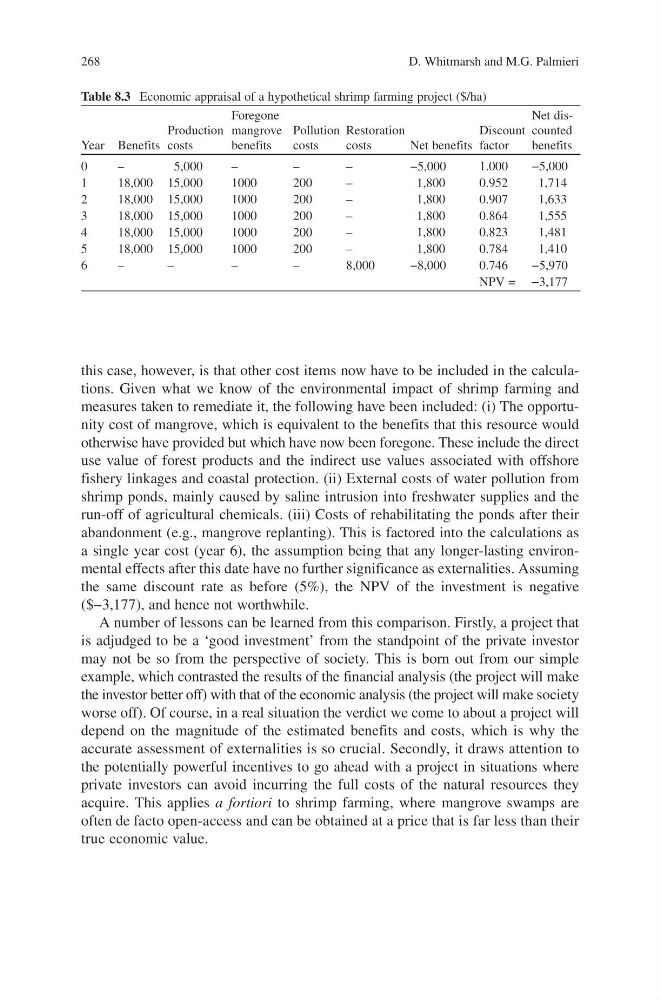
this case, however, is that other cost items now have to be included in the calculations. Given what we know of the environmental impact of shrimp farming and
measures taken to remediate it, the following have been included: (i) The opportunity cost of mangrove, which is equivalent to the benefits that this resource would
otherwise have provided but which have now been foregone. These include the direct
use value of forest products and the indirect use values associated with offshore
fishery linkages and coastal protection. (ii) External costs of water pollution from
shrimp ponds, mainly caused by saline intrusion into freshwater supplies and the
run-off of agricultural chemicals. (iii) Costs of rehabilitating the ponds after their
abandonment (e.g., mangrove replanting). This is factored into the calculations as
a single year cost (year 6), the assumption being that any longer-lasting environmental effects after this date have no further significance as externalities. Assuming
the same discount rate as before (5%), the NPV of the investment is negative
($−3,177), and hence not worthwhile.
A number of lessons can be learned from this comparison. Firstly, a project that
is adjudged to be a ‘good investment’ from the standpoint of the private investor
may not be so from the perspective of society. This is born out from our simple
example, which contrasted the results of the financial analysis (the project will make
the investor better off) with that of the economic analysis (the project will make society
worse off). Of course, in a real situation the verdict we come to about a project will
depend on the magnitude of the estimated benefits and costs, which is why the
accurate assessment of externalities is so crucial. Secondly, it draws attention to
the potentially powerful incentives to go ahead with a project in situations where
private investors can avoid incurring the full costs of the natural resources they
acquire. This applies a fortiori to shrimp farming, where mangrove swamps are
often de facto open-access and can be obtained at a price that is far less than their
true economic value.
Table 8.3 Economic appraisal of a hypothetical shrimp farming project ($/ha)
Year Benefits
Production
costs
Foregone
mangrove
benefits
Pollution
costs
Restoration
costs
Net benefits
Discount
factor
Net discounted
benefits
0
1
2
3
4
5
6
–
18,000
18,000
18,000
18,000
18,000
–
5,000
15,000
15,000
15,000
15,000
15,000
–
–
1000
1000
1000
1000
1000
–
–
200
200
200
200
200
–
–
–
–
–
–
–
8,000
−5,000
1,800
1,800
1,800
1,800
1,800
−8,000
1.000
0.952
0.907
0.864
0.823
0.784
0.746
NPV =
−5,000
1,714
1,633
1,555
1,481
1,410
−5,970
−3,177
D. Whitmarsh and M.G. Palmieri
this case, however, is that other cost items now have to be included in the calculations. Given what we know of the environmental impact of shrimp farming and
measures taken to remediate it, the following have been included: (i) The opportunity cost of mangrove, which is equivalent to the benefits that this resource would
otherwise have provided but which have now been foregone. These include the direct
use value of forest products and the indirect use values associated with offshore
fishery linkages and coastal protection. (ii) External costs of water pollution from
shrimp ponds, mainly caused by saline intrusion into freshwater supplies and the
run-off of agricultural chemicals. (iii) Costs of rehabilitating the ponds after their
abandonment (e.g., mangrove replanting). This is factored into the calculations as
a single year cost (year 6), the assumption being that any longer-lasting environmental effects after this date have no further significance as externalities. Assuming
the same discount rate as before (5%), the NPV of the investment is negative
($−3,177), and hence not worthwhile.
A number of lessons can be learned from this comparison. Firstly, a project that
is adjudged to be a ‘good investment’ from the standpoint of the private investor
may not be so from the perspective of society. This is born out from our simple
example, which contrasted the results of the financial analysis (the project will make
the investor better off) with that of the economic analysis (the project will make society
worse off). Of course, in a real situation the verdict we come to about a project will
depend on the magnitude of the estimated benefits and costs, which is why the
accurate assessment of externalities is so crucial. Secondly, it draws attention to
the potentially powerful incentives to go ahead with a project in situations where
private investors can avoid incurring the full costs of the natural resources they
acquire. This applies a fortiori to shrimp farming, where mangrove swamps are
often de facto open-access and can be obtained at a price that is far less than their
true economic value.
Table 8.3 Economic appraisal of a hypothetical shrimp farming project ($/ha)
Year Benefits
Production
costs
Foregone
mangrove
benefits
Pollution
costs
Restoration
costs
Net benefits
Discount
factor
Net discounted
benefits
0
1
2
3
4
5
6
–
18,000
18,000
18,000
18,000
18,000
–
5,000
15,000
15,000
15,000
15,000
15,000
–
–
1000
1000
1000
1000
1000
–
–
200
200
200
200
200
–
–
–
–
–
–
–
8,000
−5,000
1,800
1,800
1,800
1,800
1,800
−8,000
1.000
0.952
0.907
0.864
0.823
0.784
0.746
NPV =
−5,000
1,714
1,633
1,555
1,481
1,410
−5,970
−3,177