

242
K. Bostick
the aquaculture industry toward sustainability. WWF’s mission is the conservation
of nature around the globe, using the best available scientific knowledge to preserve
the diversity and abundance of life on Earth and the health of ecological systems.
As a large international conservation organization, WWF works on a broad range
of environmental issues and can do so from a broad perspective. Helping to ensure
that human needs are met in harmony with nature, WWF work’s includes a focus
on minimizing the negative environmental impacts of food production systems.
Aquaculture is here to stay, and some forms of it are already broadly recognized as
being responsible. WWF focuses on more sustainable species such as molluscs
and seaweeds as well as more controversial species like shrimp and salmon. The
approach attempts to encourage both the production of more sustainable species and
the use of better practices for all species and production systems.
7.4.2 Complementing Other Initiatives and Regulations
WWF aims to shift the entire aquaculture industry to more sustainable production.
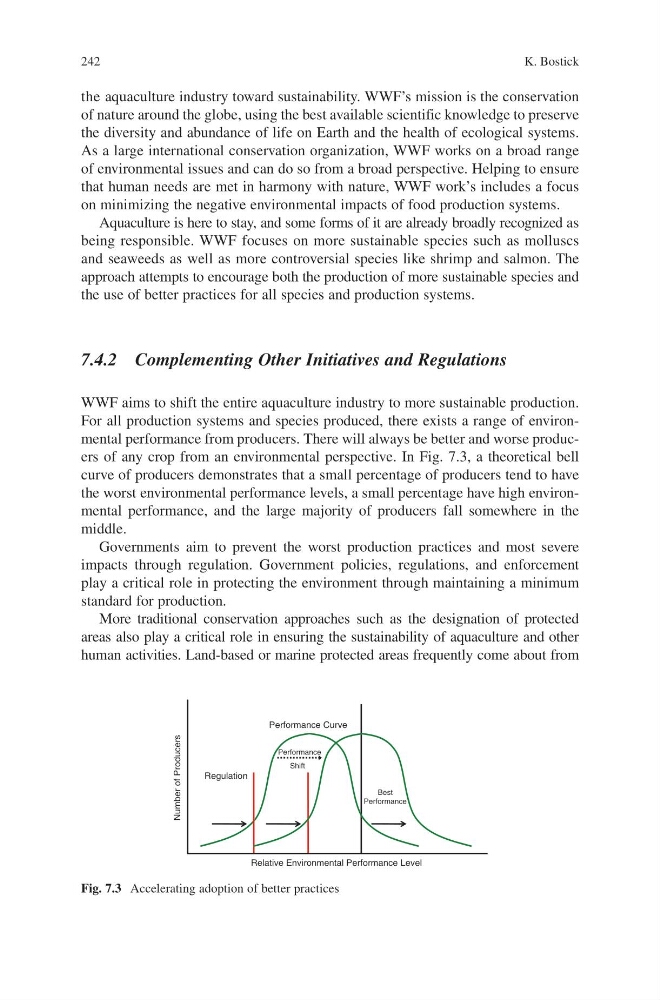
For all production systems and species produced, there exists a range of environmental performance from producers. There will always be better and worse producers of any crop from an environmental perspective. In Fig. 7.3, a theoretical bell
curve of producers demonstrates that a small percentage of producers tend to have
the worst environmental performance levels, a small percentage have high environmental performance, and the large majority of producers fall somewhere in the
middle.
Governments aim to prevent the worst production practices and most severe
impacts through regulation. Government policies, regulations, and enforcement
play a critical role in protecting the environment through maintaining a minimum
standard for production.
More traditional conservation approaches such as the designation of protected
areas also play a critical role in ensuring the sustainability of aquaculture and other
human activities. Land-based or marine protected areas frequently come about from
Fig. 7.3 Accelerating adoption of better practices
Number of Producers
Performance Curve
Regulation
Performance
Shift
Best
Performance
Relative Environmental Performance Level
K. Bostick
the aquaculture industry toward sustainability. WWF’s mission is the conservation
of nature around the globe, using the best available scientific knowledge to preserve
the diversity and abundance of life on Earth and the health of ecological systems.
As a large international conservation organization, WWF works on a broad range
of environmental issues and can do so from a broad perspective. Helping to ensure
that human needs are met in harmony with nature, WWF work’s includes a focus
on minimizing the negative environmental impacts of food production systems.
Aquaculture is here to stay, and some forms of it are already broadly recognized as
being responsible. WWF focuses on more sustainable species such as molluscs
and seaweeds as well as more controversial species like shrimp and salmon. The
approach attempts to encourage both the production of more sustainable species and
the use of better practices for all species and production systems.
7.4.2 Complementing Other Initiatives and Regulations
WWF aims to shift the entire aquaculture industry to more sustainable production.
For all production systems and species produced, there exists a range of environmental performance from producers. There will always be better and worse producers of any crop from an environmental perspective. In Fig. 7.3, a theoretical bell
curve of producers demonstrates that a small percentage of producers tend to have
the worst environmental performance levels, a small percentage have high environmental performance, and the large majority of producers fall somewhere in the
middle.
Governments aim to prevent the worst production practices and most severe
impacts through regulation. Government policies, regulations, and enforcement
play a critical role in protecting the environment through maintaining a minimum
standard for production.
More traditional conservation approaches such as the designation of protected
areas also play a critical role in ensuring the sustainability of aquaculture and other
human activities. Land-based or marine protected areas frequently come about from
Fig. 7.3 Accelerating adoption of better practices
Number of Producers
Performance Curve
Regulation
Performance
Shift
Best
Performance
Relative Environmental Performance Level