

14
P. Tett
is passive: its members simply eat what sinks from the euphotic zone. Thus the
efficiency of coupling in these waters depends on the numbers of protozoan microplankters and copepod and other mesozooplankters seeking micro-algal food. Algal
blooms may be more likely if the growth of these animals is stunted by toxic pollutants. Conversely, adding a shellfish farm to a water body can artificially increase
grazing.
1.7 Scales
Now let us consider the scales on which aquaculture can impact on ecosystems.
These depend on a combination of the nature of the pressure, the dispersion characteristics of the water at and near the farm site, and the response time for the
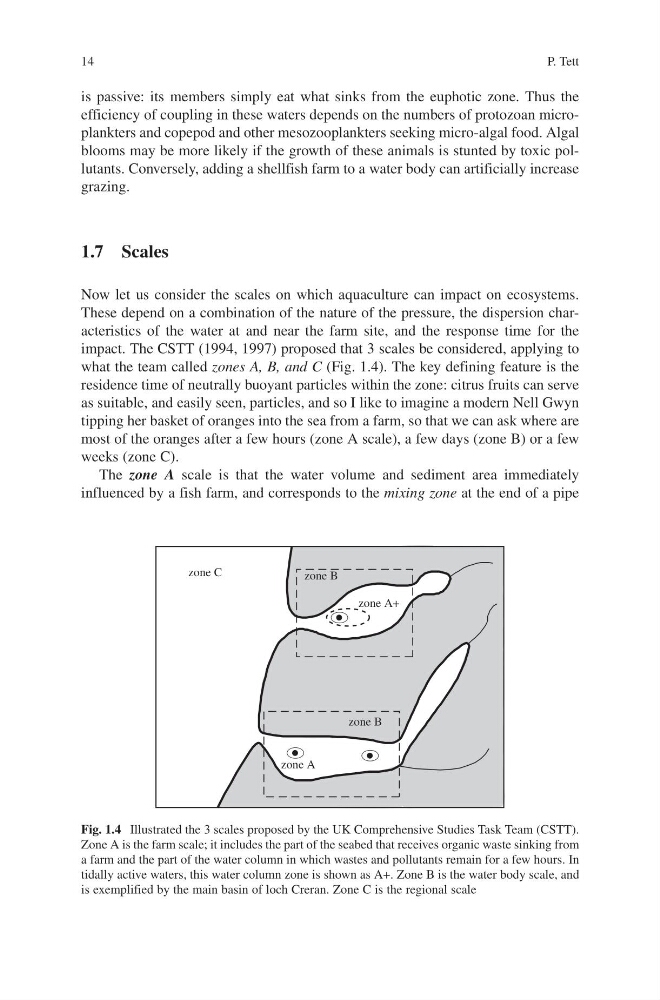
impact. The CSTT (1994, 1997) proposed that 3 scales be considered, applying to
what the team called zones A, B, and C (Fig. 1.4). The key defining feature is the
residence time of neutrally buoyant particles within the zone: citrus fruits can serve
as suitable, and easily seen, particles, and so I like to imagine a modern Nell Gwyn
tipping her basket of oranges into the sea from a farm, so that we can ask where are
most of the oranges after a few hours (zone A scale), a few days (zone B) or a few
weeks (zone C).
The zone A scale is that the water volume and sediment area immediately
influenced by a fish farm, and corresponds to the mixing zone at the end of a pipe
zone B
zone C
zone B
zone A
zone A+
Fig. 1.4 Illustrated the 3 scales proposed by the UK Comprehensive Studies Task Team (CSTT).
Zone A is the farm scale; it includes the part of the seabed that receives organic waste sinking from
a farm and the part of the water column in which wastes and pollutants remain for a few hours. In
tidally active waters, this water column zone is shown as A+. Zone B is the water body scale, and
is exemplified by the main basin of loch Creran. Zone C is the regional scale
P. Tett
is passive: its members simply eat what sinks from the euphotic zone. Thus the
efficiency of coupling in these waters depends on the numbers of protozoan microplankters and copepod and other mesozooplankters seeking micro-algal food. Algal
blooms may be more likely if the growth of these animals is stunted by toxic pollutants. Conversely, adding a shellfish farm to a water body can artificially increase
grazing.
1.7 Scales
Now let us consider the scales on which aquaculture can impact on ecosystems.
These depend on a combination of the nature of the pressure, the dispersion characteristics of the water at and near the farm site, and the response time for the
impact. The CSTT (1994, 1997) proposed that 3 scales be considered, applying to
what the team called zones A, B, and C (Fig. 1.4). The key defining feature is the
residence time of neutrally buoyant particles within the zone: citrus fruits can serve
as suitable, and easily seen, particles, and so I like to imagine a modern Nell Gwyn
tipping her basket of oranges into the sea from a farm, so that we can ask where are
most of the oranges after a few hours (zone A scale), a few days (zone B) or a few
weeks (zone C).
The zone A scale is that the water volume and sediment area immediately
influenced by a fish farm, and corresponds to the mixing zone at the end of a pipe
zone B
zone C
zone B
zone A
zone A+
Fig. 1.4 Illustrated the 3 scales proposed by the UK Comprehensive Studies Task Team (CSTT).
Zone A is the farm scale; it includes the part of the seabed that receives organic waste sinking from
a farm and the part of the water column in which wastes and pollutants remain for a few hours. In
tidally active waters, this water column zone is shown as A+. Zone B is the water body scale, and
is exemplified by the main basin of loch Creran. Zone C is the regional scale