

6 Safe and Nutritious Aquaculture Produce
193
The data from studies with salmon, and similar studies with other species,
confirm that individual fatty acids, within a blend of fatty acids, are selectively
retained or metabolised depending on their concentration in the diet and the
biological function of each specific fatty acid. One of the most striking effects, in
all species, is the preferential deposition and retention of DHA in flesh lipids,
regardless of the concentration present in the diet. This selectivity presumably
reflects the specificity of the fatty acyl transferase enzymes that incorporate the
individual fatty acids into flesh triacylglycerols and phospholipids, a phenomenon
that has been observed in previous studies with salmon fed different combinations
of VO (Torstensen et al. 2000; Bell et al. 2001a, 2002, 2003a; Rosenlund et al.
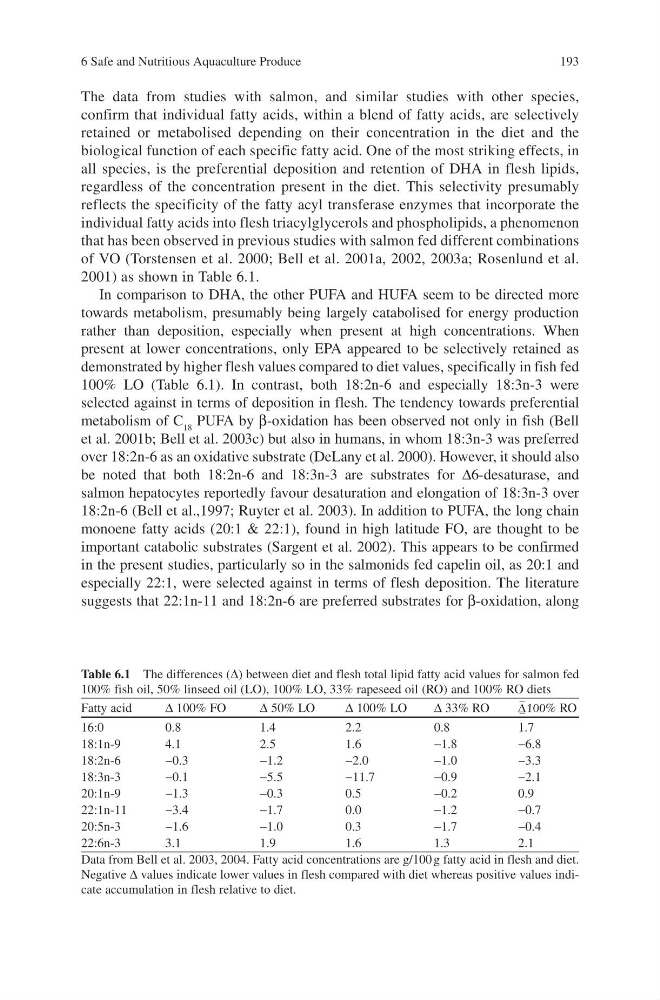
2001) as shown in Table 6.1.
In comparison to DHA, the other PUFA and HUFA seem to be directed more
towards metabolism, presumably being largely catabolised for energy production
rather than deposition, especially when present at high concentrations. When
present at lower concentrations, only EPA appeared to be selectively retained as
demonstrated by higher flesh values compared to diet values, specifically in fish fed
100% LO (Table 6.1). In contrast, both 18:2n-6 and especially 18:3n-3 were
selected against in terms of deposition in flesh. The tendency towards preferential
metabolism of C 18 PUFA by β-oxidation has been observed not only in fish (Bell
et al. 2001b; Bell et al. 2003c) but also in humans, in whom 18:3n-3 was preferred
over 18:2n-6 as an oxidative substrate (DeLany et al. 2000). However, it should also
be noted that both 18:2n-6 and 18:3n-3 are substrates for ∆6-desaturase, and
salmon hepatocytes reportedly favour desaturation and elongation of 18:3n-3 over
18:2n-6 (Bell et al.,1997; Ruyter et al. 2003). In addition to PUFA, the long chain
monoene fatty acids (20:1 & 22:1), found in high latitude FO, are thought to be
important catabolic substrates (Sargent et al. 2002). This appears to be confirmed
in the present studies, particularly so in the salmonids fed capelin oil, as 20:1 and
especially 22:1, were selected against in terms of flesh deposition. The literature
suggests that 22:1n-11 and 18:2n-6 are preferred substrates for β-oxidation, along
Table 6.1 The differences (∆) between diet and flesh total lipid fatty acid values for salmon fed
100% fish oil, 50% linseed oil (LO), 100% LO, 33% rapeseed oil (RO) and 100% RO diets
Fatty acid
∆ 100% FO
∆ 50% LO
∆ 100% LO
∆ 33% RO
100% RO
16:0
0.8
1.4
2.2
0.8
1.7
18:1n-9
4.1
2.5
1.6
−1.8
−6.8
18:2n-6
−0.3
−1.2
−2.0
−1.0
−3.3
18:3n-3
−0.1
−5.5
−11.7
−0.9
−2.1
20:1n-9
−1.3
−0.3
0.5
−0.2
0.9
22:1n-11
−3.4
−1.7
0.0
−1.2
−0.7
20:5n-3
−1.6
−1.0
0.3
−1.7
−0.4
22:6n-3
3.1
1.9
1.6
1.3
2.1
Data from Bell et al. 2003, 2004. Fatty acid concentrations are g/100 g fatty acid in flesh and diet.
Negative ∆ values indicate lower values in flesh compared with diet whereas positive values indicate accumulation in flesh relative to diet.
193
The data from studies with salmon, and similar studies with other species,
confirm that individual fatty acids, within a blend of fatty acids, are selectively
retained or metabolised depending on their concentration in the diet and the
biological function of each specific fatty acid. One of the most striking effects, in
all species, is the preferential deposition and retention of DHA in flesh lipids,
regardless of the concentration present in the diet. This selectivity presumably
reflects the specificity of the fatty acyl transferase enzymes that incorporate the
individual fatty acids into flesh triacylglycerols and phospholipids, a phenomenon
that has been observed in previous studies with salmon fed different combinations
of VO (Torstensen et al. 2000; Bell et al. 2001a, 2002, 2003a; Rosenlund et al.
2001) as shown in Table 6.1.
In comparison to DHA, the other PUFA and HUFA seem to be directed more
towards metabolism, presumably being largely catabolised for energy production
rather than deposition, especially when present at high concentrations. When
present at lower concentrations, only EPA appeared to be selectively retained as
demonstrated by higher flesh values compared to diet values, specifically in fish fed
100% LO (Table 6.1). In contrast, both 18:2n-6 and especially 18:3n-3 were
selected against in terms of deposition in flesh. The tendency towards preferential
metabolism of C 18 PUFA by β-oxidation has been observed not only in fish (Bell
et al. 2001b; Bell et al. 2003c) but also in humans, in whom 18:3n-3 was preferred
over 18:2n-6 as an oxidative substrate (DeLany et al. 2000). However, it should also
be noted that both 18:2n-6 and 18:3n-3 are substrates for ∆6-desaturase, and
salmon hepatocytes reportedly favour desaturation and elongation of 18:3n-3 over
18:2n-6 (Bell et al.,1997; Ruyter et al. 2003). In addition to PUFA, the long chain
monoene fatty acids (20:1 & 22:1), found in high latitude FO, are thought to be
important catabolic substrates (Sargent et al. 2002). This appears to be confirmed
in the present studies, particularly so in the salmonids fed capelin oil, as 20:1 and
especially 22:1, were selected against in terms of flesh deposition. The literature
suggests that 22:1n-11 and 18:2n-6 are preferred substrates for β-oxidation, along
Table 6.1 The differences (∆) between diet and flesh total lipid fatty acid values for salmon fed
100% fish oil, 50% linseed oil (LO), 100% LO, 33% rapeseed oil (RO) and 100% RO diets
Fatty acid
∆ 100% FO
∆ 50% LO
∆ 100% LO
∆ 33% RO
100% RO
16:0
0.8
1.4
2.2
0.8
1.7
18:1n-9
4.1
2.5
1.6
−1.8
−6.8
18:2n-6
−0.3
−1.2
−2.0
−1.0
−3.3
18:3n-3
−0.1
−5.5
−11.7
−0.9
−2.1
20:1n-9
−1.3
−0.3
0.5
−0.2
0.9
22:1n-11
−3.4
−1.7
0.0
−1.2
−0.7
20:5n-3
−1.6
−1.0
0.3
−1.7
−0.4
22:6n-3
3.1
1.9
1.6
1.3
2.1
Data from Bell et al. 2003, 2004. Fatty acid concentrations are g/100 g fatty acid in flesh and diet.
Negative ∆ values indicate lower values in flesh compared with diet whereas positive values indicate accumulation in flesh relative to diet.