

138
T.F. Cross et al.
will be regular injection of reared animals. Hindar et al. (2006) have modelled this
sort of situation, varying the parameters referred to above and shown a worrying
persistence of hybrids. Under this scenario, less introgressed animals than wild
individuals can occur per unit area at carrying capacity, so that productivity of the
system will decease. In addition, if hybrids come to predominate there may be a loss
of local adaptation. Since there are usually only a limited number of reared strains of
each species (for practical reasons, such as cost of rearing facilities incorporating
breeding programmes), the genetic variation which is endemic to wild populations
and which may indicate adaptive differences, will be lost.
The situation becomes more complicated in the F2 and subsequent generations. In
the F2 generation, for example, assuming random mating, several types of F2 hybrids
(depending on the sex of either type of parent and grandparent) and also of parental
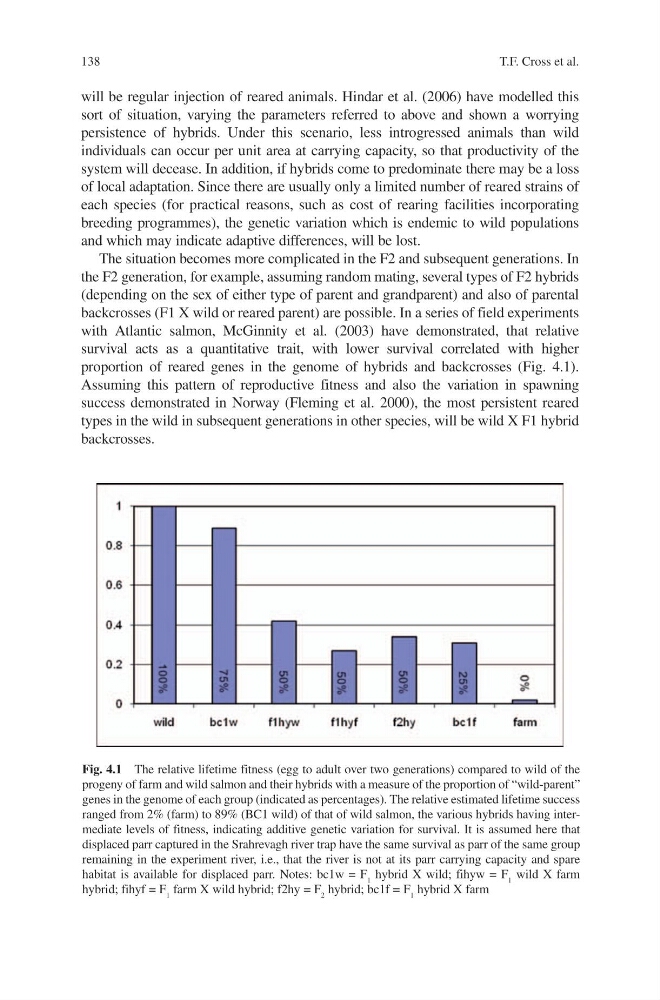
backcrosses (F1 X wild or reared parent) are possible. In a series of field experiments
with Atlantic salmon, McGinnity et al. (2003) have demonstrated, that relative
survival acts as a quantitative trait, with lower survival correlated with higher
proportion of reared genes in the genome of hybrids and backcrosses (Fig. 4.1).
Assuming this pattern of reproductive fitness and also the variation in spawning
success demonstrated in Norway (Fleming et al. 2000), the most persistent reared
types in the wild in subsequent generations in other species, will be wild X F1 hybrid
backcrosses.
Fig. 4.1 The relative lifetime fitness (egg to adult over two generations) compared to wild of the
progeny of farm and wild salmon and their hybrids with a measure of the proportion of “wild-parent”
genes in the genome of each group (indicated as percentages). The relative estimated lifetime success
ranged from 2% (farm) to 89% (BC1 wild) of that of wild salmon, the various hybrids having intermediate levels of fitness, indicating additive genetic variation for survival. It is assumed here that
displaced parr captured in the Srahrevagh river trap have the same survival as parr of the same group
remaining in the experiment river, i.e., that the river is not at its parr carrying capacity and spare
habitat is available for displaced parr. Notes: bc1w = F 1 hybrid X wild; fihyw = F 1 wild X farm
hybrid; fihyf = F 1 farm X wild hybrid; f2hy = F 2 hybrid; bc1f = F 1 hybrid X farm
T.F. Cross et al.
will be regular injection of reared animals. Hindar et al. (2006) have modelled this
sort of situation, varying the parameters referred to above and shown a worrying
persistence of hybrids. Under this scenario, less introgressed animals than wild
individuals can occur per unit area at carrying capacity, so that productivity of the
system will decease. In addition, if hybrids come to predominate there may be a loss
of local adaptation. Since there are usually only a limited number of reared strains of
each species (for practical reasons, such as cost of rearing facilities incorporating
breeding programmes), the genetic variation which is endemic to wild populations
and which may indicate adaptive differences, will be lost.
The situation becomes more complicated in the F2 and subsequent generations. In
the F2 generation, for example, assuming random mating, several types of F2 hybrids
(depending on the sex of either type of parent and grandparent) and also of parental
backcrosses (F1 X wild or reared parent) are possible. In a series of field experiments
with Atlantic salmon, McGinnity et al. (2003) have demonstrated, that relative
survival acts as a quantitative trait, with lower survival correlated with higher
proportion of reared genes in the genome of hybrids and backcrosses (Fig. 4.1).
Assuming this pattern of reproductive fitness and also the variation in spawning
success demonstrated in Norway (Fleming et al. 2000), the most persistent reared
types in the wild in subsequent generations in other species, will be wild X F1 hybrid
backcrosses.
Fig. 4.1 The relative lifetime fitness (egg to adult over two generations) compared to wild of the
progeny of farm and wild salmon and their hybrids with a measure of the proportion of “wild-parent”
genes in the genome of each group (indicated as percentages). The relative estimated lifetime success
ranged from 2% (farm) to 89% (BC1 wild) of that of wild salmon, the various hybrids having intermediate levels of fitness, indicating additive genetic variation for survival. It is assumed here that
displaced parr captured in the Srahrevagh river trap have the same survival as parr of the same group
remaining in the experiment river, i.e., that the river is not at its parr carrying capacity and spare
habitat is available for displaced parr. Notes: bc1w = F 1 hybrid X wild; fihyw = F 1 wild X farm
hybrid; fihyf = F 1 farm X wild hybrid; f2hy = F 2 hybrid; bc1f = F 1 hybrid X farm