

126
T.F. Cross et al.
situations, rather than when stripping and single-pair mating is used. However, it is
becoming clear that in mass-spawning situations, only a small proportion of the total
number of adults contribute to the resulting progeny, and of the parents that do contribute, fewer still dominate in terms of overall reproductive success. Such results are
either due to failure to spawn by certain individuals, for physiological or behavioural
reasons, or because of differential survival of progeny of different parents, or from
some combination of these factors. It is obviously vital to quantify such effects. This
can be achieved by screening both putative parents and progeny for an appropriate
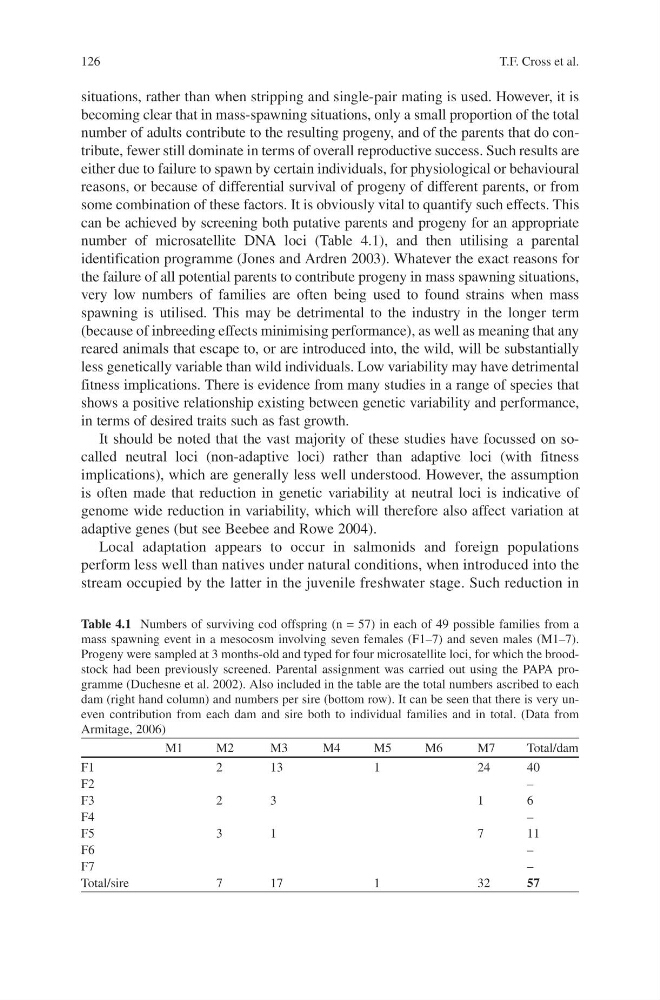
number of microsatellite DNA loci (Table 4.1), and then utilising a parental
identification programme (Jones and Ardren 2003). Whatever the exact reasons for
the failure of all potential parents to contribute progeny in mass spawning situations,
very low numbers of families are often being used to found strains when mass
spawning is utilised. This may be detrimental to the industry in the longer term
(because of inbreeding effects minimising performance), as well as meaning that any
reared animals that escape to, or are introduced into, the wild, will be substantially
less genetically variable than wild individuals. Low variability may have detrimental
fitness implications. There is evidence from many studies in a range of species that
shows a positive relationship existing between genetic variability and performance,
in terms of desired traits such as fast growth.
It should be noted that the vast majority of these studies have focussed on socalled neutral loci (non-adaptive loci) rather than adaptive loci (with fitness
implications), which are generally less well understood. However, the assumption
is often made that reduction in genetic variability at neutral loci is indicative of
genome wide reduction in variability, which will therefore also affect variation at
adaptive genes (but see Beebee and Rowe 2004).
Local adaptation appears to occur in salmonids and foreign populations
perform less well than natives under natural conditions, when introduced into the
stream occupied by the latter in the juvenile freshwater stage. Such reduction in
Table 4.1 Numbers of surviving cod offspring (n = 57) in each of 49 possible families from a
mass spawning event in a mesocosm involving seven females (F1–7) and seven males (M1–7).
Progeny were sampled at 3 months-old and typed for four microsatellite loci, for which the broodstock had been previously screened. Parental assignment was carried out using the PAPA programme (Duchesne et al. 2002). Also included in the table are the total numbers ascribed to each
dam (right hand column) and numbers per sire (bottom row). It can be seen that there is very uneven contribution from each dam and sire both to individual families and in total. (Data from
Armitage, 2006)
M1
M2
M3
M4
M5
M6
M7
Total/dam
F1
2
13
1
24
40
F2
–
F3
2
3
1
6
F4
–
F5
3
1
7
11
F6
–
F7
–
Total/sire
7
17
1
32
57
T.F. Cross et al.
situations, rather than when stripping and single-pair mating is used. However, it is
becoming clear that in mass-spawning situations, only a small proportion of the total
number of adults contribute to the resulting progeny, and of the parents that do contribute, fewer still dominate in terms of overall reproductive success. Such results are
either due to failure to spawn by certain individuals, for physiological or behavioural
reasons, or because of differential survival of progeny of different parents, or from
some combination of these factors. It is obviously vital to quantify such effects. This
can be achieved by screening both putative parents and progeny for an appropriate
number of microsatellite DNA loci (Table 4.1), and then utilising a parental
identification programme (Jones and Ardren 2003). Whatever the exact reasons for
the failure of all potential parents to contribute progeny in mass spawning situations,
very low numbers of families are often being used to found strains when mass
spawning is utilised. This may be detrimental to the industry in the longer term
(because of inbreeding effects minimising performance), as well as meaning that any
reared animals that escape to, or are introduced into, the wild, will be substantially
less genetically variable than wild individuals. Low variability may have detrimental
fitness implications. There is evidence from many studies in a range of species that
shows a positive relationship existing between genetic variability and performance,
in terms of desired traits such as fast growth.
It should be noted that the vast majority of these studies have focussed on socalled neutral loci (non-adaptive loci) rather than adaptive loci (with fitness
implications), which are generally less well understood. However, the assumption
is often made that reduction in genetic variability at neutral loci is indicative of
genome wide reduction in variability, which will therefore also affect variation at
adaptive genes (but see Beebee and Rowe 2004).
Local adaptation appears to occur in salmonids and foreign populations
perform less well than natives under natural conditions, when introduced into the
stream occupied by the latter in the juvenile freshwater stage. Such reduction in
Table 4.1 Numbers of surviving cod offspring (n = 57) in each of 49 possible families from a
mass spawning event in a mesocosm involving seven females (F1–7) and seven males (M1–7).
Progeny were sampled at 3 months-old and typed for four microsatellite loci, for which the broodstock had been previously screened. Parental assignment was carried out using the PAPA programme (Duchesne et al. 2002). Also included in the table are the total numbers ascribed to each
dam (right hand column) and numbers per sire (bottom row). It can be seen that there is very uneven contribution from each dam and sire both to individual families and in total. (Data from
Armitage, 2006)
M1
M2
M3
M4
M5
M6
M7
Total/dam
F1
2
13
1
24
40
F2
–
F3
2
3
1
6
F4
–
F5
3
1
7
11
F6
–
F7
–
Total/sire
7
17
1
32
57