

108
T. Dempster and P. Sanchez-Jerez
The use of submersible sea-cages and shellfish installations may reduce conflicts with other uses of coastal space. Removal of surface structures eliminates the
aesthetic impact of aquaculture on coastal seascapes and the source of conflict with
coastal populations, while also reducing the extent to which they act as navigational
hazards. Submersible structures avoid the strong physical forcing at the ocean surface caused by storms as most surface wave energy (95%) dissipates within the first
10 m in the open sea. Thus, they may allow use of a range of offshore sites distant
from the coast and could also reduce the number of escapes of cultured fish, which
are principally due to storm damage (Naylor et al. 2005). At present, surface cage
technologies are cheap and dominate the marketplace. Submersible or semisubmersible cages are currently used for the culture of sea bream (Sparus auratus)
in Italy (Refa-med leg tension cages), Pacific threadfin (Polydactylus sexfilis) in
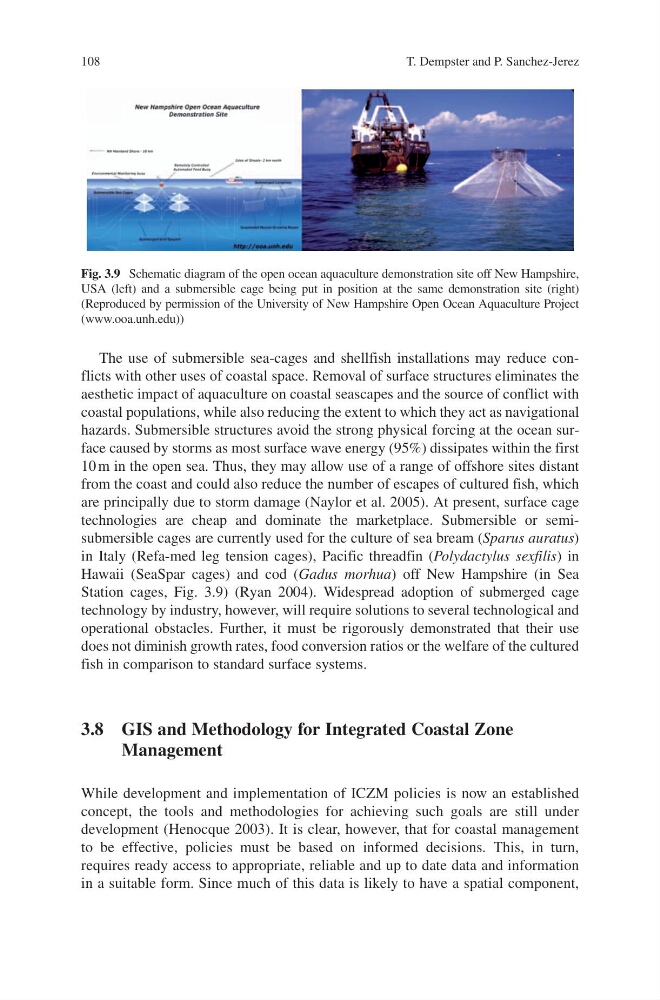
Hawaii (SeaSpar cages) and cod (Gadus morhua) off New Hampshire (in Sea
Station cages, Fig. 3.9) (Ryan 2004). Widespread adoption of submerged cage
technology by industry, however, will require solutions to several technological and
operational obstacles. Further, it must be rigorously demonstrated that their use
does not diminish growth rates, food conversion ratios or the welfare of the cultured
fish in comparison to standard surface systems.
3.8 GIS and Methodology for Integrated Coastal Zone
Management
While development and implementation of ICZM policies is now an established
concept, the tools and methodologies for achieving such goals are still under
development (Henocque 2003). It is clear, however, that for coastal management
to be effective, policies must be based on informed decisions. This, in turn,
requires ready access to appropriate, reliable and up to date data and information
in a suitable form. Since much of this data is likely to have a spatial component,
Fig. 3.9 Schematic diagram of the open ocean aquaculture demonstration site off New Hampshire,
USA (left) and a submersible cage being put in position at the same demonstration site (right)
(Reproduced by permission of the University of New Hampshire Open Ocean Aquaculture Project
(www.ooa.unh.edu))
T. Dempster and P. Sanchez-Jerez
The use of submersible sea-cages and shellfish installations may reduce conflicts with other uses of coastal space. Removal of surface structures eliminates the
aesthetic impact of aquaculture on coastal seascapes and the source of conflict with
coastal populations, while also reducing the extent to which they act as navigational
hazards. Submersible structures avoid the strong physical forcing at the ocean surface caused by storms as most surface wave energy (95%) dissipates within the first
10 m in the open sea. Thus, they may allow use of a range of offshore sites distant
from the coast and could also reduce the number of escapes of cultured fish, which
are principally due to storm damage (Naylor et al. 2005). At present, surface cage
technologies are cheap and dominate the marketplace. Submersible or semisubmersible cages are currently used for the culture of sea bream (Sparus auratus)
in Italy (Refa-med leg tension cages), Pacific threadfin (Polydactylus sexfilis) in
Hawaii (SeaSpar cages) and cod (Gadus morhua) off New Hampshire (in Sea
Station cages, Fig. 3.9) (Ryan 2004). Widespread adoption of submerged cage
technology by industry, however, will require solutions to several technological and
operational obstacles. Further, it must be rigorously demonstrated that their use
does not diminish growth rates, food conversion ratios or the welfare of the cultured
fish in comparison to standard surface systems.
3.8 GIS and Methodology for Integrated Coastal Zone
Management
While development and implementation of ICZM policies is now an established
concept, the tools and methodologies for achieving such goals are still under
development (Henocque 2003). It is clear, however, that for coastal management
to be effective, policies must be based on informed decisions. This, in turn,
requires ready access to appropriate, reliable and up to date data and information
in a suitable form. Since much of this data is likely to have a spatial component,
Fig. 3.9 Schematic diagram of the open ocean aquaculture demonstration site off New Hampshire,
USA (left) and a submersible cage being put in position at the same demonstration site (right)
(Reproduced by permission of the University of New Hampshire Open Ocean Aquaculture Project
(www.ooa.unh.edu))