

102
T. Dempster and P. Sanchez-Jerez
variety of pelagic and demersal fish species which form a portion of the spawning
stock (Dempster et al. 2002; Boyra et al. 2004; Dempster et al. 2005; Tuya et al.
2005; Tuya et al. 2006). Sea-cage fish farms should thus be designated as “no-fishing
zones” and incorporated into the management of coastal areas along with MPA
zones to protect biodiversity. Small fishing exclusion zones of hundreds of metres
around aquaculture sites exist in some countries (e.g., south-eastern Spain,
Norway), principally to avoid damage to fish farm equipment through boat strike
or fishing gear entanglement. However, most European nations have no such
restrictions at present. The effectiveness of such small exclusion zones (less than
5 hectares) in protecting wild fish has never been tested; detailed individual-based
information on fish movements is required to assist effective management in
this regard.
Allowing targeting of particular fish species that are not over-exploited in
areas where fisheries management limits the overall amount of catch (such as
through total allowable catch (TAC) systems), may mean that aggregations at
aquaculture sites and fishing can interact without increasing the overall catch. In
this scenario, the fishery may benefit economically from the interaction through
spending less time searching for fish (thereby using less energy), less time fishing
(thereby increasing efficiency) and possibly greater consistency in catch levels (thereby
increasing profit). However, the level of by-catch of such fisheries and the quality of
their catch must be examined further.
A separate important interaction of aquaculture with wild fisheries concerns the
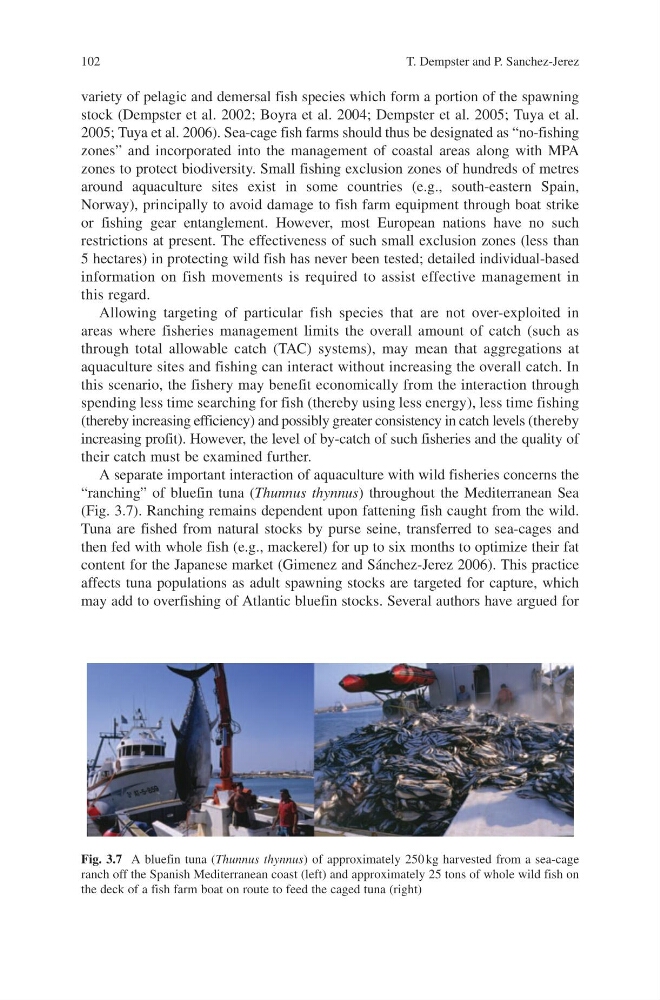
“ranching” of bluefin tuna (Thunnus thynnus) throughout the Mediterranean Sea
(Fig. 3.7). Ranching remains dependent upon fattening fish caught from the wild.
Tuna are fished from natural stocks by purse seine, transferred to sea-cages and
then fed with whole fish (e.g., mackerel) for up to six months to optimize their fat
content for the Japanese market (Gimenez and Sánchez-Jerez 2006). This practice
affects tuna populations as adult spawning stocks are targeted for capture, which
may add to overfishing of Atlantic bluefin stocks. Several authors have argued for
Fig. 3.7 A bluefin tuna (Thunnus thynnus) of approximately 250 kg harvested from a sea-cage
ranch off the Spanish Mediterranean coast (left) and approximately 25 tons of whole wild fish on
the deck of a fish farm boat on route to feed the caged tuna (right)
T. Dempster and P. Sanchez-Jerez
variety of pelagic and demersal fish species which form a portion of the spawning
stock (Dempster et al. 2002; Boyra et al. 2004; Dempster et al. 2005; Tuya et al.
2005; Tuya et al. 2006). Sea-cage fish farms should thus be designated as “no-fishing
zones” and incorporated into the management of coastal areas along with MPA
zones to protect biodiversity. Small fishing exclusion zones of hundreds of metres
around aquaculture sites exist in some countries (e.g., south-eastern Spain,
Norway), principally to avoid damage to fish farm equipment through boat strike
or fishing gear entanglement. However, most European nations have no such
restrictions at present. The effectiveness of such small exclusion zones (less than
5 hectares) in protecting wild fish has never been tested; detailed individual-based
information on fish movements is required to assist effective management in
this regard.
Allowing targeting of particular fish species that are not over-exploited in
areas where fisheries management limits the overall amount of catch (such as
through total allowable catch (TAC) systems), may mean that aggregations at
aquaculture sites and fishing can interact without increasing the overall catch. In
this scenario, the fishery may benefit economically from the interaction through
spending less time searching for fish (thereby using less energy), less time fishing
(thereby increasing efficiency) and possibly greater consistency in catch levels (thereby
increasing profit). However, the level of by-catch of such fisheries and the quality of
their catch must be examined further.
A separate important interaction of aquaculture with wild fisheries concerns the
“ranching” of bluefin tuna (Thunnus thynnus) throughout the Mediterranean Sea
(Fig. 3.7). Ranching remains dependent upon fattening fish caught from the wild.
Tuna are fished from natural stocks by purse seine, transferred to sea-cages and
then fed with whole fish (e.g., mackerel) for up to six months to optimize their fat
content for the Japanese market (Gimenez and Sánchez-Jerez 2006). This practice
affects tuna populations as adult spawning stocks are targeted for capture, which
may add to overfishing of Atlantic bluefin stocks. Several authors have argued for
Fig. 3.7 A bluefin tuna (Thunnus thynnus) of approximately 250 kg harvested from a sea-cage
ranch off the Spanish Mediterranean coast (left) and approximately 25 tons of whole wild fish on
the deck of a fish farm boat on route to feed the caged tuna (right)