

59
3 Why Spawn in Aggregations?
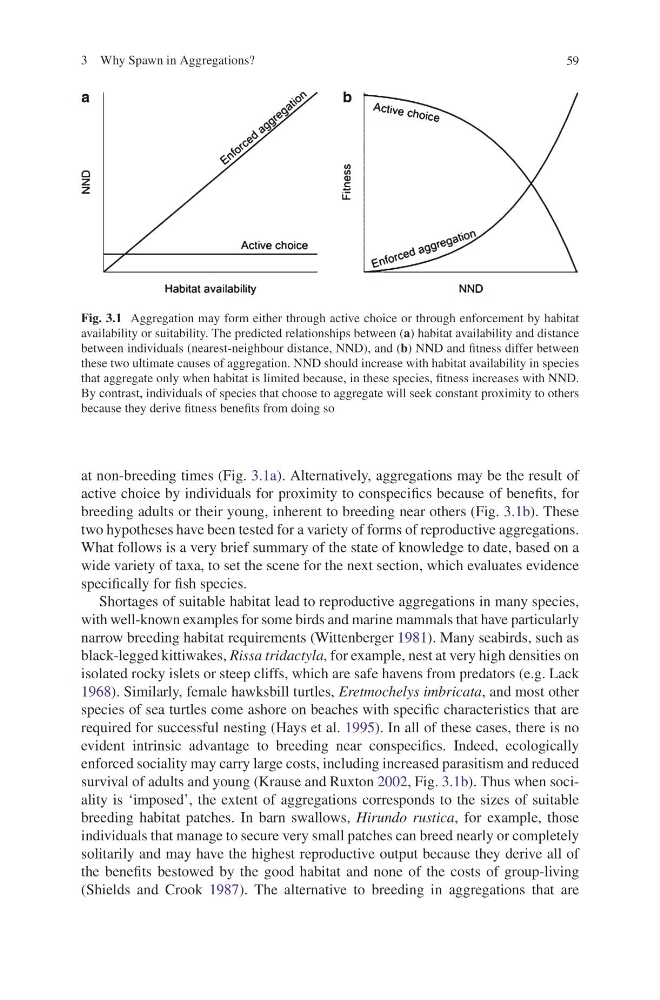
at non-breeding times (Fig. 3.1a ). Alternatively, aggregations may be the result of
active choice by individuals for proximity to conspecifi cs because of benefi ts, for
breeding adults or their young, inherent to breeding near others (Fig. 3.1b ). These
two hypotheses have been tested for a variety of forms of reproductive aggregations.
What follows is a very brief summary of the state of knowledge to date, based on a
wide variety of taxa, to set the scene for the next section, which evaluates evidence
specifi cally for fi sh species.
Shortages of suitable habitat lead to reproductive aggregations in many species,
with well-known examples for some birds and marine mammals that have particularly
narrow breeding habitat requirements (Wittenberger 1981 ) . Many seabirds, such as
black-legged kittiwakes, Rissa tridactyla , for example, nest at very high densities on
isolated rocky islets or steep cliffs, which are safe havens from predators (e.g. Lack
1968 ) . Similarly, female hawksbill turtles, Eretmochelys imbricata , and most other
species of sea turtles come ashore on beaches with specifi c characteristics that are
required for successful nesting (Hays et al. 1995 ) . In all of these cases, there is no
evident intrinsic advantage to breeding near conspecifi cs. Indeed, ecologically
enforced sociality may carry large costs, including increased parasitism and reduced
survival of adults and young (Krause and Ruxton 2002 , Fig. 3.1b ). Thus when sociality is ‘imposed’, the extent of aggregations corresponds to the sizes of suitable
breeding habitat patches. In barn swallows, Hirundo rustica , for example, those
individuals that manage to secure very small patches can breed nearly or completely
solitarily and may have the highest reproductive output because they derive all of
the benefi ts bestowed by the good habitat and none of the costs of group-living
(Shields and Crook 1987 ) . The alternative to breeding in aggregations that are
Fig. 3.1 Aggregation may form either through active choice or through enforcement by habitat
availability or suitability. The predicted relationships between ( a ) habitat availability and distance
between individuals (nearest-neighbour distance, NND), and ( b ) NND and fi tness differ between
these two ultimate causes of aggregation. NND should increase with habitat availability in species
that aggregate only when habitat is limited because, in these species, fi tness increases with NND.
By contrast, individuals of species that choose to aggregate will seek constant proximity to others
because they derive fi tness benefi ts from doing so
3 Why Spawn in Aggregations?
at non-breeding times (Fig. 3.1a ). Alternatively, aggregations may be the result of
active choice by individuals for proximity to conspecifi cs because of benefi ts, for
breeding adults or their young, inherent to breeding near others (Fig. 3.1b ). These
two hypotheses have been tested for a variety of forms of reproductive aggregations.
What follows is a very brief summary of the state of knowledge to date, based on a
wide variety of taxa, to set the scene for the next section, which evaluates evidence
specifi cally for fi sh species.
Shortages of suitable habitat lead to reproductive aggregations in many species,
with well-known examples for some birds and marine mammals that have particularly
narrow breeding habitat requirements (Wittenberger 1981 ) . Many seabirds, such as
black-legged kittiwakes, Rissa tridactyla , for example, nest at very high densities on
isolated rocky islets or steep cliffs, which are safe havens from predators (e.g. Lack
1968 ) . Similarly, female hawksbill turtles, Eretmochelys imbricata , and most other
species of sea turtles come ashore on beaches with specifi c characteristics that are
required for successful nesting (Hays et al. 1995 ) . In all of these cases, there is no
evident intrinsic advantage to breeding near conspecifi cs. Indeed, ecologically
enforced sociality may carry large costs, including increased parasitism and reduced
survival of adults and young (Krause and Ruxton 2002 , Fig. 3.1b ). Thus when sociality is ‘imposed’, the extent of aggregations corresponds to the sizes of suitable
breeding habitat patches. In barn swallows, Hirundo rustica , for example, those
individuals that manage to secure very small patches can breed nearly or completely
solitarily and may have the highest reproductive output because they derive all of
the benefi ts bestowed by the good habitat and none of the costs of group-living
(Shields and Crook 1987 ) . The alternative to breeding in aggregations that are
Fig. 3.1 Aggregation may form either through active choice or through enforcement by habitat
availability or suitability. The predicted relationships between ( a ) habitat availability and distance
between individuals (nearest-neighbour distance, NND), and ( b ) NND and fi tness differ between
these two ultimate causes of aggregation. NND should increase with habitat availability in species
that aggregate only when habitat is limited because, in these species, fi tness increases with NND.
By contrast, individuals of species that choose to aggregate will seek constant proximity to others
because they derive fi tness benefi ts from doing so